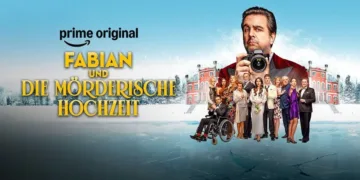






















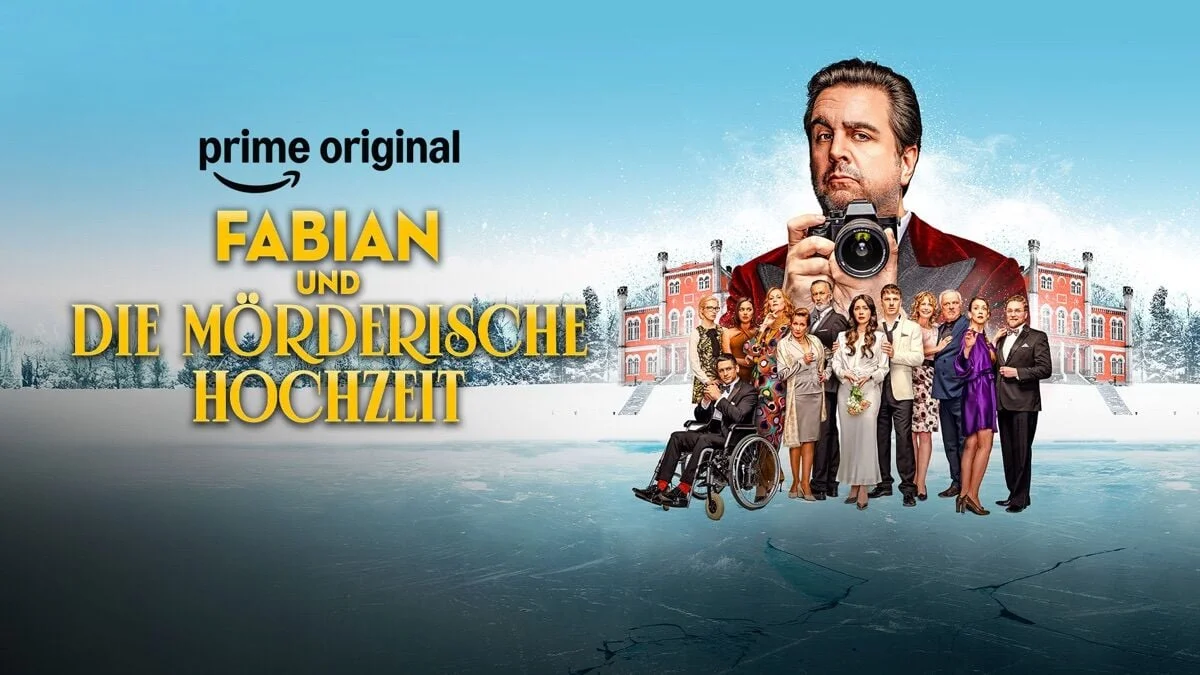

Bastian Pastewka makes Fabian’s invented police credentials sound like something he might believe himself if he keeps talking. Playing the con artist turned counterfeit investigator in Fabian and the Deadly Wedding, he borrows the language of crime dramas and expands his supposed special-unit expertise with cheerful assurance. Then nervousness breaks through the performance. The pleasure comes from watching him manage that change: he needs the wedding guests to accept his authority, while we get to enjoy how precariously he holds it.
I found myself rooting for the impersonation before becoming particularly interested in the investigation. Pastewka makes that response easy to understand. Fabian approaches police work as another opportunity to talk his way into something, and his theatrical manner belongs to a person consciously putting on a show. His confidence has an appealing fragility. Each new claim extends the deception he must maintain, giving even his apparent command of the situation a small charge of anxiety. The film earns affection for him through the possibility that his performance could fail.
Director Markus Sehr gives this improvised detective a suitably awkward assignment. Fleeing a failed real-estate scam, Fabian escapes onto a wedding-party bus disguised as the photographer. Milva and Clemens, played by Tamara Romera Ginés and Anton Dreger, are heading to a remote mansion where a snowstorm will cut the guests off from the outside world. Their hostess, Milva’s wealthy aunt Nikola Wankdorff, possesses the Venus of Wildenfeld, a sculpture valued at six million euros. Fabian’s interest in stealing it becomes entangled with a murder when Nikola is killed and the object disappears. Solving the case offers him access to his intended prize while exposing his disguise to fresh scrutiny.
The opening foot chase establishes his physical awkwardness, though its broad slapstick is less engaging than his later verbal improvisation. Pastewka’s borrowed investigative manner gives us something specific to anticipate: how long can a man playing an expert keep sounding like one when the situation requires actual expertise?
The guests provide less consistent encouragement to keep watching. An occult-minded relative and an odd butler-like figure attract attention through their peculiarities, yet the curiosity they invite receives limited development. They remain easier to recognize than to care about. The ensemble also loses continuity when supporting figures disappear from the action for long stretches. In a confined-house mystery, time spent away from a suspect can be productive if their return changes our understanding of them. Here, those absences often leave personalities too faint to generate much anticipation about their next appearance.
There are exceptions worth preserving. Milva and Clemens, the assistant, and the bride’s brother receive attention to their histories that allows some warmth into the gathering. Their stories offer a reason to respond to people beyond the question of their possible guilt. Ercan Durmaz’s suspicious, combative judge also supplies a firmer presence, with behavior that rubs against the respectability of his position. These pockets of interest make the surrounding thinness frustrating. Jealousy, financial pressure, and social contempt circulate through the family, but too many guests remain attached to an eccentric manner rather than a relationship we have come to understand.
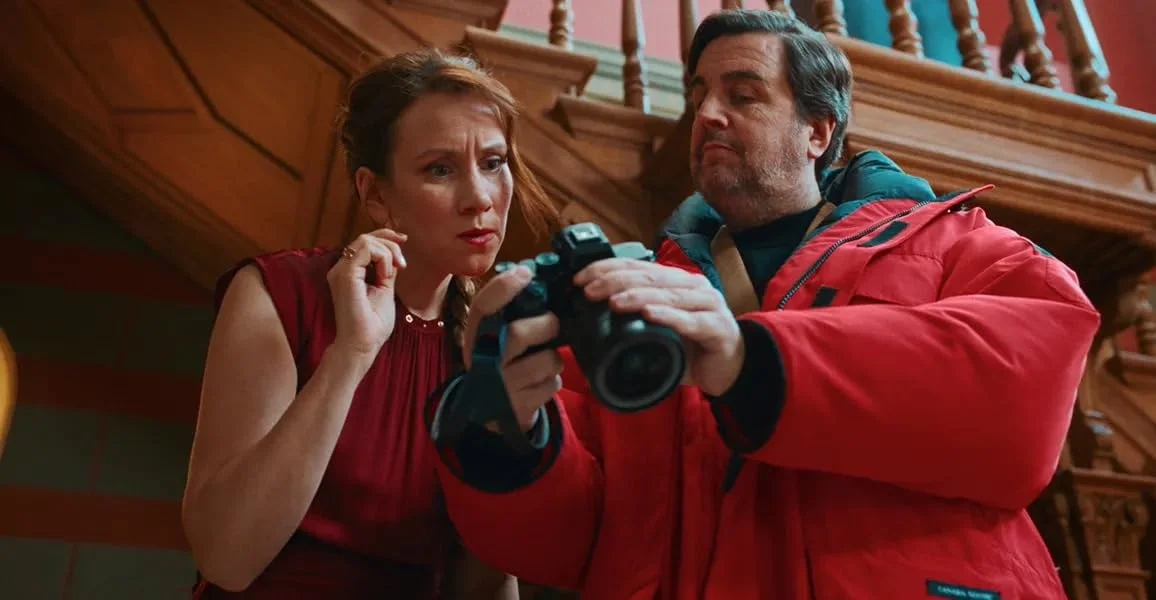
The mystery’s handling of information creates a similar distance. The snowbound setting establishes a contained group to study, and the stolen sculpture’s periodic reappearance gives the investigation a promising moving element. Its changing presence can renew attention to who has access to it and what its disappearance means. Yet some of the observations behind Fabian’s deductions occur off camera, reaching us only when they become useful to his explanation. We can follow the account he gives, but we have had fewer chances to form and revise an account of our own.
That distinction matters to the feeling of the film. A mystery need not let us solve everything ahead of its detective. Being wrong can be delightful when the revelation sends us back to something we saw and misunderstood. Information withheld from view offers less of that pleasure. It encourages waiting for Fabian to explain instead of looking closely alongside him. His impersonation supplies a reason to watch his behavior; the case struggles to give the same purpose to our attention. As the investigation continues, my affection for his improvisation survives longer than my urge to puzzle out the crime.
The persistent, playful score further softens the experience. It keeps offering a comfortable comic register even as murder and deception should disturb the wedding’s enclosed world. Lightness suits Fabian’s absurd credentials, but such continuous musical reassurance reduces the space for uncertainty to take hold. The film can feel busy without feeling especially tense. With several guests already difficult to invest in, the score makes it easier to remain pleasantly detached from a gathering whose secrets are supposed to pull us closer.
The extended final assembly asks Fabian to hold that attention through a long explanatory monologue. Gathering the suspects should give their earlier behavior fresh significance, yet the scene also has to supply information the audience could not previously examine. Pastewka’s command of a room remains useful, though the pleasure of his performance changes here. Earlier, we enjoyed hearing a fraud manufacture certainty. Now the film requires us to accept him as the person who can settle everything, and the missing opportunities to discover alongside him leave that new confidence harder to share.
Fabian and the Deadly Wedding premiered globally on Amazon Prime Video on February 6, 2026. The German crime comedy follows a charming con artist who sneaks into a lavish winter wedding at an isolated estate intending to steal a priceless statue, only to find himself entangled in a chaotic murder investigation when a body turns up on the grounds.
Where to Watch Fabian and the Deadly Wedding (2026) Online


Full Credits
Title: Fabian and the Deadly Wedding
Distributor: Amazon Prime Video, Amazon MGM Studios
Release date: February 6, 2026
Rating: TV-MA
Running time: 1 hour 40 minutes (100 minutes)
Director: Markus Sehr
Writers: Martin Eigler, Sönke Lars Neuwöhner, Sven S. Poser, Judy Horney
Producers and Executive Producers: Nataly Kudiabor, Denise Neustadt, Leonie Franziska Geisinger
Cast: Bastian Pastewka, Tamara Romera Ginés, Anton Dreger, Barbara Philipp, Ercan Durmaz, Mira Partecke, Bernhard Schütz, Nicole Beutler, Taneshia Abt, Lena Dörrie, Knud Riepen, Marta Kizyma, Daniel Rodic, Magnus Krepper
Director of Photography (Cinematographer): Paul Pieck
Editors: Stefen Rocker
Composer: Anna Kühlein
The Review
Fabian and the Deadly Wedding
I enjoyed Fabian’s struggle to keep his borrowed authority intact, even as my curiosity about the murder faded. Bastian Pastewka gives the deception an affectionate, nervous energy, and a few personal histories bring warmth to the wedding. Thin suspects, uneven access to clues, and persistent musical reassurance weaken the suspense. The lengthy explanation leaves too much discovery until the moment when we should be enjoying its payoff.
PROS
- Pastewka’s engaging shifts between confidence and panic.
- Warmth in the better-developed personal histories.
- The stolen sculpture’s reappearances renew curiosity.
CONS
- Several suspects remain defined by superficial quirks.
- Off-camera observations limit audience participation.
- Persistent playful music softens tension.
- The final explanation stretches already sluggish momentum.







