



























Warm flashes reach Xu Fu and Ma Junsheng’s apartment before the bombing forces them out of it. The light has an almost domestic softness; the rising rumble supplies the correction. Wen Muye lets the senses disagree briefly, then makes the explosion settle the matter. That delay is frightening because the men have to interpret what reaches them. War enters their room as something they cannot yet read, and the interval for understanding it is closing.
The extended takes that sustain the ensuing destruction remove another kind of protection. Cuts can offer relief, a new vantage, a momentary escape from a body’s exposure. Here, duration keeps the civilians inside the attack. A building absorbs repeated rocket strikes before collapsing into the street, and the spectacle has a terrible persistence. The technical command is impressive enough to create its own problem: we can admire the execution while recoiling from the event. Once Upon a Time in the Middle East repeatedly brings those responses close together, sometimes without adequately separating them.
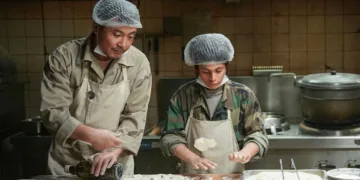
Xu, played by Shen Teng, came to Bahata to cook. A restaurant disaster in China has left him in debt; two years abroad should allow him to repay it and return to his mother and daughter. The fictional city occupies an unnamed country, though the invasion makes the Iraq War unmistakable. At Loong Restaurant, Ma, played by Jiang Qiming, translates between Xu and owner Zaid. Their early negotiations concern work, pride, and the offense of Americanized Chinese food. The menu develops a foreign policy before the restaurant has secured its future.
Closeups of grilled meat and bubbling stews establish something the demolition sequences will threaten. The preparation matters as much as the finished dishes: ingredients become meals through attention and practiced labor. Feeding people is an activity with visible stages, and Wen gives those stages their pleasure. A wedding feast combining Chinese and Middle Eastern dishes makes cultural exchange tangible without requiring anyone to deliver a lecture about it. When displaced children shelter at the restaurant and the orphan Seif becomes Xu’s apprentice, hospitality acquires obligations that survive the disappearance of paying customers.
That generosity remains entangled with calculation. Xu supplies American soldiers with food and alcohol, making money while gaining leverage to protect the children. His competence buys room to maneuver, until military custody turns the cooks’ usefulness into a reason to keep them working. Militant captivity repeats the transaction under different authority. There is a noir fatalism in this narrowing of options: the ability that promised independence becomes the means by which other people retain possession of him. The kitchen can preserve his life without giving that life back.
Shen gives this predicament a human texture through Xu’s softness beneath his irritation. The impatience involved in handling a disruptive child and the commitment involved in teaching him can coexist; his affection need not arrive as a complete personality transplant. Jiang’s welcoming manner and work as a translator give Ma’s kindness a practical function. He helps people reach an accommodation. Their later helplessness hurts because the film has established the usefulness of these skills, then placed the men among authorities who have little interest in accommodation. Cooking and persuasion both encounter their limits.

Wen’s camera makes a different claim on behalf of Zaid. The slow zoom toward him holding his dead wife and child concentrates the catastrophe into a bereaved parent’s experience. Before his turn toward terrorism, the image has required us to recognize his loss.
His earlier dependence on an American military black market for his daughter’s medication further entangles his family’s survival with the occupying force. The movement from dependence to grief to retaliation gives his violence a cause. The emphatic zoom risks making that cause feel sufficient, compressing the distance between understanding an action and accounting for it.
A tortured prisoner who later leads the militants produces a less reassuring connection. Xu’s pity for the man in American custody does not become a guarantee of his future conduct. Suffering can explain hatred while leaving the sufferer capable of inflicting fresh suffering.
This recurrence is one of the film’s strongest moral constructions, because it denies the audience a stable division between injured people and dangerous ones. It also sharpens the predicament of Seif, played by Omar Sharif. His anger makes recruitment possible, but apprenticeship supplies a competing use for his energy. Adults are fighting to define what he can become.
The distribution of those adults deserves scrutiny. Xu and Ma retain the role of protectors while Zaid and Seif face the pull of radicalization, and militants convert children into instruments of violence. Chinese guardianship becomes the dependable moral position around which local lives are tested.
Yet Zaid’s grief and Seif’s apprenticeship give those lives particular attachments; dismissing them all as caricatures would erase what the film does achieve. The limitation lies in how firmly the protective role settles around the two outsiders. Condemning American abuse and militant recruitment leaves that reassuring arrangement largely intact.
The framing narrative, with an older, scarred Xu questioned about his past despite his American exoneration, establishes that he survives. Suspense gathers around the people whose survival is uncertain and the costs his body already records. Wen sustains that anxiety, but the repeated proximity of companionship and execution becomes increasingly directive.
Tenderness begins to prepare us for another blow. Montages of children holding plush toys during indoctrination make their vulnerability instantly legible, while the insistent emotional organization leaves little space to encounter them outside that assigned meaning. The images prosecute their case vigorously.
Ma slipping Seif a smuggled can of soda gives the boy a smaller, less declarative place in the film. Pleasure briefly has no duty to prove anything. Against the indoctrination scenes, the gesture also brings attention back to the difference between caring for a child and claiming authority over his future.
Xu’s cooking lessons involve guidance too, but they give Seif a skill that can remain useful beyond his teacher’s reach. Training him for a suicide attack closes that possibility. The horror is concentrated in adults preparing a child for an act that will eliminate every choice he might make afterward.
Once Upon a Time in the Middle East premiered theatrically across China on August 11, 2026. Directed by Muye Wen and starring Teng Shen alongside Qiming Jiang, the Chinese wartime comedy-drama follows an ordinary chef who travels to the Middle East to work at a Chinese restaurant, only to be caught in the crossfire of an escalating conflict while trying to keep the establishment running.
Full Credits
Title: Once Upon a Time in the Middle East
Distributor: Dirty Monkeys Pictures, Alibaba Pictures, China Film Group Corporation, Ruyi Films
Release date: August 11, 2026
Running time: 2 hours 20 minutes (140 minutes)
Director: Muye Wen
Writers: Muye Wen, Qunli Lang, Wei Zhong
Producers and Executive Producers: Hao Ning, Muye Wen
Cast: Teng Shen, Qiming Jiang, Aarif Rahman, Omar Sharif, Sharif Sabi, Ahmed Selim, Farouk Muhammad, Russell Healy, Nailla Aksim, Karma Hazim, Qing Wei, Xiwei Zhang
Director of Photography (Cinematographer): Boxue Wang
Editors: Jinghao Liu
The Review
Once Upon a Time in the Middle East
Once Upon a Time in the Middle East makes care tangible and destruction physically oppressive. Sustained takes, expressive cooking sequences, and humane lead performances give its anti-war argument real force. Its moral inquiry becomes less searching when sentimental editing dictates our response and Chinese protectors occupy the safest ethical ground. The camera understands how people become vulnerable; it is less willing to leave their contradictions unsettled.
PROS
- Sustained war sequences create intense civilian exposure.
- Cooking connects care, survival, and coerced labor.
- Shen Teng and Jiang Qiming give kindness practical weight.
- Victims becoming perpetrators complicates easy moral divisions.
CONS
- Impressive destruction sometimes competes with attention to suffering.
- Sentimental montages and repeated emotional shocks overdirect responses.
- Chinese guardianship remains a reassuring, insufficiently tested position.







