





























Bruce Dern was trying to change his professional identity when he made Silent Running. Douglas Trumbull’s science-fiction film gave a familiar screen villain a sympathetic lead, an opportunity to loosen the grip of years spent playing dangerous men. During the production, Dern took time away to appear in The Cowboys, where he shot John Wayne’s character in the back. The films arrived around the same time. One offered him a different future; the other renewed his contract with the audience’s existing expectations.
The consequences reached his daughter’s social calendar. Laura Dern recalls having a childhood playdate canceled because her father had killed Wayne onscreen. It is a funny, faintly absurd story that also explains something a filmography cannot: how thoroughly a successful performance can trap its actor.
Mike Mendez’s Dernsie: The Amazing Life of Bruce Dern finds its strongest material in such connections, when an anecdote explains the next difficulty in a career. Its affectionate assembly of interviews, clips, and recollections becomes less revealing when the stories merely succeed one another.
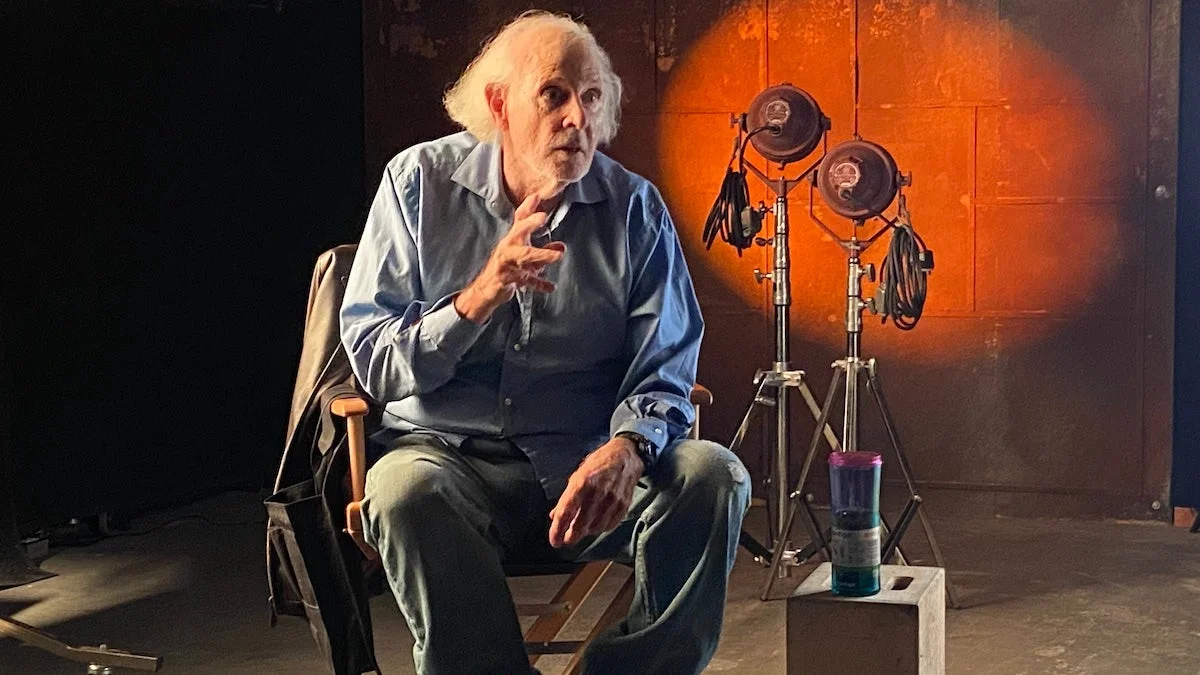
Mendez has a considerable advantage in his principal speaker. Recorded over several years, Dern’s interviews supply blunt assessments, impressions, and an appetite for remembering how the work got done. The camera can stay close to his face because he gives it something to follow.
His continuing deference to “Mr. Kazan” is particularly telling. Recalling his training at the Actors Studio, he describes spending a year performing without dialogue under Elia Kazan’s instruction. That account supplies a useful route into the behavior that gives the documentary its title, although the film leaves much of the connection for the viewer to make.

A “Dernsie” is an improvised action or line that contributes something absent from the script. The example from Coming Home deserves the attention it receives. Before his returning veteran walks into the sea to kill himself, Dern has him struggle to remove his wedding ring.
The action puts resistance inside a sequence whose destination appears settled. He can decide to leave his marriage and his life, yet the small physical task refuses to cooperate. Walton Goggins’s recollection that the moment helped inspire him to act is valuable testimony because the film gives us the choice that produced that response. Admiration has an identifiable cause.
The comic version arrives in Once Upon a Time in Hollywood. When Brad Pitt’s Cliff Booth introduces himself to Dern’s sleepy ranch owner, the reply is “John Wilkes Booth?” The misunderstanding preserves the character’s disorientation while briefly disrupting the exchange. Set beside the wedding ring, it establishes an actor alert to opportunities within a scene’s existing circumstances.
These passages suggest a more concentrated film about Dern’s working method than Mendez consistently pursues. They also establish a useful standard for the interviews: Goggins explaining a gesture or Joe Dante discussing the improvisation behind The ’Burbs contributes something that another declaration of Dern’s greatness cannot.
The documentary’s broad chronology gives those discussions an accessible framework, with enough freedom for Dern to follow a memory away from the immediate subject. That looseness is often pleasurable. His account of growing up in a wealthy Chicago family, for instance, changes the terms of his discussion of Tom Buchanan in The Great Gatsby. A role that might appear distant from his familiar screen identity draws on a world he knew and rejected. The biographical detour earns its place by returning us to an acting decision. Elsewhere, the movement between recollection, clip, and appreciative colleague keeps the film brisk without always developing its account of how he worked.
Mendez’s visual additions have a similar unevenness of purpose. Drawn animation and stop-motion puppets provide illustrations for Dern’s spoken recollections, with Nicholson and Hitchcock figures introducing a playful distance from the solemn business of career commemoration. Their differing styles are compatible with a speaker who is happy to supply every voice in his own anecdote.
The hospital reenactment is harder to accommodate. Having Dern play himself on a gurney during a recreation of his cardiac emergency introduces a staged spectacle where his direct recollection would have carried considerable force. The film briefly appears to distrust the storyteller it has otherwise sensibly employed.
Running provides the most persistent attempt to give these separate episodes a common shape. Dern’s lifelong commitment to distance running makes endurance a reasonable description of his professional history, especially when the account reaches the late opportunities offered by Nebraska and The Hateful Eight.
He acknowledges long stretches without satisfying work, so continued employment never becomes a simple victory march. But the repeated running references keep explaining a connection the career has already made visible. By the later returns to the subject, the metaphor has begun doing laps. The specific setbacks offer a richer understanding of persistence than the recurring reminder that he kept going.
Laura’s participation introduces a different kind of continuity. Her memory of a loving father, including the teetotaler ordering Shirley Temples at the Polo Lounge, corrects the threatening public image through ordinary behavior. She is especially useful because she can describe the distance between the roles and the person without asking us to accept a colleague’s professional affection as a complete character reference. The canceled playdate and the harmless drink belong to the same account: a child living with an image her father could perform brilliantly and could not entirely control.
The personal history remains selective. Dern speaks directly about the death of his young daughter and the grief shared with Diane Ladd, without turning that loss into an explanation for every troubled man he later played. His advice to Laura about resisting typecasting gives the family material a further purpose.
He encouraged her to pass on work that might narrow her future, while admitting how fear of unemployment had kept him accepting what was available. The advice carries the knowledge of someone who understood the trap and still found himself taking another part. Laura could use that knowledge before facing the same decision.
Dernsie: The Amazing Life of Bruce Dern made its world premiere in the Cannes Classics section of the 79th Cannes Film Festival on May 20, 2026. Directed by Mike Mendez, the career-retrospective documentary presents an intimate portrait of two-time Oscar nominee Bruce Dern, tracking his journey from 1960s television villain to legendary character actor alongside archival footage and interviews with close collaborators like Quentin Tarantino and Alexander Payne.
Where to Watch Dernsie: The Amazing Life of Bruce Dern (2026) Online
Full Credits
Title: Dernsie: The Amazing Life of Bruce Dern
Distributor: Cannes Film Festival, Beyond Fest
Release date: May 20, 2026 (Cannes Film Festival)
Rating: PG-13
Running time: 1 hour 51 minutes (111 minutes)
Director: Mike Mendez
Writers: Ben Epstein
Producers and Executive Producers: Mike Mendez, Ben Epstein, Robert L. Lucas
Cast: Bruce Dern, Laura Dern, Quentin Tarantino, Alexander Payne, Joe Dante, Jack Nicholson, Walter Hill
Director of Photography (Cinematographer): Robert L. Lucas, Kyle McConaghy
Editors: Thomas Verrette
The Review
Dernsie The Amazing Life of Bruce Dern
Dernsie is most rewarding when a story explains how Bruce Dern worked, what a role cost him, or what he taught his daughter. His vivid recollections and the close examination of individual acting choices sustain an affectionate portrait. Mendez’s construction is less assured: the running metaphor repeats itself, the hospital reenactment jars, and the film occasionally exchanges insight for another appreciative anecdote.
PROS
- Dern’s candid, entertaining storytelling.
- Specific insights into his improvised acting choices.
- Career anecdotes that reveal the costs of typecasting.
- Laura Dern’s revealing family perspective.
CONS
- Repetitive use of running as a career metaphor.
- Tonally awkward hospital reenactment.
- Anecdotes sometimes accumulate without deepening the portrait.







