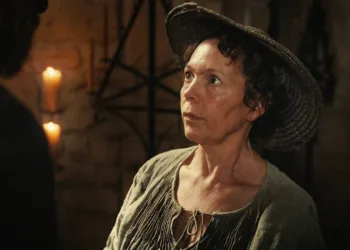








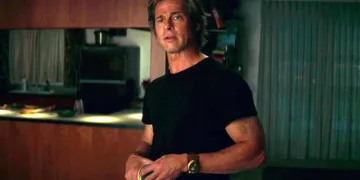

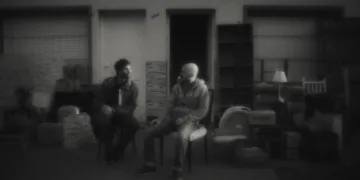
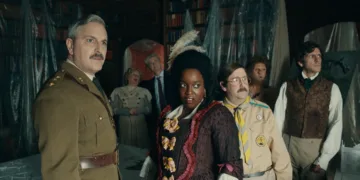





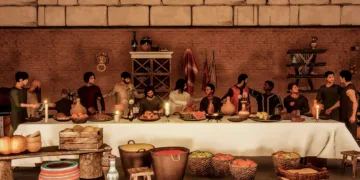



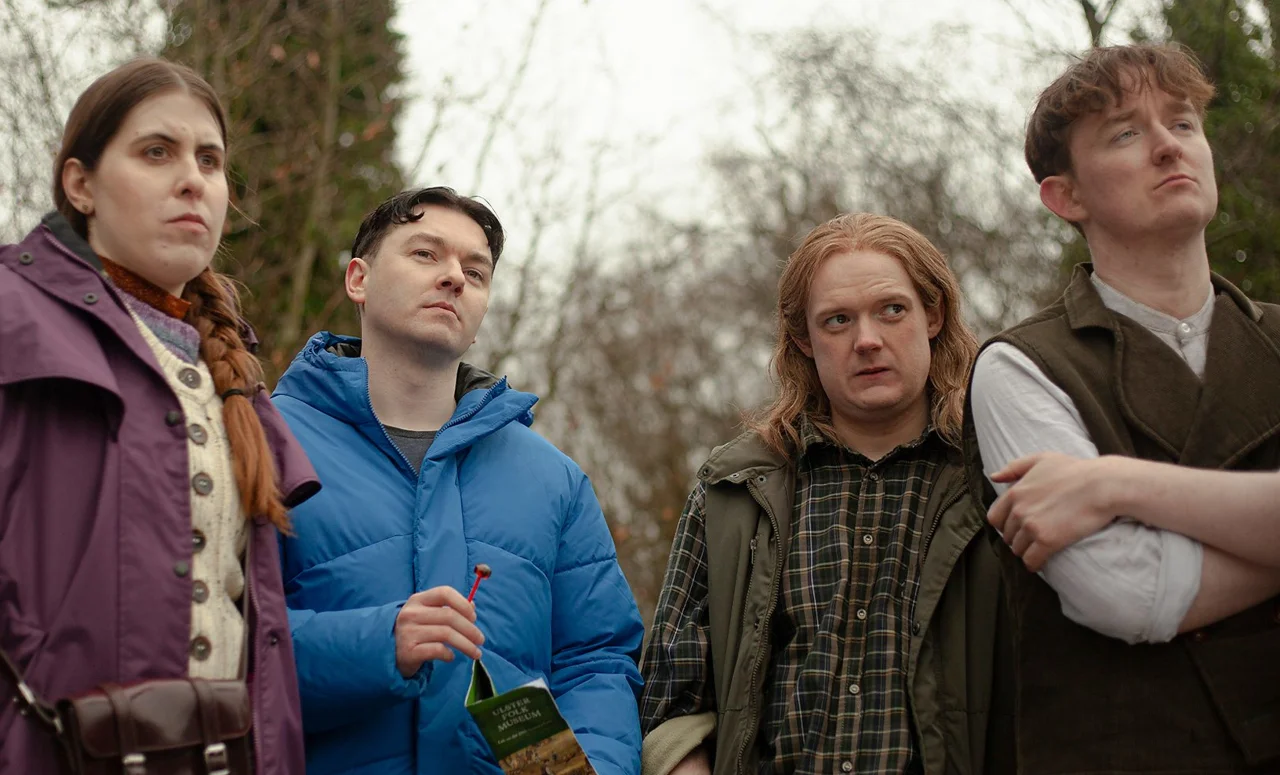
Ryan Dylan gives a conspicuously fake child the concern of a man carrying an entire family tragedy. His character, Callum, is working at a living-history attraction, playing a nineteenth-century peasant, and the doll represents his child. The prop makes no persuasive claim to being alive. Dylan keeps the emotion going anyway. Much of the pleasure of Funboys’ second season comes from watching that discrepancy widen: the less convincing the spectacle, the greater the characters’ commitment to it.
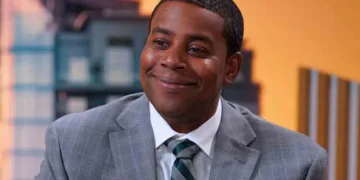
Steve Coogan, playing Callum’s boss, extends the joke by taking his own performance as a brutal historical authority far too seriously. There are two performances operating together here. Coogan plays a man doing a job, then lets that man become excessively invested in the role the job requires. Callum’s solemn attachment to his artificial offspring gives him an equally excessive emotional register to work against. The scene becomes funny through their agreement to treat this visibly inadequate little production as an occasion for enormous feeling.
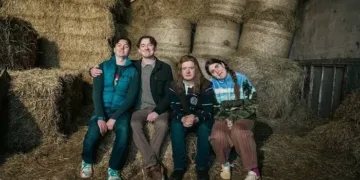
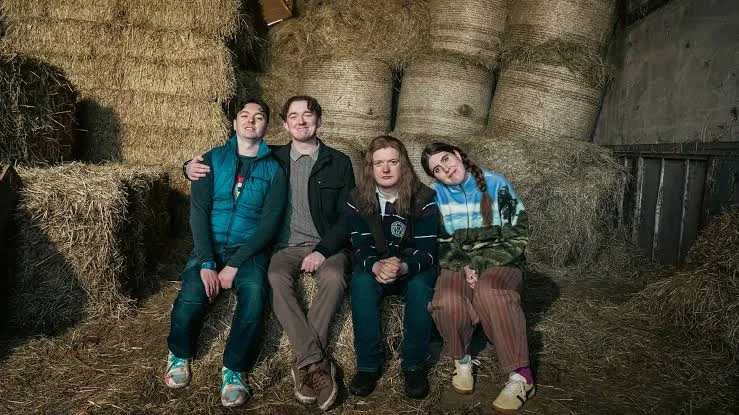
Creators Dylan and Rian Lennon carry that agreement into the ordinary lives of their characters. Across this four-part BBC series, Callum, Jordan, and Lorcan spend their twenties in the fictional Northern Irish town of Ballymacnoose, handling embarrassment with the emotional ceremony of people negotiating a historic peace settlement. Lennon’s Jordan supplies a particularly needy kind of selfishness. Lee R James gives Lorcan, the comparatively sensible friend, an encouraging sincerity that can make the group’s least sensible ideas sound worth supporting. Their hugs and motivational speeches establish a friendship whose members are deeply invested in its presentation.
The title sequence offers an early lesson in how to watch them. Countryside seen from above, a fading montage, and guitar rock supply the comforting packaging of older television. This is pastiche: an imitation that makes a familiar style available for fresh purposes.
Here, those reassuring signals promise that these people’s lives deserve our warm attention. The episodes then attach that promise to inflated arguments and ludicrous crises. I like how thoroughly the performers accept the invitation. Their earnestness gives the borrowed style something to exaggerate; a knowing smirk would release the pressure too easily.
Jordan’s encounter with the history of the Irish famine shows how carefully that pressure can be developed. He discovers empathy with the alarm of someone finding an unfamiliar appliance running in his house. His proposed response includes donating his Family Guy DVDs to children in Namibia and giving away the family car.
Each action follows a recognizable impulse, then exposes its limitations. He wants to relieve suffering, but his idea of relief comes from his own possessions and pleasures. The DVDs make his ignorance wonderfully specific. He has experienced something that makes him happy and assumes he has identified a universal need.
His friends’ intervention takes the story somewhere stranger. They arrange a flat-bottom contest for him to win, reasoning that public success will restore his ego and return him to his familiar selfishness. An uplifting friendship plot usually arranges a triumph to help someone become a better person. This one uses triumph to undo an inconvenient outbreak of consideration. The logic is ridiculous, yet it remains legible at every step: Jordan has changed, the change is causing trouble, and his friends know which emotional button will restore normal service.
That knowledge complicates the show’s affection. The friends understand Jordan well enough to engineer his recovery from generosity. They care about his distress while remaining attached to the version of him they find easiest to accommodate. James’s delivery is especially valuable within this comic world. Lorcan’s composure gives the group’s sentimental language credibility, even when its reasoning deserves none. His encouraging speeches let us hear how reassurance can make foolishness feel responsible. The friendship has room for considerable tenderness without requiring much improvement from anyone.
Ele McKenzie’s Gemma, Lorcan’s English girlfriend, puts a different kind of pressure on that arrangement. Her enthusiasm for performing analingus on him meets his reluctance, and their private negotiation becomes a public event. The subject is blunt, but the writing gives the surrounding reactions separate jobs. Gemma expresses a desire. Lorcan has to respond to it. Callum retches violently, as though someone else’s sex life has become a direct assault on his digestive system. McKenzie’s straightforward enthusiasm gives the others something solid to panic around.
The escalation reaches Lorcan’s father, who imagines his own father furiously turning in his grave. A bedroom preference has acquired an ancestral audience. That expansion is the joke’s most revealing move: each person increases the apparent significance of something that belongs primarily to the couple. Callum responds through his body; the father recruits family dignity. Their reactions remain funny because they expose different anxieties, rather than merely repeating the same expression of disgust at greater volume.
This is also demanding comedy. Callum’s retching asks us to sit with a deliberately excessive response, and the pleasure depends on enjoying the distance between his alarm and its cause. The show gives little assistance to anyone hoping the characters will recognize their own absurdity and move briskly along.
The sentimental reconciliation brings another familiar television gesture into this uncomfortable territory. We recognize the emotional shape of people repairing a relationship, even after watching them inflate a private matter into a collective crisis. The reassurance offers relief without making their earlier behavior suddenly reasonable. For Lorcan, whose discomfort has been surrounded by everybody else’s feelings, being understood still has to compete with his friends’ and family’s need to feel involved.
Funboys Season 2 premiered on BBC Northern Ireland and BBC iPlayer on June 15, 2026, with all episodes available for streaming on BBC iPlayer. Written and directed by Rian Lennon alongside co-creator Ryan Dylan, the Northern Irish comedy follows three emotionally stunted young men navigating romance, existential anxieties, and absurd local mishaps in the small rural town of Ballymacnoose.
Full Credits
Title: Funboys Season 2
Distributor: BBC Three, BBC Northern Ireland, BBC iPlayer
Release date: June 15, 2026
Rating: TV-MA
Running time: 24 minutes per episode (4 episodes)
Director: Rian Lennon
Writers: Rian Lennon, Ryan Dylan, Simon Mayhew-Archer
Producers and Executive Producers: Seb Barwell, Navi Lamba, Mary McKeagney
Cast: Ryan Dylan, Rian Lennon, Lee R. James, Ele McKenzie, Amanda Hurwitz, James Martin
The Review
Funboys Season 2
Funboys Season 2 understands how much comic work sincerity can do. Its fake historical tragedy, misguided generosity, and sexual panic become wonderfully funny through performances that treat every absurdity as emotionally urgent. The friendship has warmth, but the writing keeps exposing how reassurance can protect selfishness. Sustained embarrassment makes this a demanding comic wavelength; the carefully differentiated reactions make it worth tuning into.
PROS
- Earnest performances give absurd situations emotional weight.
- Sentimental television conventions become inventive comic tools.
- Jordan’s charity storyline connects escalation with characterization.
- Coogan and McKenzie sharpen the ensemble’s contrasting reactions.
CONS
- Prolonged bodily-reaction humor can be taxing.
- Little character self-awareness to ease the embarrassment. 1.