












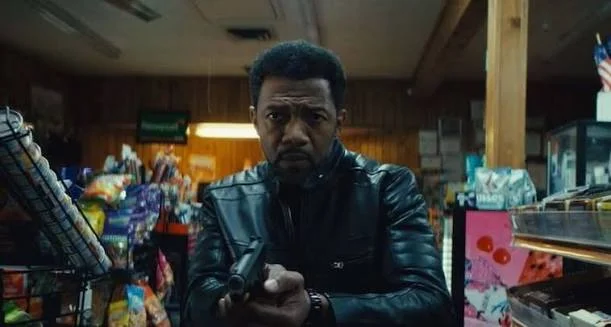

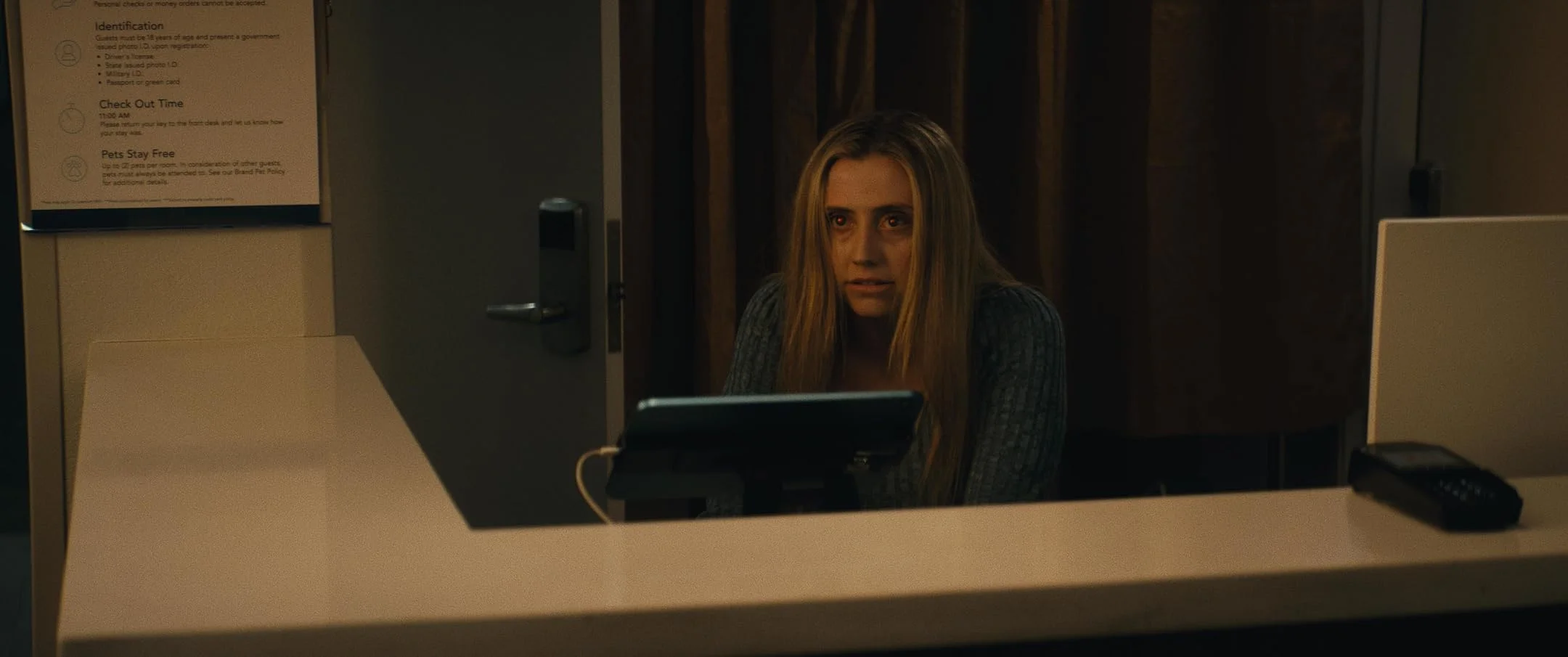
Dean Richardson goes back to a motel reception desk for towels, notices something wrong with the clerk, and decides to leave. He retrieves Wyatt and gets out without demanding an explanation. It is a pleasingly practical response to the uncanny. Clean towels can wait. Britt Bankhead, who directs, co-writes, and plays Dean in The Town That Takes, gives his protagonist the useful ability to act before curiosity becomes a death wish.
Then the film makes that ability somebody else’s problem. A shapeshifting entity takes Dean’s appearance, connecting his face to violence he did not commit. The man who correctly recognizes a threat becomes a threat others think they recognize. This is where the premise acquires some intellectual bite: Dean’s instincts can help him protect a child, yet they cannot establish his innocence. The police have to distrust what appears to be evidence.
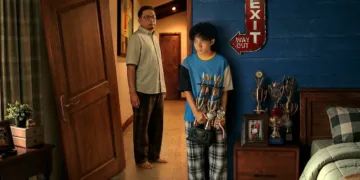
Wyatt already has reasons to keep his distance. Following his mother’s death, he is leaving with Dean for Georgia, and their exchange at the cemetery makes the arrangement feel painfully provisional. Dean’s condolence is awkward; Wyatt calls him by his first name. Bankhead and Nico Tirozzi establish a relationship in which the adult’s claim to responsibility has yet to become the child’s experience of trust. The impersonation plot could press directly on that uncertainty. A familiar face supplies no guarantee of care, and a parental role does not automatically confer emotional authority.
The film finds a simpler way for Dean to demonstrate his value. As the investigation gives way to car chases, gunfire, and hand-to-hand combat, his capacity to protect Wyatt becomes increasingly physical. Bankhead has the presence for this turn. Dean looks capable of surviving the encounters the screenplay gives him, and the practical stunt work supplies a welcome material resistance to a threat otherwise defined by supernatural evasion. Bodies collide; vehicles move; somebody has to get through the next confrontation. The action gives the film an urgency its mythology cannot consistently sustain.
I initially wanted to blame that shift for shrinking the horror. An entity that destabilizes identity becomes easier to process once it provides something to hit. Yet the motel scene complicates that objection. Dean’s first effective decision is already an action: he removes Wyatt from danger. His later violence extends an established protective instinct. There is no inherent reason a film about unstable appearances must forbid its characters physical competence.
What disappoints me is how quickly competence becomes the principal evidence of their relationship. The early discomfort between Dean and Wyatt raises a question about earning trust after absence and loss. Once Wyatt disappears, rescue gives Dean a clear objective, and fighting supplies a readily visible measure of commitment. The child’s guardedness is harder to address. A successful rescue can establish devotion without resolving the emotional distance registered in that cemetery conversation.
The investigative strand briefly offers a different kind of engagement. Douglas O’Shea, played with useful steadiness by Miles Mussenden, confronts a burned house where the fire seems to have stopped without an intelligible cause. Scorched remains, unfamiliar markings, and the word “Croatoan” suggest an event whose physical traces refuse an ordinary explanation.
A convenience-store massacre deepens the problem when surveillance footage supplies no visible perpetrator. These are effective invitations to think alongside the investigators. Something has happened, and the available record cannot account for it.
Other absences are less productive. After Dean and Wyatt’s off-road crash, Wyatt reaches a hospital while Dean wakes alone in the overturned vehicle. The connective information is missing: how the boy was recovered separately, and how Dean knows where to seek him.
That omission matters because the search depends on knowledge the film has not adequately established. We are trying to follow a frightened adult’s decisions and are denied the steps that make those decisions legible. A fire extinguishing itself creates a question. A character acquiring unexplained information interrupts one.
Wyatt’s podcast about shapeshifters adds to this problem. It introduces decapitation as a means of killing them, then receives no clear acknowledgment as the danger becomes immediate. The podcast need not be correct. Children can listen to dubious folklore, and terrified people can forget things. But the screenplay gives the information the prominence of preparation without making its later irrelevance expressive. Alongside unanswered questions about the outbreak’s timing and its choice of victims, such loose connections make it difficult to judge which details deserve attention.
St. Clair’s scholarly inquiries promise to organize the evidence. Grace Patterson’s investigator seeks help translating the unfamiliar language, bringing research into a film increasingly governed by Dean’s force. Yet the eventual explanation carries an uglier shortcut. The opening narration has already linked Roanoke, “Croatoan,” a shape-changing demon, and stolen children. Later material connects Indigenous ritual, child sacrifice, possession, and the town’s violence, without giving those associations enough cultural specificity or causal development to bear their weight.
The possession element requires care. People compelled by an entity cannot simply be treated as willing perpetrators. Even with that distinction preserved, Indigenous identity and ritual are made available as signs through which evil becomes recognizable. The film asks the viewer to hesitate before trusting Dean’s face, then spends considerably less effort questioning the ominous authority it gives unfamiliar language and Native associations.
My objection does not require a historically instructive horror film. An invented supernatural explanation can be outrageous, malicious, or absurd and still possess a considered relationship to what it borrows. Here, the distance between the vanished colony and the present killings remains thinly developed, while “Croatoan” does much of the work of making the violence seem ancient and consequential. At the burned house, the investigators encounter a word they cannot yet explain. The film’s later account supplies ritual and sacrifice, but leaves the people attached to that explanation scarcely more knowable than the markings on the wall.
The Town That Takes opened in select theaters across North America via Atlas Distribution Company on July 10, 2026. Directed, co-written, and starring Britt Bankhead, the supernatural horror thriller follows a troubled Army veteran whose young son vanishes during a road trip through a remote North Carolina town, forcing him to team up with two local detectives as they uncover a dark conspiracy tied to an ancient, predatory entity.
Where to Watch The Town That Takes (2026) Online
Full Credits
Title: The Town That Takes
Distributor: Atlas Distribution Company, Bankhead Productions
Release date: July 10, 2026
Running time: 1 hour 33 minutes (93 minutes)
Director: Britt Bankhead
Writers: Britt Bankhead, Jon Blaze
Producers and Executive Producers: Britt Bankhead, Grace Patterson, Jon Blaze
Cast: Britt Bankhead, Miles Mussenden, Grace Patterson, Mike Markoff, Nico Tirozzi, Marie Wetherell, Paul Kolker, Blake Higdon
Director of Photography (Cinematographer): Joel Froome
The Review
The Town That Takes
The Town That Takes gives its hero sound instincts, physical presence, and a face he cannot trust other people to recognize correctly. That is fertile horror territory. I can forgive the turn toward fists and gunfire; the action earns some of its urgency. The missing causal links and thinly examined Indigenous mythology are harder to excuse. Dean can fight his way toward Wyatt, but the screenplay leaves their damaged trust waiting for attention.
PROS
- Shapeshifting creates meaningful uncertainty about identity.
- Practical action gives the rescue narrative urgency.
- The contained fire and surveillance footage establish effective mysteries.
- Dean’s motel escape demonstrates welcome common sense.
CONS
- Missing causal links weaken the investigation.
- Physical protection overshadows the development of emotional trust.
- Indigenous ritual becomes an insufficiently examined explanation for evil.
- The Roanoke connection remains thinly developed.