





















The curtain at Sundersheim’s Pumpkin Festival opens on a spectacle nobody ordered: mayor Katarina Vinson’s body, Wanda standing beside her, and blood supplying an exceptionally unhelpful explanation. The staging does several jobs at once. It interrupts the Klatts’ tentative return to ordinary life, puts their daughter in police custody, and gives an entire town the same incriminating image. Where’s Wanda? Season 2 understands the usefulness of an audience within the audience. Before Wanda can explain herself, her neighbors have effectively attended the prosecution’s opening presentation.
Chief Detective Simon Schmidt treats that presentation with considerable enthusiasm. Wanda’s account of encountering a threatening man backstage receives little interest; the visible circumstances receive plenty. Torben Liebrecht gives Schmidt the self-satisfaction of someone who regards further questions as an administrative nuisance. Schmidt appears ready to solve the murder chiefly by discouraging additional information.
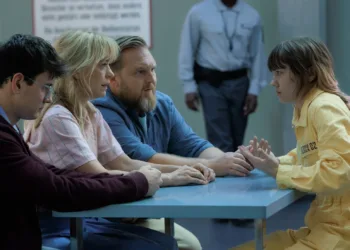
That obstruction sends Carlotta and Dedo Klatt back into the amateur detective business, a profession for which parental panic remains their principal qualification. A year after Wanda’s disappearance and return, losing access to her again is enough to make Carlotta attempt to steal an expensive television. Her reasoning is magnificently defective: get arrested, get imprisoned, reach daughter.
Every step follows from the previous one, provided you have never encountered the criminal justice system. Heike Makatsch keeps the desperation legible beneath the foolishness, while Michelle Rauch’s refusal to cooperate supplies the necessary resistance. The scene works because Carlotta has a specific, painful objective. The television is merely her appalling solution.
Dedo’s attempt to think through Wanda’s possible guilt gives the family comedy a different rhythm. Carlotta discovers his list of suspicious behavior and hears a declaration of disloyalty. Only later does he reveal the accompanying column supporting Wanda’s innocence.
This is economical withholding: the missing information briefly makes husband and wife seem further apart than they are. Axel Stein gives Dedo room to consider an unwelcome possibility without turning that consideration into emotional desertion. The delayed second column also improves the first. His faith becomes something he has tested, which makes Carlotta’s demand for immediate certainty less comfortable.
Makatsch and Stein are particularly effective when their shared purpose produces incompatible methods. Carlotta needs action; Dedo attempts assessment; each can make the other’s response look intolerable. Their marriage gives the absurdity somewhere to hurt. Ole’s frustration usefully interrupts the assumption that everyone should welcome another family emergency. Having begun to recover his own life, he is expected to surrender it to Wanda’s crisis again. His resentment prevents the rescue effort from becoming an uninterrupted celebration of togetherness. Being the helpful sibling is an unpaid position with dreadful hours.
The investigation board in the basement of Uncle Rüdiger’s bar brings those competing habits of interpretation together. Wanda has collected material linking Katarina to the criminal identity “King.” For Schmidt, the board establishes obsession and supplies a motive. For her family, it suggests that her suspicions deserve investigation. The same arrangement of photographs and clippings can support two stories, which is useful mystery writing.
Wanda’s research need not prove her allegation for Schmidt’s dismissal to feel inadequate. The fingerprints he cites are incriminating; they do not make every other question disappear. His eagerness to announce a culprit shrinks a potentially interesting contest over evidence into a struggle to get the evidence considered.

That simplification is the season’s clearest structural weakness. The Klatts’ behavior gains comic force from recognizable emotions pushed into reckless action. Schmidt’s behavior often serves the more transparent purpose of keeping the family investigation necessary.
Their foolishness has a cause we can follow; his incuriosity gives the plot permission to continue. The distinction matters in a series asking slapstick and murder suspense to share space. Carlotta can make an outrageous decision because she is frightened. Giving her an investigator this dismissive makes her decision to interfere almost too easy to endorse.
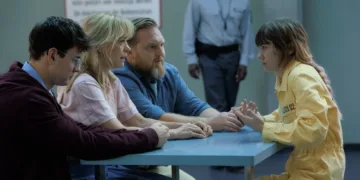
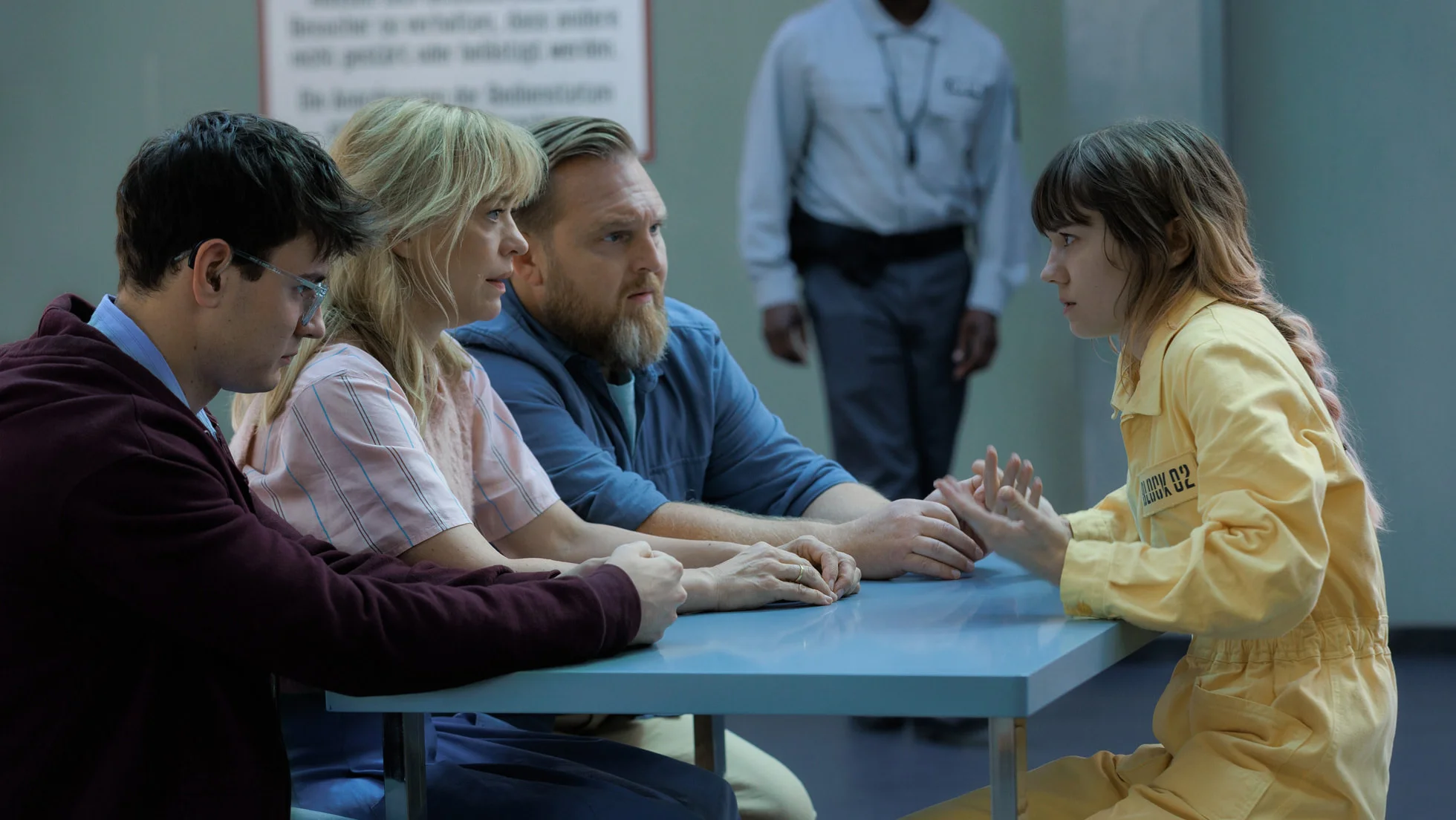
The Monday-to-Sunday structure supplies a useful calendar for the expanding trouble, with Friday occupying two episodes. Wanda’s imprisonment also gives the story a separate arena rather than leaving her waiting to be rescued. Her encounter with Lena Brauer, previously arrested as the supposed “King,” puts an existing grievance into an enclosed setting. Wanda’s anxiety under questioning and her demand for a lawyer give Lea Drinda a useful tension to play: she needs protection and insists on speaking for herself. The prison strand can generate trouble from her previous entanglements while the family produces fresh trouble outside.
Sundersheim’s pastel artificiality helps accommodate this density of criminal activity. The festival’s civic cheer and theatrical murder reveal belong to the same exaggerated town, so the absurdity has a visual home. The burglary at the Klatts’ house, followed by the arrival of an unusually interested neighboring couple played by Alexandra Maria Lara and Sam Riley, uses a familiar cliffhanger trick effectively. Proximity encourages suspicion before any connection has been established. A ransacked bedroom makes a routine introduction feel like another intrusion. The new neighbors barely need to do anything; the episode has arranged for their timing to do the work.
Wanda had already been using Rüdiger’s basement to get away from her overbearing parents before the arrest. That small detail puts pressure on the rescue story from a direction the murder investigation cannot resolve. Carlotta and Dedo’s determination to bring her home is understandable, funny, and sometimes exhausting to watch. Home was also somewhere Wanda needed relief from. Once the Klatts have finished fighting for access to their daughter, can they bear to let her close a door?
Where’s Wanda? Season 2 premiered globally on Apple TV on October 21, 2026, releasing weekly episodes through December 9, 2026. Created by Oliver Lansley and Zoltan Spirandelli, the German-language dark comedy series follows Carlotta and Dedo Klatt as they face a new crisis after their missing daughter is finally located—only to be caught standing over a dead body as a prime murder suspect.
Where to Watch Where’s Wanda? Season 2 Online


Full Credits
Title: Where’s Wanda? Season 2 (German: Wo ist Wanda?)
Distributor: Apple TV, UFA Fiction
Release date: October 21, 2026
Rating: TV-MA / 16+
Running time: 43–48 minutes per episode (8 episodes)
Director: Tobi Baumann, Christian Ditter
Writers: Oliver Lansley, Zoltan Spirandelli
Producers and Executive Producers: Nataly Kudiabor, Oliver Ossege, Sebastian Werninger, Oliver Lansley
Cast: Heike Makatsch, Axel Stein, Lea Drinda, Leo Simon, Nikeata Thompson, Palina Rojinski, Kostja Ullmann, Alexandra Maria Lara, Sam Riley
Editors: Sandy Saffeels, Friedemann Schmidt
Composer: Christoph Zirngibl, Ralf Wengenmayr
The Review
Where's Wanda Season 2
Parental panic remains an excellent source of terrible decisions in Where’s Wanda? Season 2. Heike Makatsch and Axel Stein make the Klatts’ reckless devotion funny and emotionally credible, while the festival reveal and suspicious neighbors keep the mystery moving. The detective’s determination to avoid further thought makes the investigation too easy to dismiss, and the family’s rescue efforts occasionally exhaust. Still, Carlotta’s attempt to shoplift her way into prison earns its absurdity through painfully understandable logic.
PROS
- Makatsch and Stein’s contrasting responses to parental fear.
- Emotionally grounded, character-driven absurdity.
- Efficiently staged festival reveal.
- Suspense built through conflicting interpretations of evidence.
CONS
- Schmidt’s incuriosity simplifies the investigative conflict.
- The parents’ frantic interventions occasionally become exhausting.