























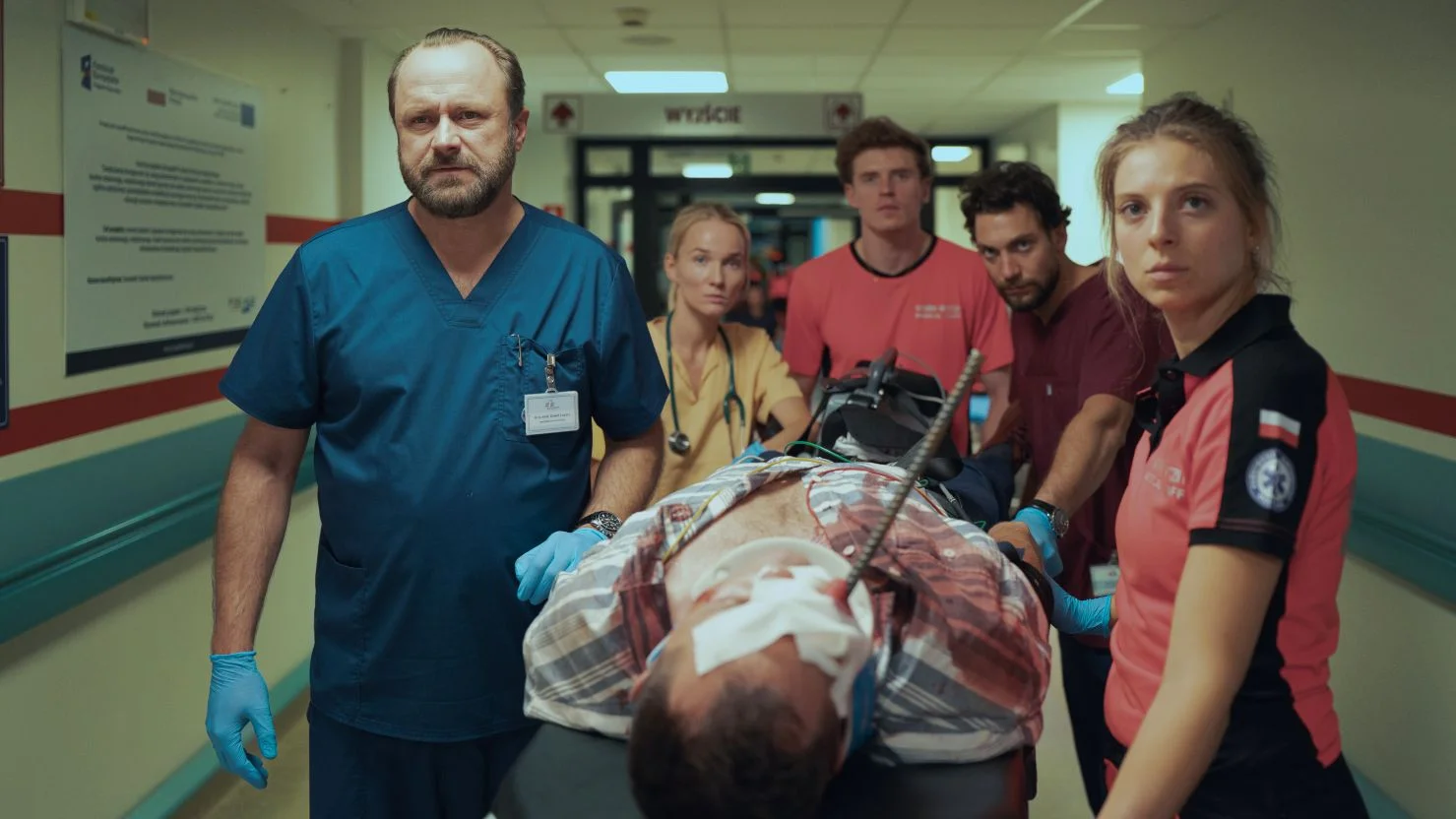

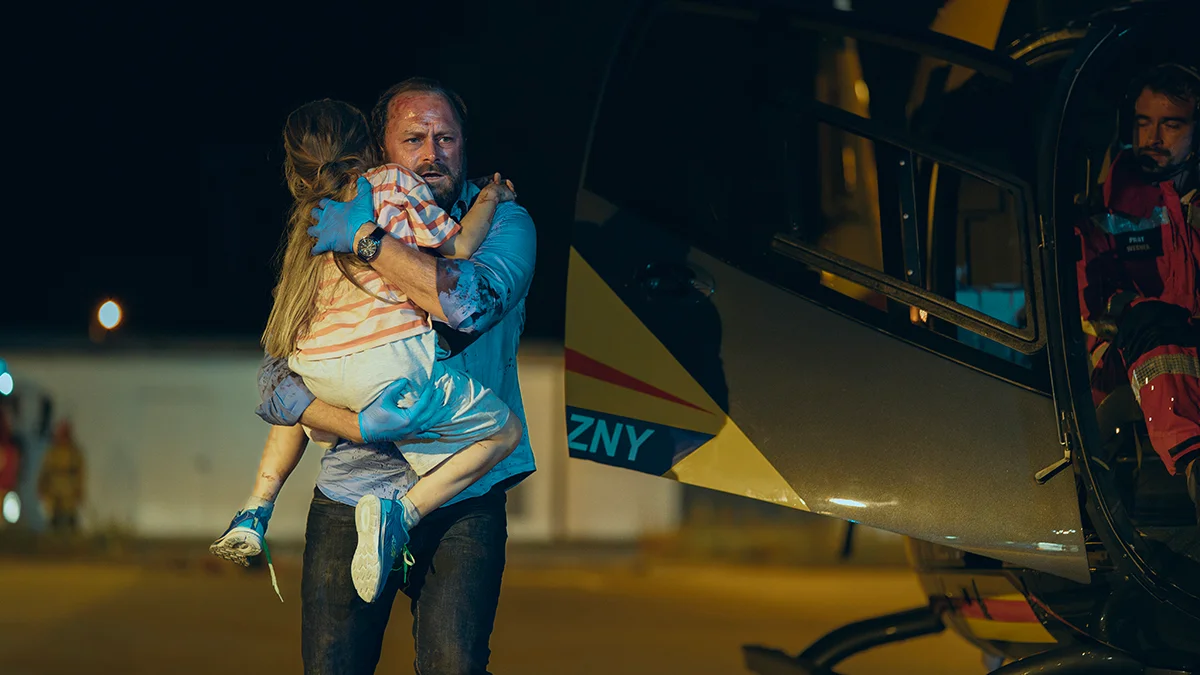
The pilot of Anaesthesia moves Dawid Łazarz from professional disgrace to a fresh appointment before he has much opportunity to examine the disgrace. After a young patient dies during surgery, the Warsaw neurosurgeon punches his clinic director and is dismissed. His drive to a lakeside retreat takes him past a train collision, where he joins the rescue effort. The emergency gives the small, poorly equipped Suwałki hospital an urgent reason to need him. It also gives him somewhere to be useful while the questions he has left behind remain unanswered.
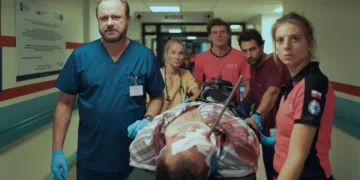
Director Łukasz Ostalski makes that usefulness difficult to dispute. When paramedic Ada suffers a head injury, Dawid uses an electric drill to relieve pressure inside her skull. The procedure is gruesome, but its dramatic function is precise: Ada’s partner Zawisza, previously at odds with Dawid, suddenly has a powerful reason to trust him. The rescue introduces relationships through decisions made under pressure. By the time hospital director Frycz offers Dawid work, the appointment feels earned, even as news of possible professional suspension gives Dawid a less selfless reason to accept.
Leszek Lichota supplies the continuity between the man who lashes out in Warsaw and the doctor others follow during a catastrophe. His authority in the rescue scenes makes Dawid’s confidence persuasive; the confrontation with his former boss exposes how readily that confidence turns aggressive. Lichota allows both qualities to remain recognizable as the setting changes. Dawid’s ability can attract people without making him agreeable, and his emotional outbursts feel consistent with someone accustomed to having the decisive answer. The performance keeps his competence visible without smoothing away the difficulty of working or living with him.
The recurring appearances of Mikołaj, the patient who died, give that assurance an internal interruption. Dawid can change hospitals, but the series keeps returning the dead young man to his thoughts. These visions are a blunt device, making guilt visible when Lichota already gives Dawid considerable strain.
They also preserve an essential gap between his reputation during an emergency and his unresolved experience of failure. Feeling haunted establishes neither culpability nor innocence. The investigation into the operation has a different task, and the season becomes less convincing when its handling of opposition makes scrutiny seem chiefly a matter of personal hostility.
Grzelka’s resentment is introduced through Frycz’s enthusiasm for the newcomer, with the established chief’s position suddenly looking less secure. His decision to contact prosecutor Kozieł therefore places personal rivalry underneath the scrutiny of Dawid.
That is useful conflict, though it gives viewers an early reason to distrust objections before considering their substance. Kozieł’s dogged pursuit further tilts the story toward a gifted doctor besieged by obstructive people. Investigating a patient’s death remains reasonable. The writing sometimes makes an awkward assignment of the role: accountability arrives wearing the expression of a personal grudge.
A stronger challenge to Dawid comes from Wanda Kott. Their disagreement over amputating the injured footballer Mateusz’s leg initially gives his determination the familiar appeal of a doctor refusing to surrender. Wanda’s explanation that she plants a sapling for every patient who has lost a limb changes the meaning of her position.
She carries the consequences of those decisions beyond the operating room. The exchange makes room for a colleague whose care takes a form Dawid has failed to recognize. Mateusz’s continuing difficulty adjusting to limb loss also extends the case beyond the immediate drama of choosing a procedure.
Dorota Kolak and Krzysztof Stelmaszyk give Wanda and her husband Leszek the ease of people with a shared working life, which makes the strain beneath their familiarity register. Leszek continues treating casualties while injured, then breaks down in a bathroom after losing patients.
The scene briefly removes him from the collective effort and lets the losses become personal. Its restraint is effective. Elsewhere, the series moves quickly from deaths to the next demand on the staff, leaving emotional aftermath unevenly developed. This quiet interval demonstrates how much a little space can accomplish.
The hospital also becomes richer when Dawid’s surgical priorities encounter expertise outside his own field. Psychiatrist Jagoda Wilk, played by Aleksandra Popławska, supports the bereaved and injured while her department struggles for resources. Her disagreements with Dawid give their relationship professional stakes before private complications accumulate.
Oleg, a Belarusian cardiac surgeon working as a cleaner while awaiting local qualification, offers useful advice during the pilot. His contribution is brief, but it disrupts the assumption that the person with the most visible authority possesses all the knowledge the situation requires. These encounters keep Suwałki from becoming merely a grateful audience for its new arrival.
Across eight episodes, however, the distribution of attention becomes less assured. Early medical cases introduce colleagues and reveal their priorities while the hospital is functioning. Later, the growing emphasis on personal connections means the doctors’ own difficulties increasingly supply the cases and conflicts.
Leszek’s health and younger clinician Patrycja’s ambitions compete with Jagoda’s family story, Dawid’s marriage and the investigation. Several of these threads deserve development, yet their accumulation leaves the closing two episodes hurrying through material that needs time to register. Greater selectivity would have helped as much as additional running time. The season keeps finding new demands for its characters while becoming less patient with the consequences.
Dawid’s family provides the clearest reason to preserve some of that private material. Basia, played by Karolina Gruszka, has to live with decisions whose professional urgency he can readily explain. His relocation and devotion to work reorganize the lives of people outside the hospital without giving them an equivalent voice in those decisions. Their son Franek initially wants to become a doctor like his father.
When public accusations against Dawid reach school, admiration becomes a source of exposure: the boy faces harassment and ridicule over events he cannot explain or control. The investigation can proceed through adult arguments about responsibility while Franek has to return to the same classmates the next morning.
Anaesthesia premiered globally on Netflix on November 4, 2026. The Polish medical drama follows a brilliant neurosurgeon who transfers to a regional hospital after a controversial surgical procedure, where he navigates high-stakes medical emergencies and complex ethical dilemmas.
Where to Watch Anaesthesia Online
Full Credits
Title: Anaesthesia (Polish: Znieczulenie)
Distributor: Netflix
Release date: November 4, 2026
Rating: TV-MA
Running time: 60 minutes per episode
Director: Leszek Dawid, Bartosz Prokopowicz
Writers: Wiktor Piatkowski, Magdalena Lankosz
Producers and Executive Producers: Netflix, Telemark
Cast: Leszek Lichota, Aleksandra Popławska, Filip Kowalewicz, Karolina Gruszka, Dorota Kolak, Masza Wągrocka, Krzysztof Stelmaszczyk, Gamou Fall
Director of Photography (Cinematographer): Piotr Sobociński Jr.
Editors: Przemysław Chruścielewski
Composer: Łukasz Targosz
The Review
Anaesthesia
Anaesthesia makes a persuasive case for Dawid’s usefulness, then gives his accountability a less rigorous hearing. Leszek Lichota keeps the surgeon’s skill, arrogance and distress in productive friction, while Wanda’s difficult choices and Franek’s school life expose consequences a successful operation cannot settle. The pilot introduces its ensemble through action with impressive economy. Later episodes become crowded, and the investigation too often frames scrutiny as hostility. Enough sharply observed human fallout sustains the season, though several promising arcs need attention its closing stretch cannot spare.
PROS
- Lichota makes skill, arrogance and vulnerability coexist.
- The pilot establishes relationships through urgent action.
- Wanda’s choices challenge the heroic surgeon formula.
- Family consequences give professional conflict personal weight.
CONS
- The investigation leans too heavily on personal antagonism.
- Crowded closing episodes rush promising supporting arcs.
- Doctors’ grief receives uneven attention.