




























Takeshi’s father complains that his children never thank him. As his marriage deteriorates in Takenoshin Yaza’s debut feature, Hinotama: Ball of Fire, he wants his unhappiness acknowledged and his authority preserved. This is a demanding combination for anyone still doing homework. His complaints make the children responsible for reassuring him at precisely the moment when they have reason to feel insecure themselves. Gratitude becomes another obligation they are failing to meet.
His use of family memories makes that pressure harder to resist. Approaching separation, he recruits experiences meaningful to the children into his effort to secure their allegiance. Nothing requires those memories to be false (that would make the problem easier). Their emotional value is what makes them useful to him. Yaza understands the discomfort of being asked to account for affection: remembering a parent’s kindness can start to feel like evidence one has been instructed to give. The father’s neediness remains recognizable even as his methods become increasingly objectionable.
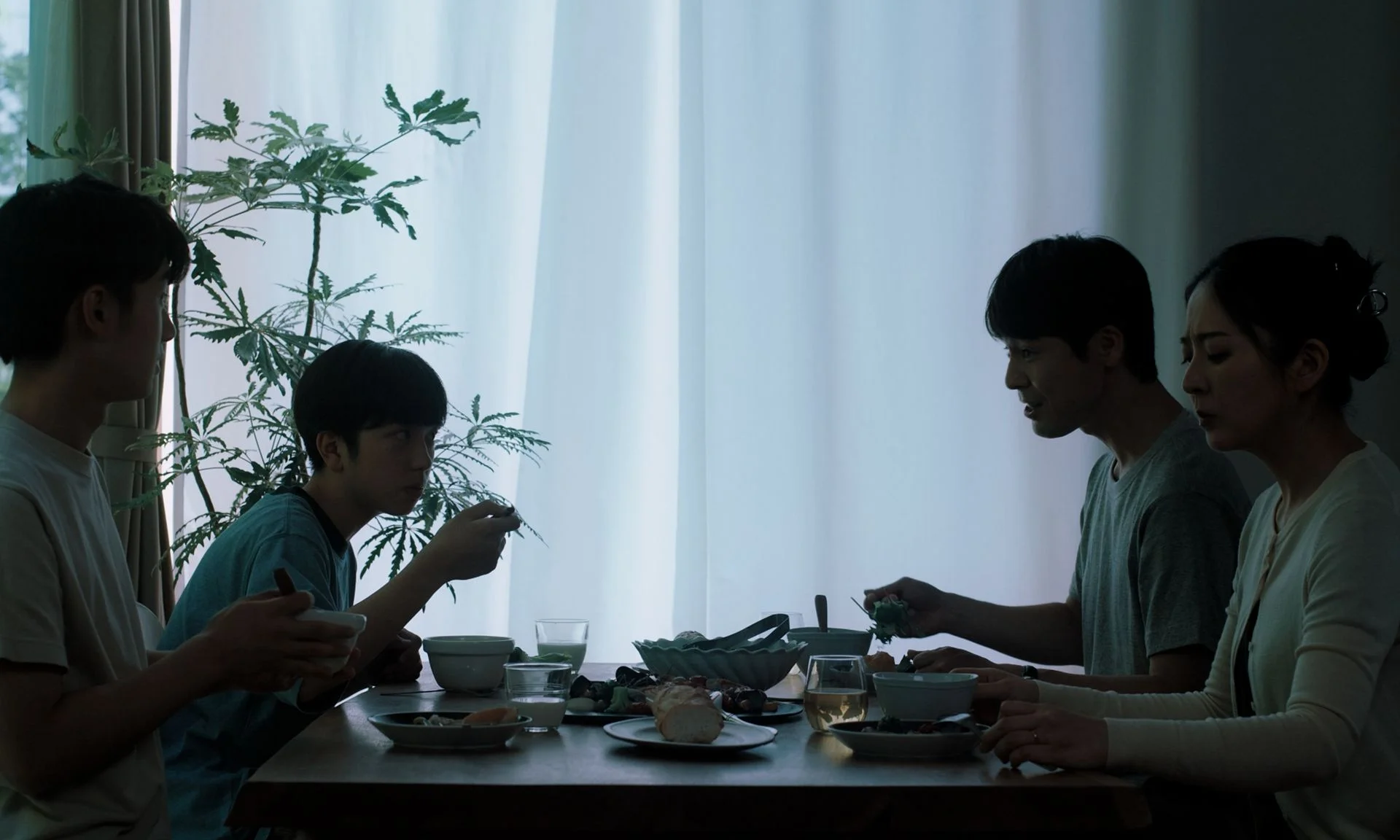
The household accommodates this unhappiness with remarkable visual tidiness. Cinematographer Yoshio Kitagawa arranges people within the home’s straight lines and symmetrical spaces; Mari Kusu, playing Takeshi’s mother, lets frustration press against that composure. Early correspondences between numbers called at school and items counted at a supermarket give daily life a rhythm of things being processed correctly.
There is nothing inherently sinister about an orderly frame or a completed errand. Here, though, the routines offer little room for an unexpected emotional response. The father can demand recognition. Everyone else seems to need permission to become inconvenient.
For high-school student Takeshi, played by Riku Onishi, the prospect of seeing a mysterious ball of fire offers a subject that does not arrive with an adult’s demand attached. His childhood friend Akari (Himena Irei) tells him about it, and his curiosity grows as his availability to his family diminishes. The appeal is understandable without giving the fire a definitive symbolic meaning. He can wonder about something instead of being required to understand it. In a household where even a happy memory can be recruited into an argument, that distinction has considerable value.
Onishi makes Takeshi’s withdrawal difficult to read without making it vacant. His prolonged looking and subdued responses withhold the explanations a viewer might expect from a drama about divorce. When Takeshi jumps into a muddy puddle and ruins a pristine pair of sneakers, the action releases a frustration that his manner has kept inaccessible. Yaza’s stationary camera gives the gesture an awkward physical presence. Nobody has to explain that the boy is angry; the shoes have received the explanation. The scene earns its restraint by letting an action disturb the behavioral order established around it.
I find that a persuasive defense of Onishi’s reserve. I am less certain that I have been distinguishing his performance from the film’s distribution of attention. Takeshi’s younger brother Kento (Koe Odani) faces bullying and begins trying to ease the family’s distress while his older brother becomes absorbed elsewhere. Understanding Takeshi’s wish to escape does not make Kento’s increased burden easier to accept. The film’s interest in the withdrawn child can leave the child who responds to immediate needs looking prematurely self-sufficient.
The brothers’ remaining affection makes this painful without requiring a large confrontation. Their silences contain attachment alongside distance. Kento’s efforts to help expose the inadequacy of using visible composure as a measure of how well somebody is coping. It would be unfair to demand that Takeshi repair the household, and the film gains nothing from inviting that demand. The sharper issue is how readily another child’s activity can be mistaken for his ability to manage. Kento is doing things because the family is suffering; his usefulness gives no assurance that he is protected from it.
Yaza’s formal control becomes less helpful when children stand in an orderly line watching Kento walk toward a new house. The arrangement makes his exposure visible, but the bodies seem positioned to deliver that meaning before they can register as separate people. Compared with the muddy sneakers, where an action unsettles the still image, this composition seems to have settled the emotional significance in preparation for the action. I can see the loneliness being expressed. I have less freedom to discover anything within it.
Across 112 minutes, that distinction matters. Long takes can give a suppressed feeling time to become perceptible, but continued duration cannot keep deepening an estrangement whose terms have stopped changing. The three-month leap is disruptive for a related reason. Having trained us to attend to small increments of domestic damage, Yaza abruptly asks us to inhabit changed circumstances. The emotional adjustment needs room of its own; the film’s persistent reserve makes that adjustment harder to register.
The landscapes offer a different scale without reliably offering release. Vegetation and open space occupy images that exceed the house’s carefully organized interiors, yet Takeshi carries his detachment into that expansiveness. As the film moves toward allegory and a surreal ending, his search for the fire gains weight that the brothers’ relationship struggles to share.
The risk is in the relative attention each receives: Takeshi’s withdrawal acquires a mysterious dimension, while Kento’s efforts remain tied to the practical work of easing other people’s pain. The later abstraction asks us to keep interpreting Takeshi’s escape while Kento’s increasing usefulness leaves his own need for care easier to miss.
Hinotama: Ball of Fire premiered at the Busan International Film Festival in October 2026 before screening at the Tokyo International Film Festival. Written and directed by Yaza Takenoshin, the Japanese domestic drama follows a young student observing the slow fracturing of his parents’ marriage while becoming fixated on local folklore about a mysterious ball of fire.
Full Credits
Title: Hinotama: Ball of Fire
Distributor: Festival Release (Busan International Film Festival / Tokyo International Film Festival)
Release date: October 2026 (Busan International Film Festival)
Running time: 1 hour 52 minutes (112 minutes)
Director: Yaza Takenoshin
Writers: Yaza Takenoshin
Producers and Executive Producers: Yaza Takenoshin
Cast: Riku Onishi, Koe Odani, Himena Irei, Mari Kusu, Tomomitsu Adachi
Director of Photography (Cinematographer): Yoshio Kitagawa
Editors: Yaza Takenoshin
The Review
Hinotama: Ball of Fire
Yaza sees how a parent can turn affection into an obligation, and Onishi gives suppressed anger a convincing physical outlet. I trust that restraint most when Takeshi ruins his sneakers. Elsewhere, the careful staging and prolonged silences begin deciding feelings for us. The late allegory compounds the imbalance between Takeshi’s mysterious escape and Kento’s unglamorous need for care. An observant family drama that sometimes becomes too absorbed in arranging its distress.
PROS
- Sharp examination of parental demands for gratitude.
- Onishi’s restrained performance gives frustration physical force.
- The brothers’ unequal burdens deepen the family conflict.
CONS
- Overcontrolled staging can make distress feel predetermined.
- Prolonged silences lose force as estrangement stops developing.
- Late allegory draws attention away from Kento’s needs.