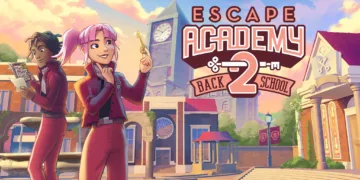


























Feeding a cat requires getting into the cafeteria, obtaining ingredients, and working out the order in which its meal should be served. Elsewhere, a student needs a sequence of dance steps arranged for a performance. Such requests give Escape Academy 2: Back 2 School its most appealing sense of community. Everyone has accepted that ordinary life involves elaborate acts of interpretation. Helping someone means entering their particular puzzle, learning the rules of an activity that matters to them, and briefly sharing their obsession.
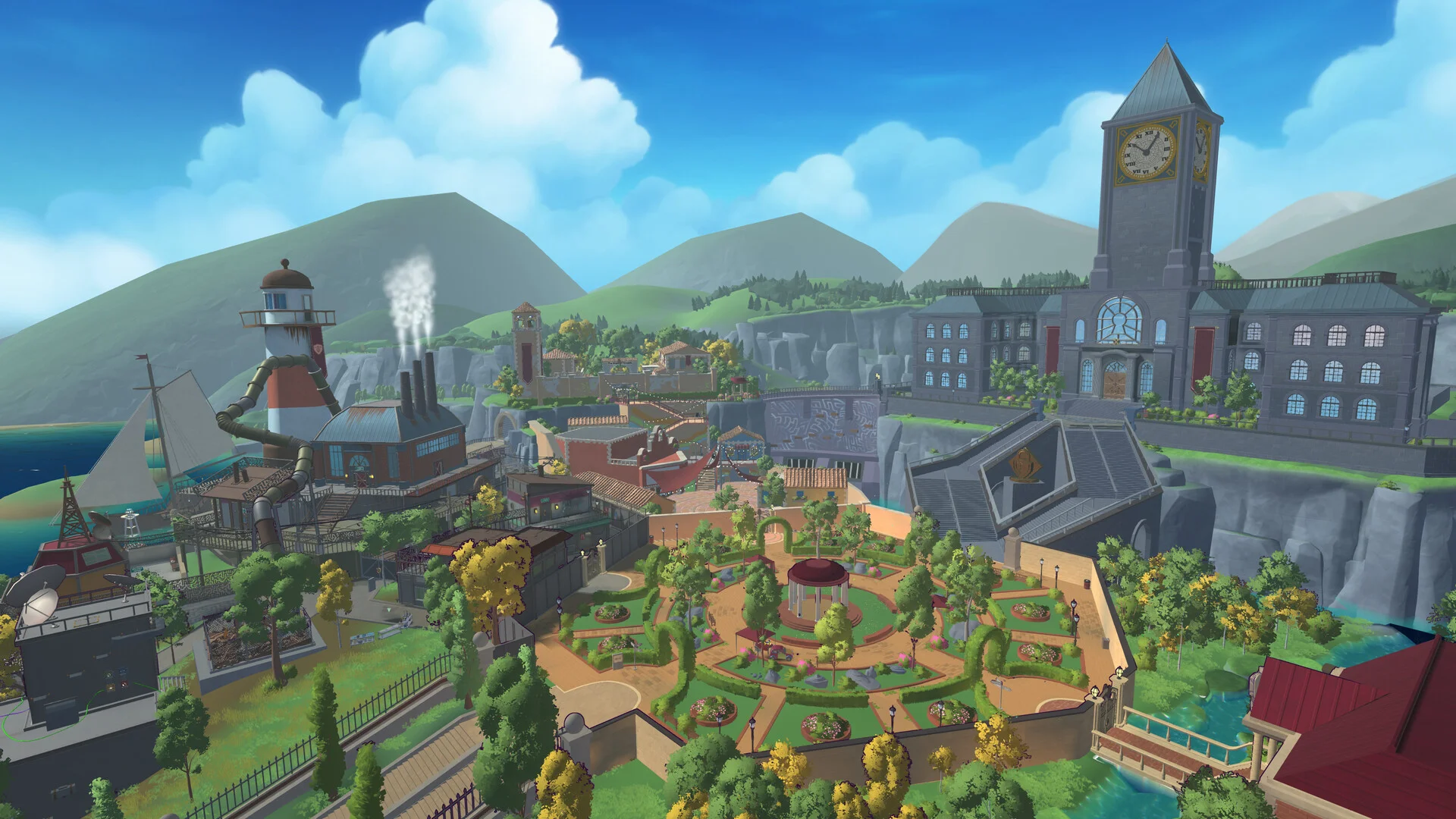
The campus makes this communal eccentricity into a system of belonging. Solving puzzles earns credentials that open doors into laboratories, libraries, museums, and classrooms. Knowledge has a visible consequence: a place previously inaccessible becomes somewhere you can spend an afternoon.
The gradual expansion gives the school a readable shape without exposing everything immediately. Short environmental challenges and student requests fill the spaces between formal examinations, allowing curiosity to continue outside the classroom. Painting landmarks even turns light platforming into an excuse to find another pocket of campus life.
Returning for a second academic year, the player also joins an investigation into disappearances and the school’s founding history. The dormitory ensemble recalls the genial amateur detectives of Scooby-Doo, particularly when a Loch Ness Monster theory enters the discussion.
This comparison fits the group’s comic disagreements and appetite for mystery, rather than promising elaborate detective work. Chapter-opening exchanges give the investigation a social rhythm, with excitement and rivalries making room for personalities between assignments. Puns from objects, teachers, and PA announcements extend the school’s peculiar vocabulary well beyond its plot scenes.
There is a less idyllic relationship between extracurricular activity and the timetable. Escape Bucks, separate from the credentials opening new areas, purchase equipment, ziplines, and items required for story progression. Exploring can therefore finance the next lesson, which gives small discoveries practical value.
Mandatory purchases also mean that a player ready to continue may have to leave an assignment and earn money elsewhere. The system works most comfortably when the player already wants to pursue campus errands; its freedom becomes conditional when those errands must cover an outstanding expense.
Inside the larger challenges, academic subjects provide useful identities for the puzzles. Constructing chemical notation for a memory-erasing gas makes science an activity rather than a classroom backdrop. The opening station challenge similarly connects colored routes, symbols, ticket numbers, and flags into a progression toward boarding a train.
These sequences offer the satisfaction of seeing one interpretation produce the object or access needed for the next. A sinking boat supplies a different scale of theatrical danger, adding rising water and a cannon to circumstances that a physical escape-room business would struggle to accommodate.
The imaginative settings do sometimes outrun the variety of deductions. Number and letter combinations recur frequently enough that opening locks can become the common destination of otherwise different lessons. Context-related word answers create a particular weakness: once enough letters suggest the appropriate term, the remaining evidence can become unnecessary. Recognizing the subject lets the player skip part of the reasoning. That shortcut suits a world so pleased with its own vocabulary, but it can make an examination feel finished before its sequence of clues has earned the answer.
Co-op gives those familiar procedures a different social function. The entire campaign supports two players locally or online, while remaining playable alone. Partners can explore independently, contribute to a shared cash pool, and divide the work of reading and entering information.
Online play’s optional split-screen view is especially useful when a clue and its corresponding mechanism occupy separate locations. One person can consult the information while the other acts on it. The resemblance to a physical escape room lies in that exchange, with understanding moving between people instead of remaining inside one player’s head.
Filtered glasses expose a limit to this arrangement. The item reveals hidden information, but only its current holder can wear it. Passing it between partners distributes turns without necessarily giving both players meaningful work at once.
Even the online partner-view display fails to reproduce what the wearer can see through the filter. Restricted information can encourage collaboration when each participant holds something the other needs; here, the restriction can leave one person waiting for access to the problem itself. Independent movement offers little compensation while the relevant discovery belongs to someone else’s inventory.
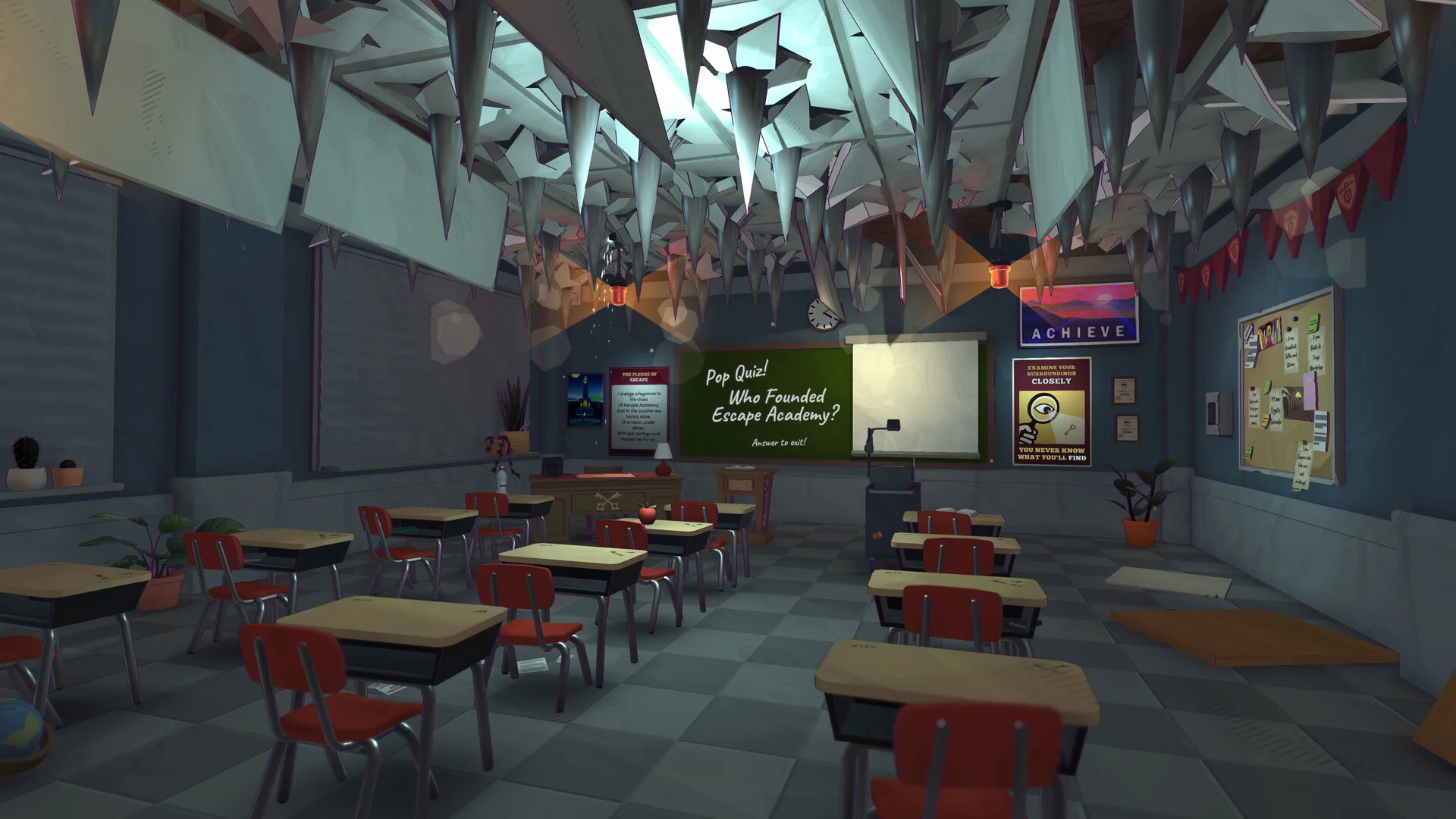
Access becomes a different question when the school’s English wordplay travels. A context-related password may arrive almost automatically for a fluent speaker who recognizes the likely expression. Someone unfamiliar with that vocabulary must first establish what the words mean before attempting the deduction.
The absence of Brazilian Portuguese subtitles in the version considered here matters particularly because language carries instructions and solutions throughout the game. This is a concrete obstacle for players who need that localization, rather than evidence that every player outside an English-speaking country will struggle equally. Familiarity with English and skill at puzzles remain separate abilities.
The support systems recognize some forms of uncertainty better than others. Highlighted NPC dialogue draws attention to useful information, and requested hints combine an image of a relevant detail with a short prompt. That can preserve the pleasure of making the final connection independently.
Yet an auditory challenge requiring sounds to be arranged by pitch exposes the weakness of a hint that merely directs the player to listen. Identifying the material to examine offers limited help when the missing understanding concerns how to organize it. The player may already be attending to exactly the right sounds.
Removing the escape-room timer gives players welcome space to work through such difficulties. Its implementation has an awkward wrinkle: asking for an extension in classic mode switches the game to casual, so classic timing needs to be restored manually.
The larger benefit remains substantial, since a player can choose to think without the clock applying pressure. For someone still decoding an unfamiliar expression or searching for the principle connecting several sounds, however, time is only one part of the problem. They can remain in the classroom longer and still need the lesson explained differently.
The Review
Escape Academy 2: Back 2 School
Escape Academy 2 turns school life into a shared enthusiasm, with student errands and subject-specific challenges giving its campus a persuasive identity. Independent exploration and cooperative clue sharing make learning feel social. Repeated locks and guessable passwords limit the examinations, while restricted co-op information and English-dependent puzzles complicate the invitation to join in. Its strongest achievement is a community expressed through play, though participating fully can demand the right vocabulary or possession of the right item.
PROS
- Student requests give campus life personality.
- Themed challenges connect school subjects with deduction.
- Independent co-op exploration and useful partner-view tools.
- Optional timers allow unhurried problem solving.
CONS
- Repeated locks and prematurely guessable word answers.
- Mandatory purchases can interrupt story progression.
- Filtered glasses can leave one partner sidelined.
- English-dependent clues create localization barriers.
- Some hints identify clues without clarifying their logic.