










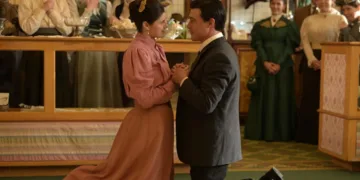

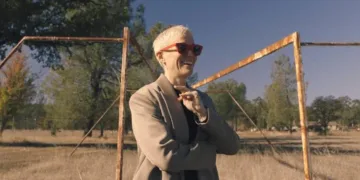





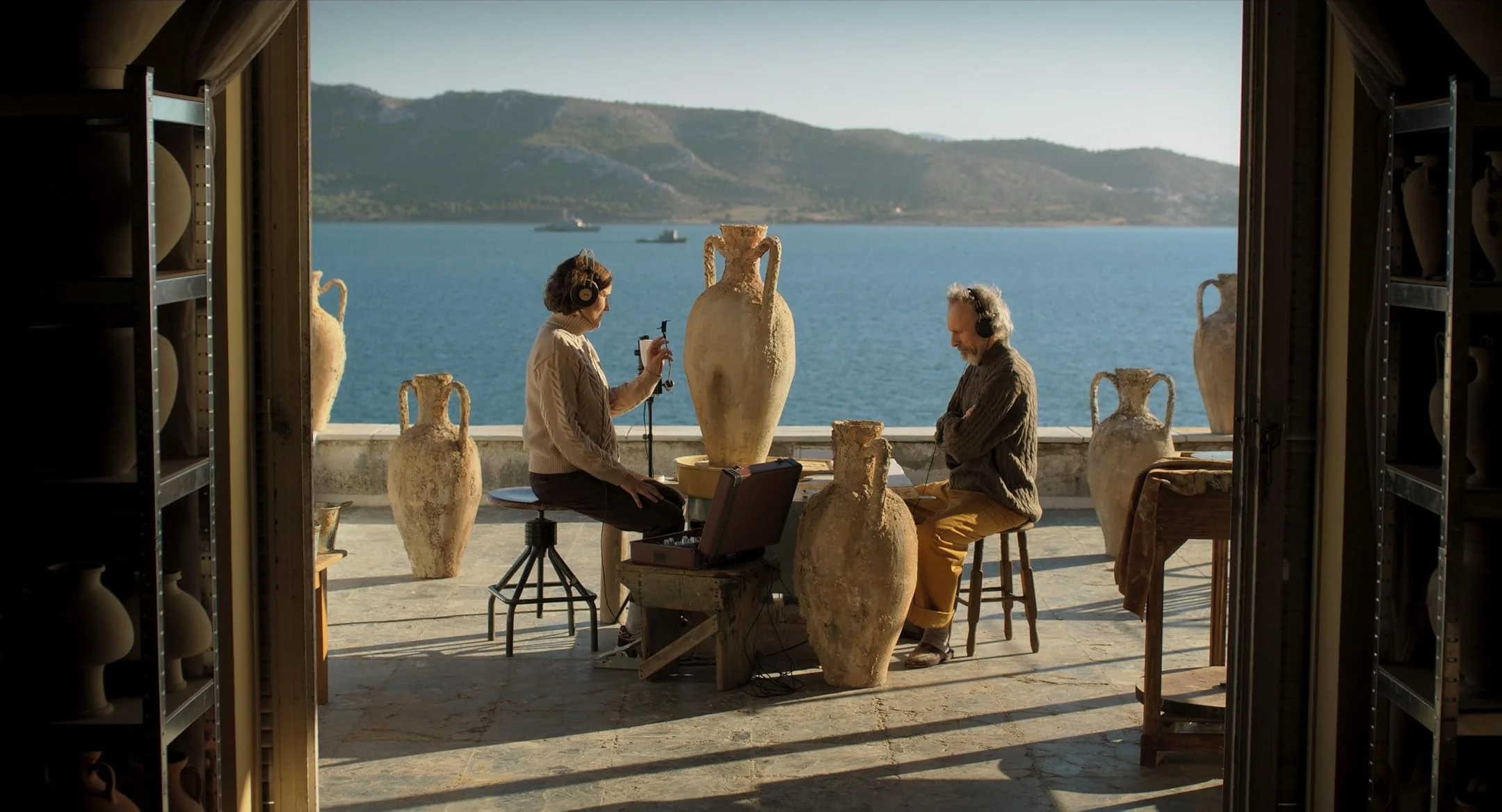

Sofia hopes the ancient world has been speaking all this time, its voices caught in clay and waiting for someone to find the right way to listen. A marine archaeologist played by Angeliki Papoulia, she believes amphorae might have retained sounds impressed upon them during their manufacture.
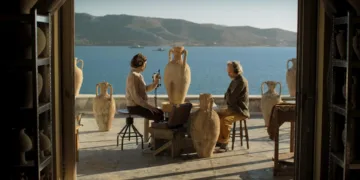
Before risking the antiquities, she needs replicas. This brings her to her former brother-in-law, a craftsman known as Potter, whose coastal home becomes a testing ground crowded with unwelcome noises. Her cockatoo screeches. Her Bluetooth vibrator buzzes. The sounds she wants to recover are separated from these irritations by millennia and the good fortune of belonging to absent people.
Among Sofia’s imagined discoveries is the laughter of Diogenes. The wish has a peculiar tenderness: a philosopher briefly restored to the involuntary life of a body, caught laughing before anyone could organize his existence into an inheritance of ideas.
Spiros Stathoulopoulos gives this longing an apparatus as ridiculous as it is suggestive. A vibrator and freshly worked pottery might permit contact with the dead. Sexual pleasure, technical curiosity, and the desire to defeat silence share the same equipment. The Megalomaniacs is most alive when its absurdity allows these impulses to coexist without requiring any of them to become respectable.
Potter has little patience for the experiment’s attendant life. Jan Bijvoet plays him with an aggrieved ferocity that makes another person’s presence seem like an injury requiring compensation. Sofia has, admittedly, arrived expecting skilled work without offering payment. Their dictionary dispute turns an accusation of freeloading into a contest over who possesses the authority to describe the arrangement.
Words become another resource to hoard. Papoulia’s insistence keeps Sofia from settling into the comforting role of misunderstood visionary; her curiosity can be heedless of the person whose hands must make it practicable. His resentment has a recognizable cause. Its expression grows monstrous.
The space around them seems almost indecently generous. Andrés Felipe Morales photographs the Mediterranean in wide compositions that leave the pair room to move and very little capacity to escape themselves. Sea and sky offer breadth while their conversation contracts around grievances.
Held together in extended frames, these people must endure the duration of the encounter, and we endure it with them. The beauty produces a peculiar isolation. An open view can become oppressive when everything within it has been reduced to the next insult, the next claim upon another person’s attention.
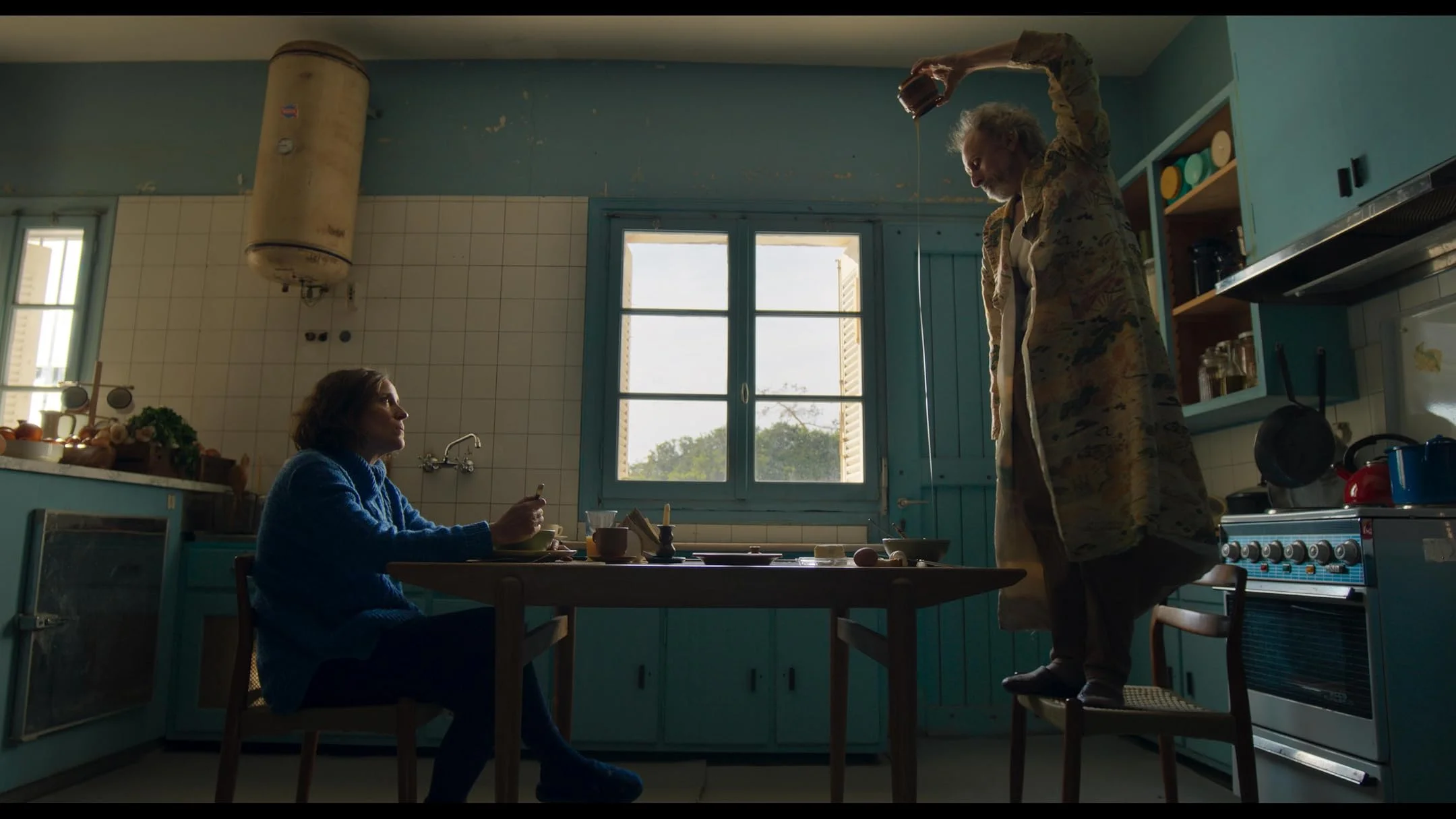
That pressure sometimes thickens into inertia. The dictionary exchange gives their hostility a precise mechanism; other quarrels renew the familiar spectacle of two people making coexistence intolerable. Spending so long inside antagonism that has already disclosed its terms becomes wearying. The shared frames preserve the comic embarrassment of being trapped with someone, yet the succession of verbal assaults gradually narrows what the actors can reveal. Bijvoet’s fury and Papoulia’s self-absorption remain forceful after the encounters begin yielding diminishing discoveries.
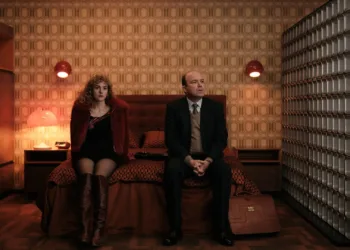
Sofia encounters a different kind of refusal in her attempt to obtain research access to Mount Athos. The film supplies an opening notice about the region’s exclusion of women, then brings the restriction into the undignified present of a phone call with a monk. Sofia is partly undressed, her vibrator buzzing nearby.
Her scientific purpose and bodily autonomy occupy the same domestic space as an authority that would exclude her body altogether. The juxtaposition is funny because the institution’s solemn prohibition must contend with a life proceeding outside its permission. Sofia’s vanity does nothing to make that exclusion reasonable.
There is a connection here to the film’s later attention to death and cremation: institutions regulate access to the past and lay claim to the body’s disposal. Yet the call supplies a sharper dramatic encounter than the larger argument develops. Sofia’s interrupted research, the household experiment, and the arrangements surrounding death sit beside one another with an intermittently frustrating looseness. Their shared concerns are legible, but the film keeps opening further disputes before it has made the earlier ones intimate. Its reach can feel strangely impersonal for a work so crowded with intrusive bodies and insistent voices.
Punky offers the simplest version of Sofia’s ambition. The cockatoo retains scraps of her speech, including her swearing, and returns them without the archaeological labor. A living creature already performs the miracle she seeks in an object.
This makes Potter’s violence toward the bird the film’s most troubling collision of sound and silence. Stathoulopoulos surrounds its aftermath with the ceremony of Potter putting on an apron and the grandeur of Mozart’s Requiem. The disparity is grotesquely funny, then difficult to inhabit. Potter attends to his own ritual while another creature’s existence becomes material for it.
The sequence exposes his self-importance with terrible clarity, but its elaborate presentation also places a limit on the sorrow it permits. Punky’s borrowed phrases have given the bird a small, audible place in the household. The kitchen ritual draws attention toward the ingenuity of the desecration, away from that particular presence.
I am less certain the scene finds a feeling adequate to the loss than that it finds a memorable arrangement for cruelty. The Requiem supplies a magnitude the relationship has scarcely been allowed to acquire. For a moment, the film’s aesthetic appetite seems uncomfortably close to Potter’s.
The eventual shift to a future museum changes the conditions of looking. Objects associated with bodily use have outlasted the people who gave them purpose; time has made them available to an attention their owners could never supervise. Sofia’s wish to recover a life from its material traces now faces the reverse prospect, a life becoming traces for someone else.
The display preserves an outline of human appetite while leaving its private sensations inaccessible. Looking at these remnants, one can imagine the care with which a future observer might study them, and the ease with which that observer might get us wrong.
The Megalomaniacs premiered at the Tallinn Black Nights Film Festival. Directed by Spiros Stathoulopoulos, the comedy-drama follows an archaeologist who travels to a remote island to test a bold theory that ancient pottery preserves recorded sounds.
Full Credits
Title: The Megalomaniacs
Distributor: Reason8 Films
Release date: November 15, 2025 (Tallinn Black Nights Film Festival)
Running time: 1 hour 54 minutes (114 minutes)
Director: Spiros Stathoulopoulos
Writers: Spiros Stathoulopoulos
Producers and Executive Producers: Konstantinos Vassilaros, Stelios Kammitsis, David Corredor, Ursula Romero Gerberding, R. Paul Miller
Cast: Angeliki Papoulia, Jan Bijvoet, Christos Passalis, Vasilis Magouliotis
Director of Photography (Cinematographer): Andrés Felipe Morales
Editors: George Cragg, Martina Zamolo
The Review
The Megalomaniacs
The Megalomaniacs gives the wish to hear the dead an absurd, bodily life, with Papoulia and Bijvoet making vanity feel almost physically abrasive. Its spacious coastal images hold an isolation the dialogue sometimes merely repeats. The quarrels wear thin, the institutional satire remains loosely attached, and the ceremony surrounding cruelty can overwhelm the loss it invokes. Yet Sofia’s longing to recover an ancient laugh retains a tenderness that the film’s elaborate provocations cannot quite extinguish.
PROS
- An inventive acoustic premise connecting bodily absurdity with mortality.
- Papoulia and Bijvoet give the competing egos force and friction.
- Expansive coastal framing makes shared space feel isolating.
CONS
- Repeated quarrels yield diminishing insight.
- Institutional satire remains loosely integrated with the central relationship.
- Elaborately staged cruelty limits the emotional weight of loss.