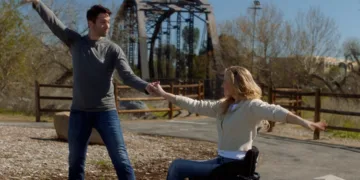
























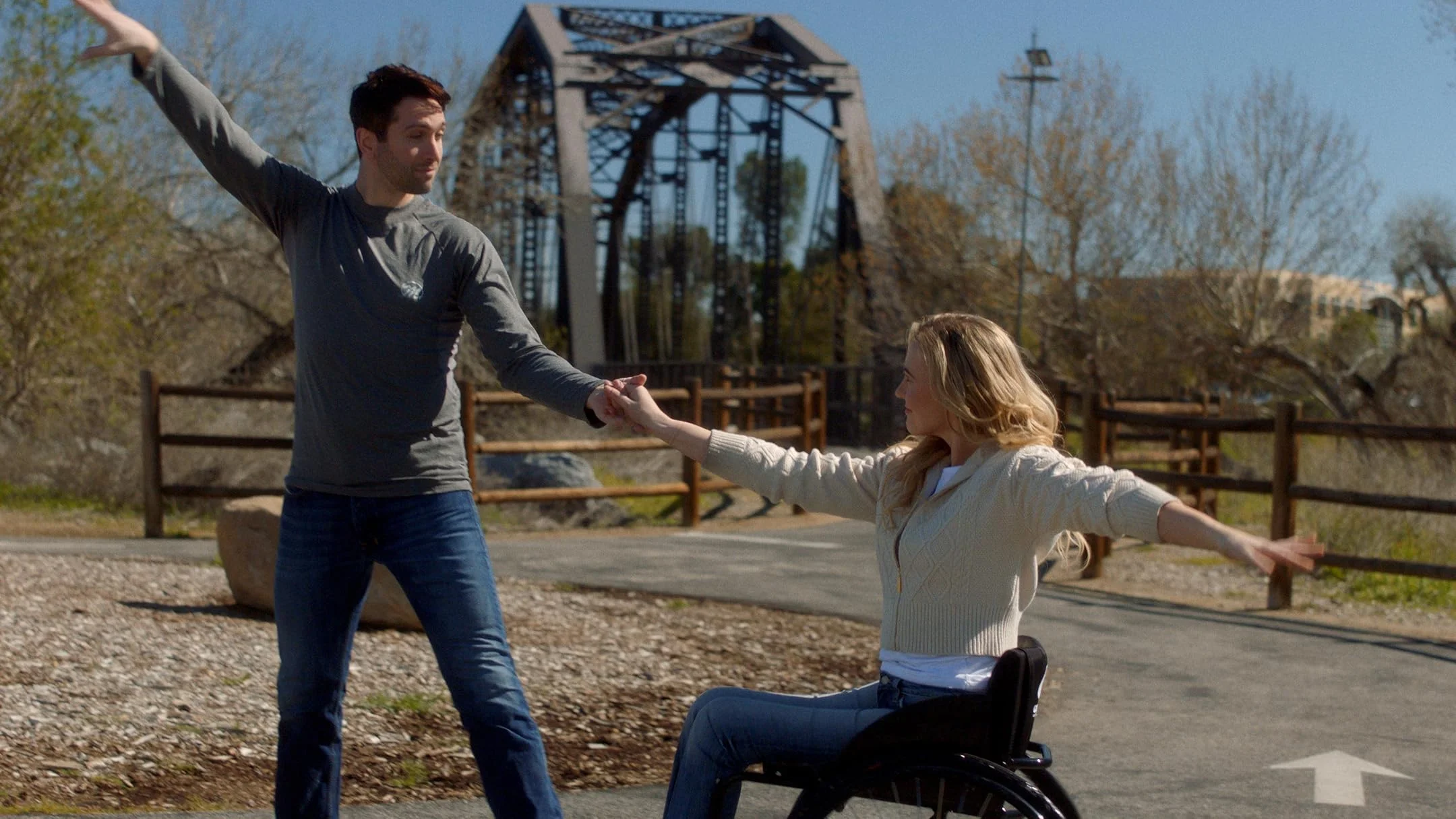

Petro introduces Violet to wheelchair ballroom dancing as an existing practice she can learn. That practical act of instruction gives Laurence Walsh’s Ballroom its strongest subject. An aspiring dancer left paraplegic after a car accident, Violet needs a way to pursue an ambition whose physical demands have changed.
Petro has knowledge she lacks, and their work together makes continuing possible. The wheelchair becomes part of her dancing. For a film organized around recovery, this is a consequential choice: the activity Violet loves can take a different form without waiting for her body to return to its previous state.
The film’s emphasis on self-acceptance sits alongside this account of assistance. Therapists help Violet adjust; Petro helps her acquire a new artistic vocabulary. Her renewed confidence develops within those relationships, giving the language of personal determination something practical to stand on.
It would be easy for encouragement to become an instruction to feel better, leaving the work of recovery entirely with the person already struggling. Ballroom gives Violet people who can contribute skills and care. Her participation still requires effort, but the film has supplied a setting in which effort has somewhere to go: back into learning dances for an audition.
Violet also wants Petro, played by Dmitry Chaplin, and a callback for an Off-Broadway musical. These desires give her emotional life a welcome untidiness. Professional ambition brings the possibility of rejection; attraction brings the possibility of disappointment. Neither can be secured through an improved relationship with herself.
When a callback rejection and a secret from Petro’s past threaten her confidence, the story places that distinction under pressure. Self-acceptance must survive encounters with people whose decisions and histories Violet cannot control. The romance matters here because it allows her to desire another person while remaining vulnerable to him. She has concerns that exceed the business of adjusting to disability.
Madeline Delp’s casting gives this romantic and artistic centrality a material dimension. Delp is a wheelchair user, and the production used a body double for Violet’s standing scenes. A disabled actress occupies the continuing role, including the character’s ambition, depression, attraction, and renewed involvement in dance.
The arrangement makes the earlier physical state the portion requiring substitution. There is no need to turn that decision into a claim that lived experience guarantees an accomplished performance. Its significance is already specific: Delp has been entrusted with the woman whose life continues after the accident, across the different kinds of experience the screenplay gives her.
Dancing has to share the film with a considerable amount of personal drama. Alongside the accident and medical adjustment, the screenplay carries Violet’s romance, her relationship with her mother Janet, played by Kate Orsini, and the audition goal. Each strand has a place in a story about rebuilding a life.
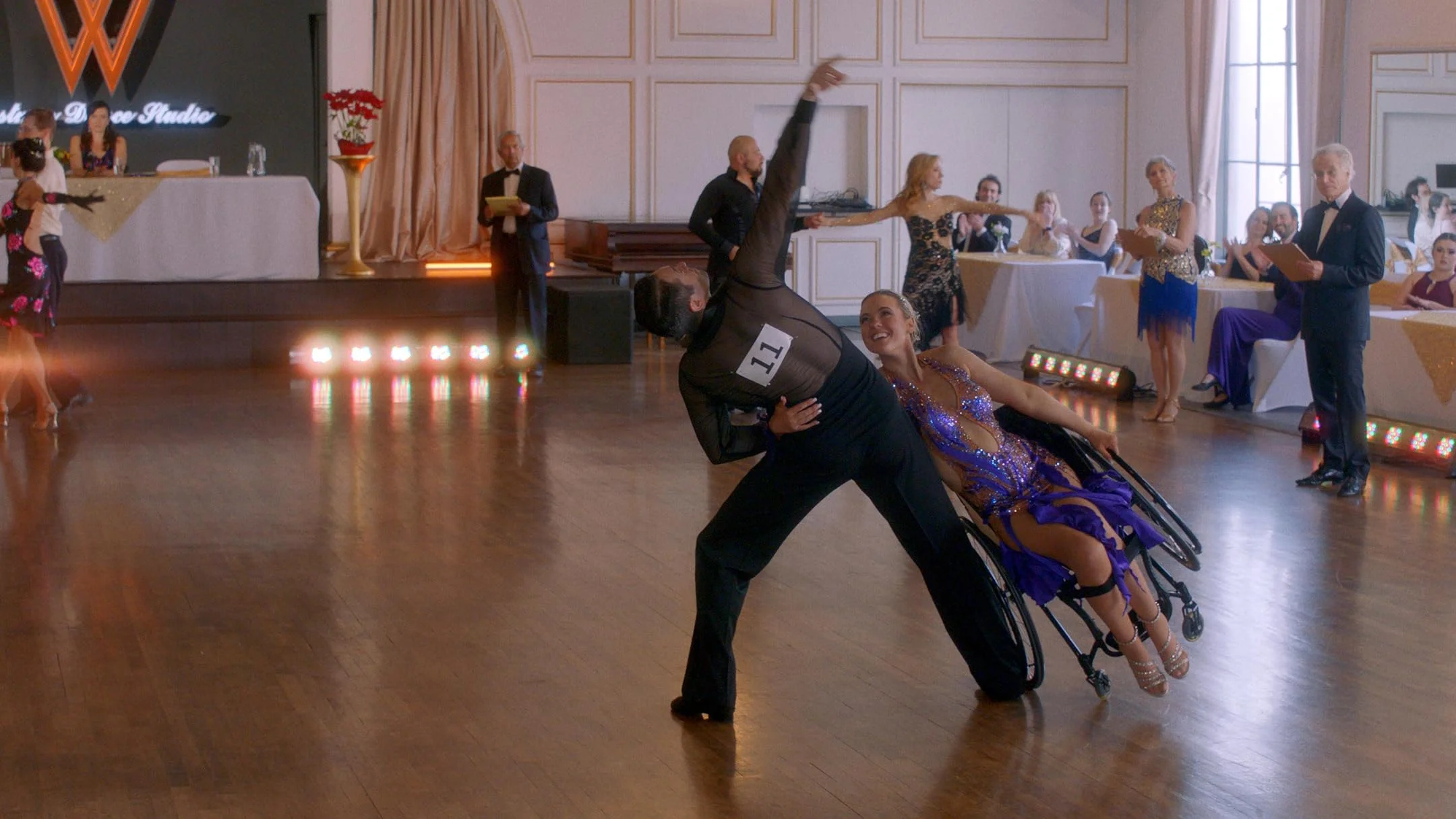
Yet dancing becomes more prominent only as the film moves toward its later stages, and the dance passages remain brief. The balance leaves a desire to spend longer with the practice that makes Violet’s ambition tangible. Family and romantic complications can explain what threatens her confidence; sustained attention to dancing could develop the activity she is trying to preserve.
The variety of the dance sequences and their occasional acrobatic elements provide pleasures that deserve that space. They give Violet’s return an aesthetic purpose, allowing the dancing to be enjoyed for its skill and physical invention. The film’s hopeful register is most persuasive when that pleasure becomes available.
Admiration for someone’s perseverance can keep the spectator occupied with the difficulty of an achievement, scarcely attending to the achievement itself. Its abbreviated passages offer a taste of that fuller engagement, then return to the personal drama surrounding it.
During the end credits, footage of real para-dancers extends the film’s attention beyond Violet. Wheelchair ballroom dancing has participants outside the screenplay, people pursuing forms of expression that the central character is only beginning to discover. The footage gives those dancers space within a film otherwise attached to one woman’s interrupted plans. After the audition anxiety and romantic uncertainty, the screen holds evidence of an artistic life being practiced by others, with Violet’s story placed beside it.
Ballroom was released on North American digital and VOD platforms by Freestyle Digital Media on September 25, 2026, and is available to stream on platforms like Amazon Prime Video and Apple TV. The emotional drama follows an aspiring dancer who, after a devastating accident forces her to use a wheelchair, finds a renewed path forward through an unexpected connection and wheelchair ballroom dancing.
Where to Watch Ballroom (2026) Online


Full Credits
Title: Ballroom
Distributor: Freestyle Digital Media
Release date: September 25, 2026
Running time: 1 hour 33 minutes (93 minutes)
Director: Laurence Walsh
Writers: Laurence Walsh
Producers and Executive Producers: William Francesco Allen, Madeline Delp, Jane Alcala, Jon Philion, Laurence Walsh
Cast: Madeline Delp, Dmitry Chaplin, Kate Orsini, Tyne Stecklein, Jamison Reeves, Mia Schaikewitz, Zuri Starks, Laurence Walsh
The Review
Ballroom
Ballroom earns its optimism through practical care and a heroine allowed professional ambition, desire, and disappointment. Casting Madeline Delp places a disabled actress within that full emotional life, while the dance sequences offer artistic pleasure. The screenplay gives dancing too little sustained attention, especially before its later stages. Its account of adaptation gives hope a concrete basis in instruction, partnership, and an art form that already exists.
PROS
- Violet has romantic and artistic desires beyond recovery.
- Practical support gives self-acceptance substance.
- Delp’s casting places a disabled actress in the central romantic role.
- Varied choreography and real para-dancer footage celebrate an existing practice.
CONS
- Dancing gains prominence late.
- Brief dance passages limit engagement with the choreography.