




























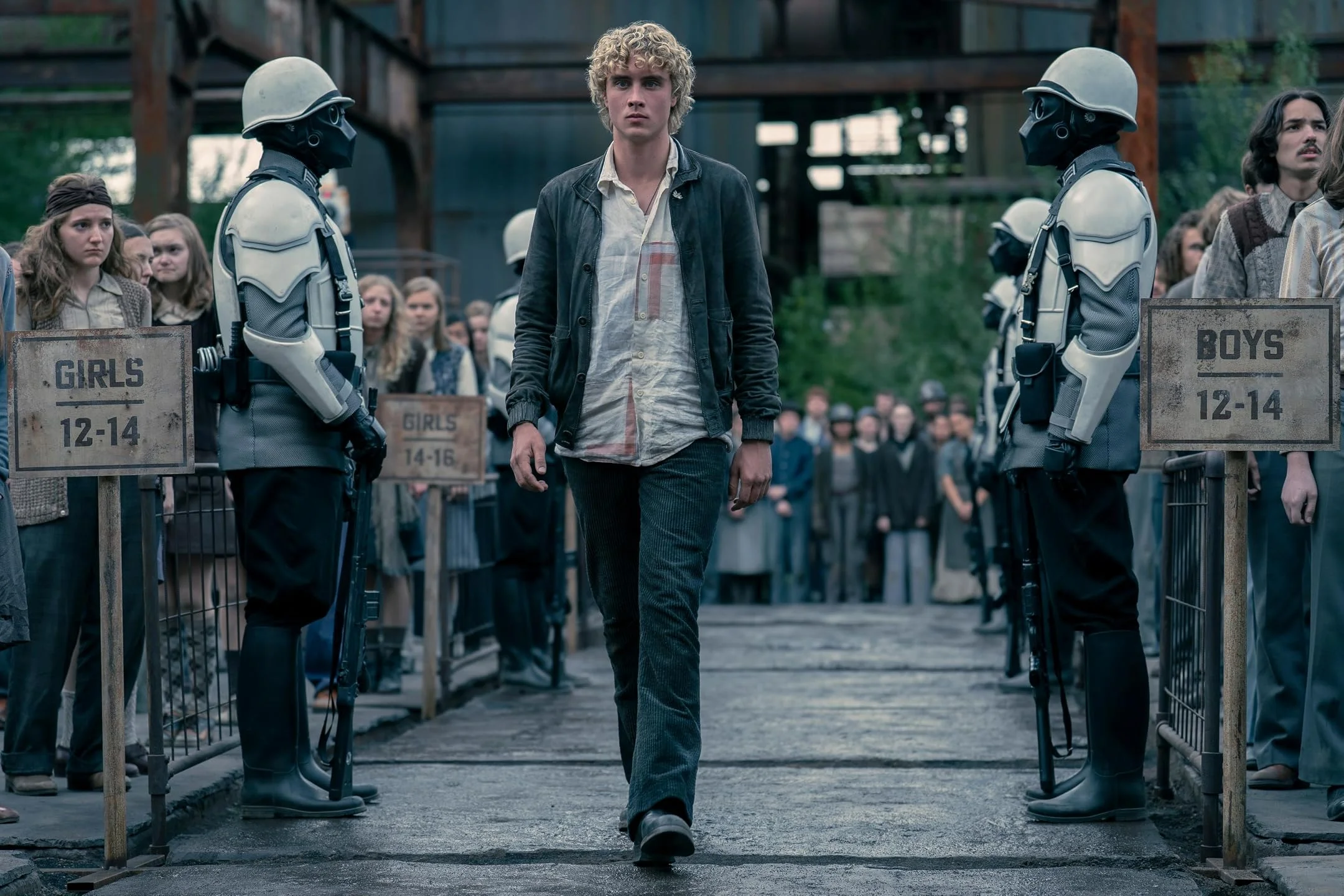
When a boy runs from the reaping in District 12, the Peacekeepers shoot him and the lottery acquires a vacancy. Haymitch Abernathy gets into the ensuing scuffle and is put in the boy’s place. It’s his sixteenth birthday. The Capitol has already doubled the number of children it will take for the fiftieth Hunger Games, a special edition called the Second Quarter Quell. Forty-eight children from twelve districts will go into the arena. The public draw is supposed to give every family the same reason to fear it. In a matter of minutes, the authorities demonstrate that they can make the rules personal.
Then Plutarch Heavensbee gets to work on the farewells. He calls for fresh takes as the tributes are separated from their families, a job that requires a producer’s eye for grief and a producer’s impatience with the people feeling it. Francis Lawrence’s The Hunger Games: Sunrise on the Reaping follows that work past the reaping.
When tragedy strikes at the tribute parade, Haymitch stares down President Snow in front of a crowd. The broadcast omits the look. The people at the parade have seen a boy look at the president with open contempt, and they know they saw it together. The edit denies the districts a shared image of what it looks like to defy Snow in public.
Jesse Plemons gives Plutarch an even voice and a steady gaze that come in handy when he recruits Haymitch to sabotage the arena. He can sound like the first adult to take the boy’s anger seriously. He can also afford to talk calmly about what will happen once the boy is inside. There’s a case for trusting him. His position gives the resistance access it needs. Plemons leaves the danger of that offer in plain view. A man with a place in the control room can ask someone in the arena to wager his life, and mean every word he says about the cause.
The Capitol sells Haymitch as a rascal, an agreeable part for a boy whose anger has already embarrassed Snow. Joseph Zada gives the Capitol’s new television personality a life away from the cameras. His promise to see Lenore Dove (Whitney Peak) after the reaping carries the ordinary confidence of a boy who expects to keep his plans.
Later he cries just before entering the arena. Between those moments, he still finds it in himself to reassure Louella (Molly McCann), the youngest of his district’s tributes. Panem has an appetite for bold teenagers once their boldness can be packaged. A teenager who feels responsible for another child is harder to accommodate in a game with one survivor.
Haymitch and Maysilee Donner (Mckenna Grace) have every reason to expect the worst of each other after their history at home. The Capitol escort Drusilla Sickle reaches for a riding crop when Maysilee talks back, treating a girl’s refusal to show deference as a breach of discipline. Grace carries the girl’s steeliness into the alliance with Haymitch, where it becomes something he can depend on. Living alongside him gives Maysilee a chance to reconsider the boy she thought she knew. The arena’s rules make such ordinary revisions of opinion a costly business.
Uli Hanisch makes the arena look ready for visitors. There are immaculate alpine slopes, bright flowers and butterflies that can deliver an electrical shock. The chambers and corridors beneath the hillsides bring the arena’s artifice into focus. Somebody has arranged the view and can intervene whenever the show demands it.
There is pleasure in looking at the arena, even after its purpose is clear. Lawrence gets furthest from the Capitol’s idea of a good show during a late fight on a hill. Both combatants are so tired that climbing becomes an ordeal in itself. The gasps and stumbles give the fight a rhythm set by what two bodies can still manage.
Back in District 12, the film has a boy who scarcely knows how to live at home. He withdraws and begins to drink heavily. Twenty-four years later, in the story the franchise has already told, Woody Harrelson’s Haymitch is the heavy-drinking man assigned to mentor Katniss Everdeen.
Knowing that destination makes the early tenderness hurt and leaves Lawrence with a difficult stretch of time to dramatize. Zada has shown how naturally this boy could reassure a frightened child. There’s a whole private history between that boy and the man the Capitol still expects to look after the children it’s about to send into the arena.
The later reunion has its own emotional force. The familiarity of the faces gives the intervening years a scale a title card could hardly supply. The scene puts that recognition to work chiefly as reassurance, a chance to see Haymitch among people an audience already knows how to care about. Back in District 12, where the story still belongs to Zada, the film hurries through the part of Haymitch’s life in which it takes an effort just to get through a day.
The Hunger Games: Sunrise on the Reaping premiered in London on October 28, 2026, before its wide theatrical release by Lionsgate on November 20, 2026. Directed by Francis Lawrence, the dystopian sci-fi action film takes viewers back to Panem for the infamous 50th Hunger Games, also known as the Second Quarter Quell.
Where to Watch The Hunger Games: Sunrise on the Reaping (2026) Online
Full Credits
Title: The Hunger Games: Sunrise on the Reaping
Distributor: Lionsgate
Release date: October 28, 2026 (London premiere), November 20, 2026 (United States)
Rating: PG-13
Running time: 2 hours 38 minutes (158 minutes)
Director: Francis Lawrence
Writers: Billy Ray, Michael Lesslie, Suzanne Collins
Producers and Executive Producers: Nina Jacobson, Brad Simpson, Francis Lawrence
Cast: Joseph Zada, Jesse Plemons, Ralph Fiennes, Glenn Close, Ben Wang, Kieran Culkin, Elle Fanning, Mckenna Grace, Maya Hawke, Whitney Peak, Kelvin Harrison Jr., Jennifer Lawrence
Director of Photography (Cinematographer): Jo Willems
Editors: Mark Yoshikawa
Composer: James Newton Howard
The Review
The Hunger Games Sunrise on the Reaping
A boy the Capitol can sell as a rascal still knows how to reassure a frightened child. Joseph Zada makes that ordinary kindness matter in a game that treats it as a liability. Francis Lawrence is sharp about what the Capitol cuts from its broadcast, especially when a crowd sees Haymitch look at Snow with contempt. The film gives two exhausted tributes time to drag themselves uphill. It gives Haymitch far less time to get through a day at home.
PROS
- The parade edit makes censorship tangible.
- Zada gives Haymitch tenderness away from the cameras.
- Plemons makes Plutarch’s offer sound sincere and dangerous.
- The alpine arena draws the eye, and the uphill fight makes exhaustion felt.
CONS
- Haymitch’s return to District 12 gets too little time.
- The reunion leans heavily on the comfort of familiar faces.