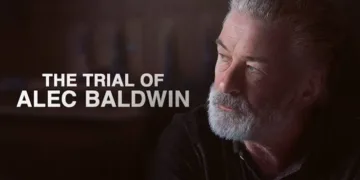




















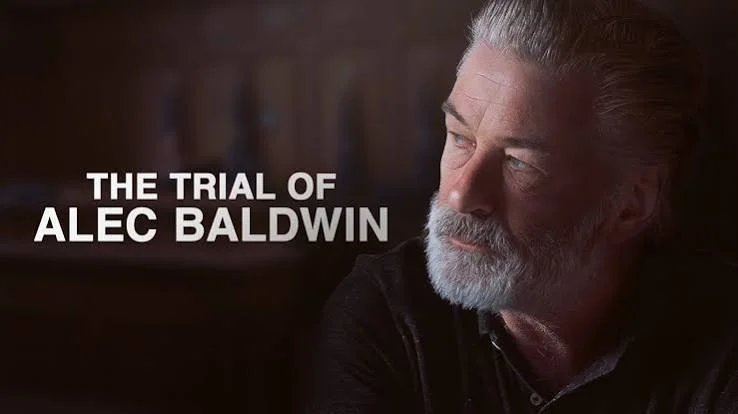

Baldwin speaks of his acting career as though the pleasure has been drained from it, leaving the work and the obligation to continue. Rory Kennedy’s camera stays close enough to make that depletion uncomfortable. In the dimmer interviews, his face seems to recede into the expensive rooms around him; from the passenger seat of a car, the proximity feels cramped rather than privileged. His accounts of sleeplessness have a weary intimacy. Here is a man accustomed to holding an audience who appears to find little comfort in having one, yet keeps trying to explain himself to it.
Hilaria’s presence gives these encounters a different emotional temperature. Filmed in brighter, more composed circumstances, she offers the steadiness his own account struggles to find. Her support matters because Baldwin’s statements about unhappiness can otherwise become sealed rooms, places where every subject returns him to his own desolation. Their warmth permits a glimpse of life continuing through care, through someone else’s insistence that he remain attached to it. I cannot know how much the camera changes these exchanges. The tenderness is still perceptible, and dismissing it as publicity would be its own refusal to look.
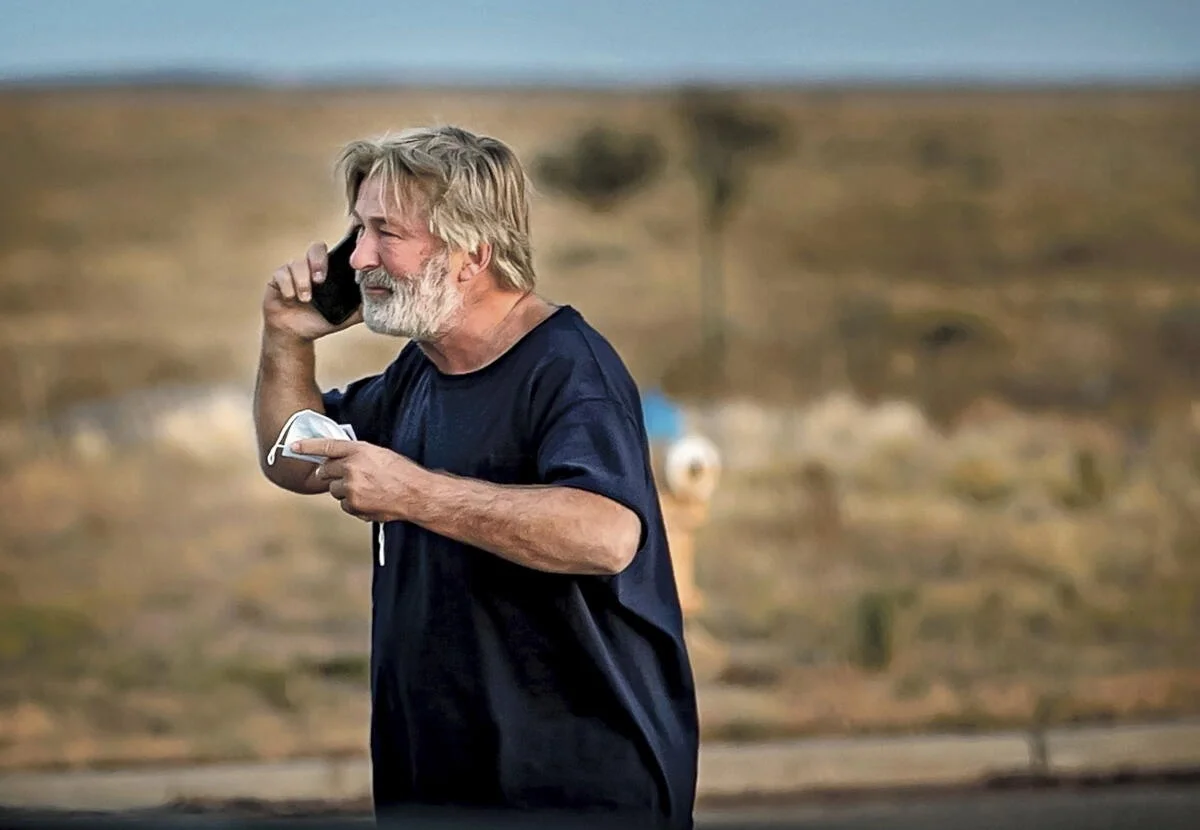
Kennedy began following Baldwin in 2023, after criminal charges were filed over the October 2021 shooting on the set of Rust. A revolver he was holding discharged a live round, killing cinematographer Halyna Hutchins and injuring director Joel Souza. The Trial of Alec Baldwin accompanies him through the uncertainty in New York, the completion of the production in Montana, and the proceedings in New Mexico. He describes finishing the film as something undertaken for Hutchins’ son. Acting, emptied of the satisfaction he once sought from it, persists as an obligation tied to the death of a colleague.
An opening disclaimer specifies that Baldwin supplied no financing, received no compensation, and had no editorial control. Those are useful distinctions, though they cannot determine the emotional direction of a film. Kennedy gives his exhaustion sustained attention, while his wish to be understood repeatedly governs the conversation. The difficulty lies in what that wish can absorb. Pain may be entirely credible and still occupy so much space that other people’s experience becomes hard to reach. The close camera records his distress; his explanations keep directing us toward his reputation.
The biographical passages offer several kinds of understanding, with uneven returns. His sister Elizabeth supplies the economically strained childhood and the route toward acting. Career clips restore the familiar assurance of the accomplished performer, while press encounters and confrontations with paparazzi collect the history of his anger. Ireland’s discussion of the abusive voicemail and patterns of hurt within the family is especially valuable. She gives the anger an intimate consequence, someone who has had to live with it after the public stopped listening. Her contribution makes the past feel inhabited rather than merely documented.
Elsewhere, the accumulation begins to stall. Success, hostility, exposure, explanation: the career and media material repeatedly brings Baldwin back to the same wounded relationship with being seen. His distinction between sadness and guilt in the George Stephanopoulos interview belongs to this history, but returning to his public reception does little to deepen the film’s inquiry into Hutchins’ death. The middle stretches feel long because so much evidence performs the same task. A life with decades of incident gradually narrows into a grievance with many illustrations.
Hutchins receives nothing approaching this density of attention. We learn little about the work through which she understood herself, or the particular qualities that made her a colleague worth remembering. During much of the second half, even her name and image recede. That absence changes the meaning of Kennedy’s intimacy with Baldwin. We have been brought close enough to notice the fatigue in his face, yet remain at a considerable distance from the person whose death has reorganized his life. Her loss becomes legible chiefly through its consequences for him.
A documentary about a defendant can legitimately concentrate on the defendant. Here, however, the extended family history and career account give Baldwin a fullness that the treatment of Hutchins cannot answer. The imbalance leaves his suffering without enough human counterweight. It also limits the production-safety inquiry: the film provides little sustained examination of the working conditions and responsibilities surrounding the shooting. Compassion for Baldwin need not settle those questions, but Kennedy’s concentration on his ordeal allows them to drift behind the portrait.
The courtroom passage, occupying roughly the final half-hour of this 111-minute film, changes the quality of attention. Evidence withheld from the defense becomes decisive during proceedings that last three days. When prosecutor Kari T. Morrissey takes the witness stand and faces defense questioning, the documentary acquires a forward pressure its retrospective passages often lack. Statements have immediate consequences. The case can change while people are still in the room, and the camera has something to follow beyond Baldwin’s account of what has happened to him.
His small facial reactions carry particular weight here. Their relative brevity leaves room for the viewer to attend to uncertainty without another explanation arriving to organize it. These glimpses cannot disclose his entire inner life, but they allow his distress to exist alongside events independent of his narration. The withheld evidence gives the criticism of the prosecution a concrete basis; claims of political targeting remain interpretations. Dismissal with prejudice ends the criminal case without supplying a complete reconstruction of the shooting or answering every question about responsibility on the production.
The relief surrounding dismissal has an understandable human force, and Kennedy grants it the weight of an ending. The closing attention remains with Baldwin’s release from the threat of punishment. There is little return to Hutchins’ career, to the images she helped create, or to the person her colleagues knew before a live round made her name inseparable from this case.
The Trial of Alec Baldwin premiered at DOC NYC in November 2025 before receiving a limited theatrical release in the United States by Abramorama on October 1, 2026. Directed by Rory Kennedy, the documentary examines the legal proceedings, media scrutiny, and public fallout surrounding actor Alec Baldwin in the aftermath of the fatal shooting on the set of the Western film Rust.
Where to Watch The Trial of Alec Baldwin (2026) Online
Full Credits
Title: The Trial of Alec Baldwin
Distributor: Abramorama
Release date: November 13, 2025 (DOC NYC), October 1, 2026 (Limited theatrical release)
Running time: 1 hour 51 minutes (111 minutes)
Director: Rory Kennedy
Writers: Mark Bailey, Julia Marchesi
Producers and Executive Producers: Rory Kennedy, Mark Bailey, Julia Marchesi, Jared Underwood, Andrew C. Robinson, Colin Marshall, Todd Thompson, Rita Powers, Tanner Cusumano, Rob Guillermo, Ray Maiello, Louis Krubich, Dan Fried, Jawad Metni
Cast: Alec Baldwin
Director of Photography (Cinematographer): Jenna Rosher
Editors: Jawad Metni
Composer: Gary Lionelli
The Review
The Trial of Alec Baldwin
Kennedy records Baldwin’s exhaustion with an intimacy that can be painful to inhabit, and the courtroom passages give his smallest reactions room to speak. Yet the extended account of his reputation repeatedly circles familiar grievances, while Hutchins remains difficult to know beyond her death. The film earns compassion for the man it follows, but its limited attention to her life and the production’s working conditions leaves that compassion carrying too much of the inquiry.
PROS
- Intimate footage makes Baldwin’s exhaustion tangible.
- Ireland’s testimony gives his anger personal consequences.
- Courtroom observation brings tension and revealing reactions.
CONS
- Hutchins’ life and work receive little sustained attention.
- Repetitive biography slows the middle passages.
- Production safety and responsibility remain underexamined.