












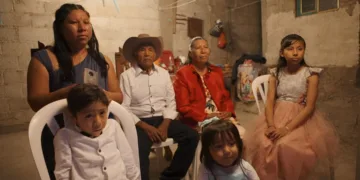













When a grandfather trims Mitra’s fringe, Khadim Dai’s camera attends to a small obligation being fulfilled. Someone needs a haircut; someone else knows how to give it. Such exchanges establish the human scale of Hazara Town, a documentary filmed among Dai’s displaced relatives in Quetta, Pakistan. His attention to domestic work grants its subjects competence before asking us to consider their vulnerability. Sedeqa carries a tray of glowing coals through the house during her morning cleaning. The camera records people maintaining a home they may soon have to leave.
The house’s architecture shapes that uncertainty. Its courtyard and few outward-facing windows turn family life inward, making the interior a protected field of activity. Dai’s access allows us to see what this enclosure shelters: grooming, reading, conversation, the repeated tasks through which people remain responsible for one another.
Yet the restricted outlook also makes security feel geographically small. The camera can move close to these lives because the family has admitted it. The world outside offers no comparable assurance. Domestic intimacy acquires a political dimension through the limited space in which it can safely exist.
Sedeqa lives here with her daughters, Machid and Mitra, and the girls’ grandparents. Her husband Hussain, Dai’s brother, is in Canada, hoping to bring his family there. Having fled persecution in Afghanistan, they remain targets of ethnic and religious violence as Hazaras in Pakistan while their asylum applications proceed at a pace indifferent to childhood. Mitra barely remembers her father’s presence at home. This is the film’s most exact measure of delay: a relationship has to be sustained with someone whose daily company a daughter can scarcely recall.
Machid’s attachment to Judy Blume and her ambition to study in the United States give the household’s future a less uniform shape. She has her own idea of where opportunity lies, while Canada occupies the family’s shared horizon. Dai’s affectionate observation leaves room for that difference.
Reading becomes an activity with consequences for how she imagines her life, without requiring each book to serve as an emblem of liberation. The imposition of gender segregation at the girls’ school sharpens the stakes. Their intellectual lives are developing inside circumstances that keep narrowing the places available to them.
Outside the house, Dai repeatedly visits the cemetery. The film keeps killings offscreen, registering the rising death toll in intermittent numbers while the burial ground supplies the physical evidence of loss. Portraits give the dead faces, then disappear from their places of display.

By recording those likenesses, Dai preserves something that the memorial site itself does not retain indefinitely. There is an uncomfortable difference between documenting a grave and recording a person’s gradual disappearance from public view. His camera attends to both, without pretending either can tell us everything about the life that ended.
The sound design makes this space especially difficult to treat as a finished monument. Wind moves through it; stonemasons keep tapping at grave markers. Their work gives the death counts a continuing, material consequence. Burial requires labor, and the labor continues.
Children’s voices occupy the same acoustic space as they play, dance, and sing among the graves. The cemetery accommodates social life because the living have so few secure places to gather. That proximity prevents the children from becoming convenient evidence that grief has been overcome. They are spending time where the community’s losses remain visible.
The white markers and fluttering flags are beautiful, and Dai’s compositions invite sustained looking. Beauty here carries a risk: the spectator might settle into melancholy and mistake that feeling for understanding. The tapping resists such repose. There are still markers to make.
The children complicate it further, bringing ordinary distraction into a place the distant viewer might prefer to keep solemn. Dai’s images allow the cemetery several uses at once, preserving the community’s right to inhabit it without obeying an outsider’s expectations of mourning.
Back at home, phone and video calls give absence a face and a voice. Hussain describes Canadian weather and cultural differences with an encouraging brightness, offering his family glimpses of a life that remains elsewhere. These exchanges convey affection, but their repetition also exposes the limits of contact.
Mitra can speak to her father without recovering the years when he was missing from the household. The screen supplies an image of presence while everyday responsibilities continue to fall to the people physically there. Dai keeps the calls attached to those relationships, where reassurance and longing can occupy the same conversation.
The film is less assured in orienting us across its extended chronology. Relationships and the connections between some topics can take time to become clear, producing occasional uncertainty about how the family’s circumstances have changed. That difficulty is distinct from the suspension imposed by asylum proceedings.
One belongs to the subjects’ situation; the other asks the viewer to reconstruct information. The intimacy partly explains the problem: a family record can assume knowledge a stranger lacks. It remains a limitation, especially when the emotional significance of a development depends on understanding who has been waiting for whom.
Departures make the consequences legible in spatial terms. Dai leaves, the grandparents leave, and Machid’s American university scholarship opens a route different from the Canadian future the household has imagined together. Hussain’s return after obtaining permanent residence allows a reunion whose warmth has been earned through years of remote conversation. Yet being together again cannot restore the time Mitra has already spent growing up without him. Each new possibility changes the arrangement of care inside the house, including who will be there to receive the next call.
Dai films departures through the taxi’s rear window, placing the camera with the person whose life is about to move elsewhere. Water thrown against the glass for good luck briefly distorts the view of relatives remaining behind. The gesture reaches after the traveler, but the camera continues with the car. Its position gives the person leaving a view of the separation already taking place. Through the wet glass, relatives who have gathered to wish the traveler safety grow smaller as the taxi pulls away.
Hazara Town premiered at the International Documentary Film Festival Amsterdam in November 2026. Directed by Khadim Dai, the documentary follows a Hazara family living in Pakistan twenty years after fleeing Afghanistan, facing the agonizing choice of whether to stay together or scatter across the world in search of safety.
Full Credits
Title: Hazara Town
Distributor: Filmotor
Release date: November 14, 2026 (IDFA Premiere)
Running time: 1 hour 43 minutes (103 minutes)
Director: Khadim Dai
Writers: Khadim Dai
Producers and Executive Producers: Ilyas Yourish, Graeme Isaac, Anke Petersen, Khadim Dai
Cast: Bibi Hawa, Ramzan Ali, Sedeqa Nasiri, Hussain Nasiri, Machid Nasiri, Mitra Nasiri, Khatima Ahmadi
Director of Photography (Cinematographer): Khadim Dai
Editors: Joëlle Alexis
The Review
Hazara Town
Dai’s strongest ethical decisions are also his strongest cinematic ones: keeping attacks offscreen, letting grave-making remain audible, placing the departing passenger’s camera opposite the family left behind. Hazara Town preserves the practical care and individual ambitions that persecution threatens to reduce to anonymous suffering. Its chronology and family connections occasionally need clearer articulation, but its images understand the cost of separation with painful precision. Safety can become attainable while daily life together slips out of reach.
PROS
- Intimate domestic observation preserves individual personalities.
- Framing makes protection and separation spatially tangible.
- Cemetery sound design gives loss a continuing physical presence.
- Departures convey the emotional cost of reaching safety.
CONS
- Chronology occasionally becomes difficult to track.
- Family relationships can be slow to clarify.