






















Classical film noir made fugitives of its protagonists and accomplices of its shadows. The darkened city offered the possibility of concealment, even as its architecture suggested imprisonment. Mariko Minoguchi achieves something comparable in The Other Side through the almost indecent openness of the Alpine landscape.
Cinematographer Felix Pflieger photographs snow-covered peaks rising above immense banks of cloud, producing images of geographical freedom in a film concerned with its systematic denial. A mountain range can accommodate an extraordinary number of people. The society depicted here has decided that certain individuals should have no place within it.
Among those excluded is Hanna (Nina Hoss), a doctor who survived a devastating viral epidemic that claimed the lives of her husband and son. Still infected, she lives in the wilderness of southern Germany, avoiding settlements and the authorities responsible for rounding up people like her. The government confines infected citizens to camps where exposure to further mutations makes survival increasingly unlikely. Hanna understands the medical reasons for keeping her distance from other people. She has considerably less faith in the institutions enforcing that separation.
Minoguchi’s second feature is an accomplished and deeply unsettling piece of filmmaking, worth seeking out for the precision of its visual storytelling and a performance from Hoss that makes every physical inconvenience register. Its speculative politics occasionally lack definition, and the narrative loses some of its peculiar intensity as it becomes a fugitive thriller. Yet the early passages possess a remarkable confidence. Minoguchi can sustain tension through the preparation of an evening meal.
Hanna hunts rabbits, chops wood and makes do with meager provisions. An encounter with hunters and their dogs leaves her with a substantial wound in her leg, which she must treat herself in her woodland shelter. Hoss approaches the procedure with the concentration of a medical professional performing a necessary task under appalling conditions. There is precious little room for self-pity in her performance. Her deteriorating winter jacket, patched with duct tape, provides a fairly accurate assessment of her circumstances.
The makeup work deserves particular attention for its contribution to the film’s moral atmosphere. Scabs, rashes and festering wounds are immediately legible as signs of illness. Through Pflieger’s expressive close-ups, Hoss remains an intensely readable human presence beneath these physical alterations. The camera affords Hanna a degree of scrutiny that the people she encounters are unwilling to grant her. They see the symptoms and reach their decisions. Minoguchi gives us the uncomfortable privilege of examining the person who must live with those symptoms, including the less sympathetic aspects of her conduct.
Consider Hanna’s decision to kill a dog after it comes into contact with her infected blood. The act is disturbing precisely because her medical expertise gives it a conceivable justification. Hoss has established enough practical competence by this point that her judgment commands respect, even when its consequences are difficult to stomach. A conventional thriller might reserve such an incident for the revelation of a character’s ruthlessness. Here, it belongs to the daily business of preventing further infection.
Minoguchi finds a particularly nasty strain of humor in an encounter with an injured skier who hesitates to accept assistance from an infected doctor. Apparently, freezing to death has certain hygienic advantages. Hanna summons help, exposing herself to recognition and surrendering the relative security of her hiding place.
The film’s acoustic restraint contributes considerably to the anxiety of these episodes. With dialogue and musical accompaniment kept to a minimum, barking dogs and the sounds of approaching people acquire disproportionate significance. The howling wind and battering rain complicate the apparent serenity of Pflieger’s compositions. Even the intermittent radio broadcasts intrude upon this precarious existence, supplying infection statistics and reports of returning normality in a country where Hanna cannot safely approach a village.
The most affecting sequence takes place at a remote mountain farm inhabited by an elderly woman, played by Barbara Petritsch. Having lost her family, the woman offers Hanna a shower, fresh bedding and a meal. She regards the possibility of infection as a comparatively minor hazard beside the everyday danger posed by a staircase at her age.
Pflieger’s use of candlelight during their dinner is perhaps the film’s most eloquent visual decision. After so much exposure to the cold expanses of the mountains, the restricted illumination of a domestic interior permits a different kind of intimacy. The two women occupy a space where physical proximity is freely negotiated.
The older woman has assessed the danger herself, and the warmth of the image acquires an ethical significance through that exercise of personal judgment. There is considerable tenderness in seeing Hoss relinquish some of Hanna’s formidable reserve as the two discuss their losses. Minoguchi has spent sufficient time establishing the physical conditions of Hanna’s isolation that an embrace carries an emotional charge quite out of proportion to its simplicity.
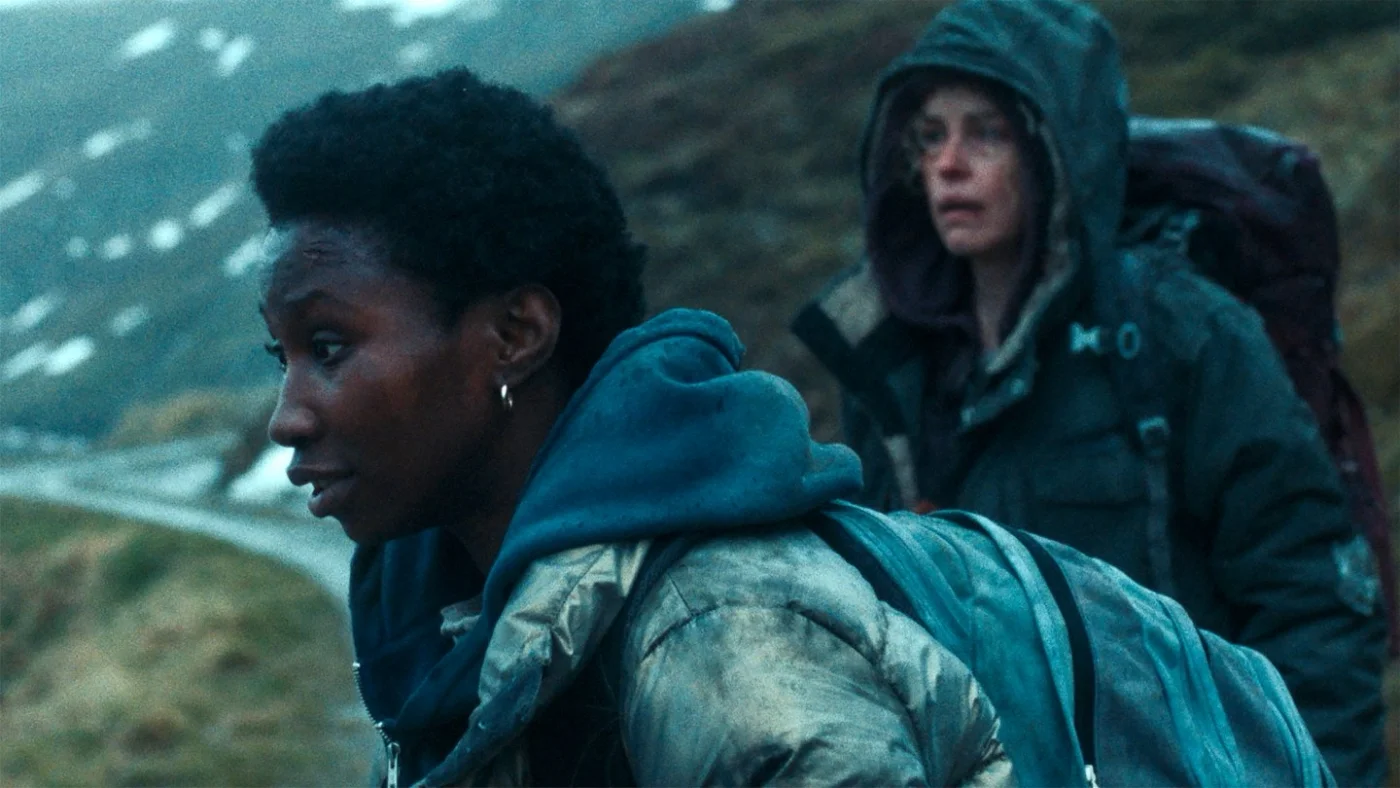
The narrative acquires a different rhythm when Hanna reaches an encampment of displaced survivors near the Italian border. Among them is Lila (Precious Mariam Sanusi), a heavily pregnant young woman who once taught Hanna’s son at kindergarten. Their attempt to reach Italy gives the film a definite geographical objective and introduces an obligation that Hanna cannot discharge through isolation. Pregnancy brings its own timetable. The painstaking routines that previously governed Hanna’s survival must now accommodate another person’s physical limitations.
There are recognizable echoes of The Road in this development, particularly in the responsibility of protecting vulnerable life amid the deterioration of social order. Minoguchi retains the distinctive element of medical suspicion, though the transition into a recognizable escape narrative sacrifices some of the earlier material’s tension. The uncertainty surrounding a stranger’s intentions, so effective in the woodland encounters, increasingly gives way to the identifiable danger of armed persecution.
The detention camps and the proposed Alpine crossing carry obvious political associations with European refugee movements. In a German film, the state-sanctioned internment of an unwanted population also acquires a particularly uncomfortable historical significance. The threat of further infection inside the camps makes the official policy of containing the disease potentially fatal to the people subjected to it.
The withholding of information initially works because our understanding of the epidemic develops through observation of Hanna’s behavior. Once the narrative extends its interests to collective persecution, that restricted perspective leaves important questions about institutional responsibility underdeveloped. The radio reports suggest a society recovering some degree of stability, yet the film offers little opportunity to examine the ordinary citizens participating in that recovery and accepting the continued exclusion of the infected.
The proposed crossing into Italy raises a problem that the camera’s allegiance to Hanna can only partially address. The hope of a safer existence rests upon reaching a territory where the authorities apparently exercise a different judgment about the same diseased body. It is a fascinating political proposition, deserving of something approaching the attention Minoguchi lavishes on those few minutes of candlelight at the farmhouse.
The Other Side (Die andere Seite) had its festival premiere at Filmfest Hamburg on September 27, 2026, before opening in German cinemas on October 22, 2026, via X Verleih, with an Austrian theatrical release scheduled through Filmladen on November 27, 2026. Written and directed by Mariko Minoguchi and starring Nina Hoss, the drama-thriller follows a former doctor living in alpine isolation after losing her family to a contagious illness who teams up with another outcast to cross the Alps toward the south.
Full Credits
Title: The Other Side (Die andere Seite)
Distributor: X Verleih (Germany), Filmladen (Austria), Beta Cinema (World Sales)
Release date: September 27, 2026 (Filmfest Hamburg premiere), October 22, 2026 (Germany theatrical release), November 27, 2026 (Austria theatrical release)
Running time: 1 hour 45 minutes (105 minutes)
Director: Mariko Minoguchi
Writers: Mariko Minoguchi
Producers and Executive Producers: Josefine Trini Götze, David Armati Lechner, Constanze Schumann, Thomas W. Kiennast
Cast: Nina Hoss, Precious Mariam Sanusi, Barbara Petritsch, Mohamed Achour, Johannes Nussbaum, Therese Affolter, Helmuth A. Häusler
Director of Photography (Cinematographer): Felix Pflieger
Editors: Monika Willi
Composer: Yu-Chun Huang
The Review
The Other Side
The Other Side finds an unsettling visual language for institutional fear, transforming the apparent freedom of the Alpine landscape into a condition of perpetual vulnerability. Nina Hoss is exceptional, giving Hanna's moral compromises and physical exhaustion equal weight. Minoguchi's restrained soundscape and precise cinematography sustain an atmosphere of suspicion, interrupted by moments of extraordinary tenderness. The transition into a conventional escape thriller diminishes some of that intensity, and the political implications deserve fuller exploration. Even so, the film's examination of compassion under conditions of collective paranoia makes it well worth seeing.
PROS
- Exceptional physical and emotional performance from Nina Hoss.
- Expressive cinematography with genuine moral significance.
- Restrained sound design that intensifies psychological tension.
- Deeply affecting farmhouse encounter.
- Thoughtful examination of compassion, fear, and individual responsibility.
CONS
- Underdeveloped political and institutional world-building.
- Diminished psychological tension during the later escape narrative.