
























![Kingdom Hearts Collection [I-III] Review](https://gazettely.com/wp-content/uploads/2026/10/Kingdom-Hearts-Collection-I-III-1-360x180.webp "Kingdom Hearts Collection [I-III] Review: KHII Holds Steady as Newer Entries Fluctuate 37")



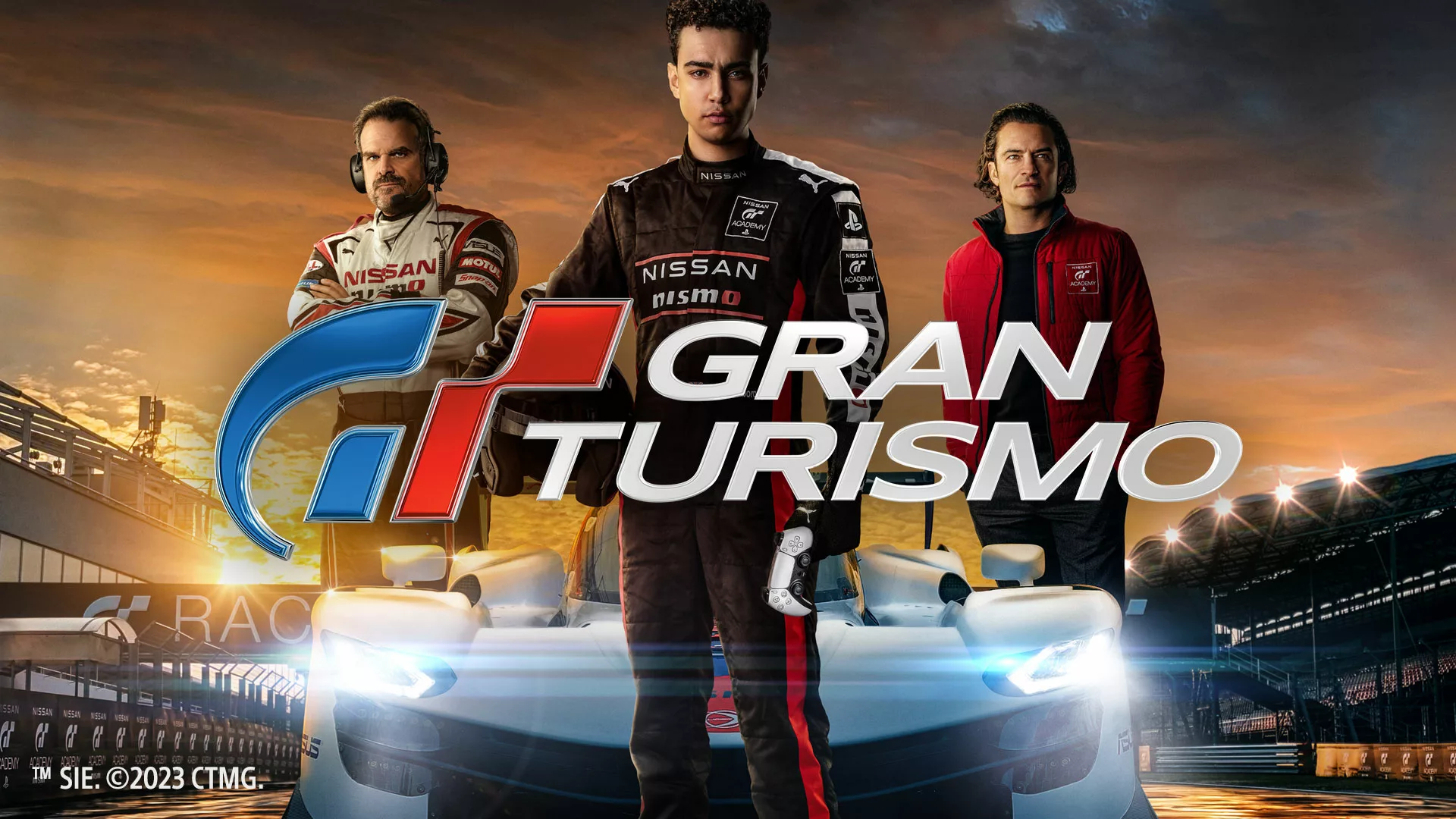

When engines howl and the camera locks on a driver’s hands, a film can do more than thrill the senses. It can stage desire. Gran Turismo stages desire with confidence: a teenage gamer turned real-world racer, a corporately polished production house stepping into biography, and sequences designed to make the viewer’s pulse match the tachometer. The film takes an arcade aspiration and translates it into tarmac motion, and it asks, in modestly serious tones, what it feels like when play becomes practice.
From Pixels to Pit Lane: The Core Story
The narrative follows Jann, a British teenager whose skill at a racing simulator opens a door into professional motorsport. That premise supplies an obvious dramatic engine. The movie charts the shock of entry—how joystick mastery meets the physical demands of real racing—and the social currents that buffet a young person who must prove himself in a world that prizes experience.
Characters orbit Jann in familiar ways: family who worry, rivals who test him, mentors who push him to meet a standard he has only imagined. These figures do the work of reflection; they mirror ambition, fear, and the cost of risk. The plotted moments—auditions for speed, mechanical failures, emotional reckonings—stick closely to the story’s real-world inspiration. Because the film is anchored in an actual life, its choices about what to show feel deliberate rather than decorative. Scenes that could have been mythic are instead quietly human, and that restraint matters.
Machinery and Meaning: Style, Performance, and Visuals
Gran Turismo succeeds most robustly where cinema behaves like engineering. The filmmaking rigs a convincing sensory reality. Camera placement and editing recreate the claustrophobia inside a cockpit and the sweep of international tracks. Close-ups register concentration; wide frames register scale. Special effects work with the stunt footage to produce races that feel immediate and physical rather than purely digital spectacle (the movie’s lineage to gaming is visible, but the sequences aim to register as lived experience).
Actors give these images emotional ballast. The lead’s performance registers as a believable mix of zeal and insecurity; supporting turns supply texture rather than caricature. When the film pauses for quieter moments, it asks us to consider what a young person must surrender to pursue a dream: comfort, anonymity, ordinary expectations. Those scenes often work because the performances suggest inward life without theatrical exaggeration.
This is a picture that knows how to please an audience (and a certain audience in particular). The action sequences and production values will satisfy viewers who enjoy speed as spectacle. Yet the film makes room for a political imagination of sorts: it stages social reactions to a dream that originates in play and asks whether institutions will accept that origin as legitimate. That question lingers beneath the roar.
Where the Transmission Slips: Predictability and Commerce
The film’s chief structural weakness is predictability. The plot follows an established underdog arc: discovery, training, setback, redemption. The beats are comfortable. Comfort can be useful, but here it blunts suspense when the narrative should pry open uncertainty. Emotional payoffs arrive on schedule. The viewer is rarely surprised. That familiarity softens the film’s potential for tension and undercuts some of its quieter moral questions.
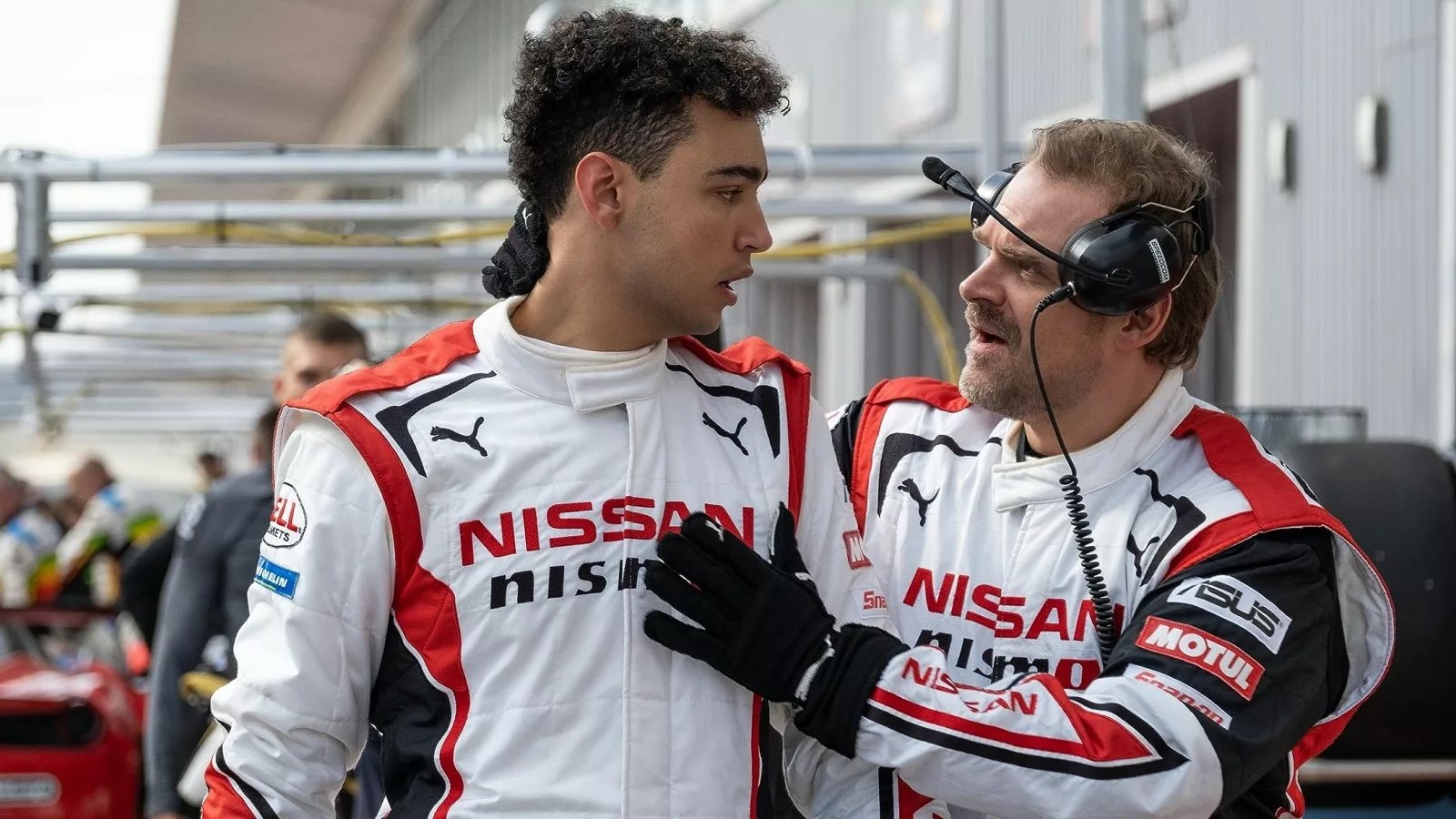
Certain dramatic moments that should land with added force instead come off as perfunctory. Confrontations that promise rupture resolve without the sting they hint at. Revelations register as signposts rather than shocks. Those missed chances turn some stretches inert, like a car idling without taking the turn.
Another distraction is the film’s commercial visibility. Logos and branded ephemera accumulate onscreen in ways that draw attention away from character. Product placement reads as a constant reminder of the movie’s industrial context (PlayStation Productions being part of that context is a recurrent, explicit fact in the material). When brand presence becomes louder than interior life, the film’s rhythm stutters. The world of commerce in the frame competes with the emotional life of the characters, and that competition is rarely productive.
Comparison and Cultural Reach
It helps to place Gran Turismo beside other recent racing narratives. Where Ford v Ferrari dramatizes rivalry among established professionals and corporate strategy, Gran Turismo dramatizes initiation—an amateur crossing into professional practice. That difference changes the moral stakes. Ford v Ferrari often felt like a study of vocation and legacy; this film asks how legitimacy gets conferred when talent arrives via unconventional means.
Visually, Gran Turismo often wins the contest for spectacle. Its race sequences blend photographic realism with a videogame aesthetic in a way that appeals to viewers who grew up on simulators. The autobiographical hook gives these sequences a rhetorical charge: the film presents a dream made real rather than a fantasy invented for cinema. That provenance gives the movie cultural interest beyond mere entertainment. It raises a modest but persistent question about the permeability of professional spheres in an increasingly digital age.
Public reaction has been mixed, and that ambivalence is apt. Fans of racing and gaming often praise the movie’s energy and craft. Critics and more skeptical viewers note the formulaic plotting and the intrusive product placement. A group of viewers occupies a middle ground that acknowledges the film’s pleasures while registering its limits. That distributed response feels accurate to the material: the film offers reward along clear lines but resists elevation into a wider cultural phenomenon.
Final Lap
Gran Turismo is a crowd-minded film with technical muscle. It converts an unusual true story into a work that delivers sensory intensity and humane small moments. Where it slows is where the script follows a familiar map and where commerce intrudes into cinematic space. The result is an uneven but often enjoyable picture: a movie that will please viewers hungry for well-crafted races and a tidy emotional arc, while leaving those searching for structural surprise and deeper emotional abrasion wanting more.
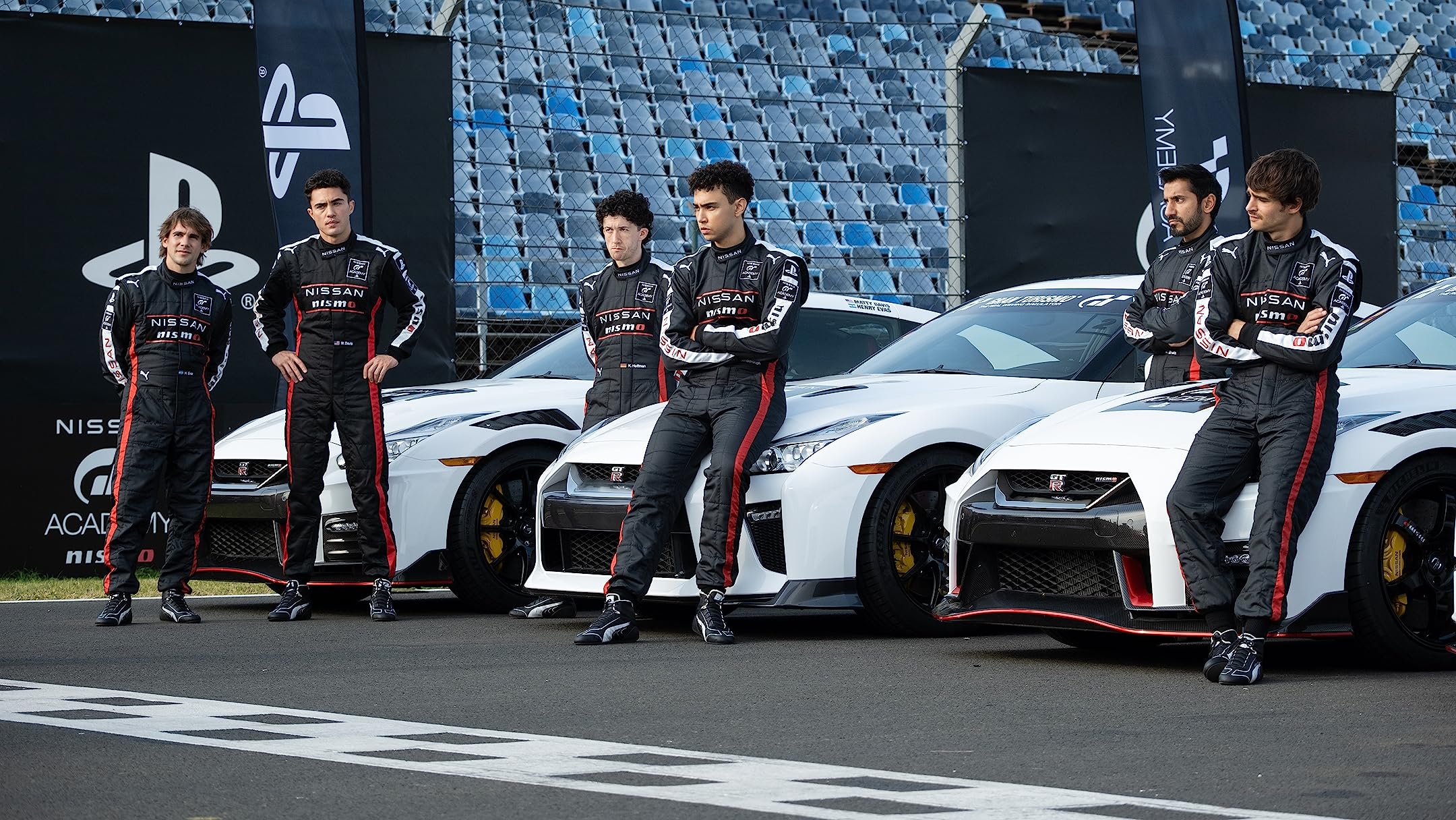
If you go for speed and competent sentiment, the film supplies both in generous measure. If you seek narrative risk or a radical rethinking of the sports bioform, you will find fewer surprises. Either way, the film offers a clear experience: a portrait of a person who crossed from controllers to cockpits, rendered with care and the occasional cinematic flourish (and with a steady, visible sense of the industry that produced it). It is not a revolution in racing cinema. It is, however, a well-made entertainment that captures the thrill of acceleration and the odd dignity of someone who learned to steer.
Gran Turismo is an exhilarating biographical sports drama that tells the incredible true story of Jann Mardenborough, a teenage gamer whose mastery of the Gran Turismo video game earned him a spot in the GT Academy and a chance to become a professional race car driver. Directed by Neill Blomkamp, the film captures the high-stakes transition from virtual simulation to the dangerous reality of the racetrack. It premiered in various international markets in early August 2023 before its wide release in the United States. You can currently stream the movie on Netflix or purchase it through digital retailers like Apple TV and Amazon Prime Video.
Where to Watch Gran Turismo (2023) Online










Full Credits
Title: Gran Turismo
Distributor: Sony Pictures Releasing
Release date: August 11, 2023 (United Kingdom), August 25, 2023 (United States)
Rating: PG-13
Running time: 2 hours 15 minutes
Director: Neill Blomkamp
Writers: Jason Hall, Zach Baylin, Alex Tse
Producers and Executive Producers: Doug Belgrad, Asad Qizilbash, Carter Swan, Dana Brunetti, Kazunori Yamauchi, Hermen Hulst, Jason Hall, Matthew Hirsch
Cast: David Harbour, Orlando Bloom, Archie Madekwe, Darren Barnet, Geri Halliwell Horner, Djimon Hounsou, Josha Stradowski, Daniel Puig
Director of Photography (Cinematographer): Jacques Jouffret
Editors: Colby Parker Jr., Austyn Daines
Composer: Lorne Balfe, Andrew Kawczynski
The Review
Gran Turismo
"Gran Turismo" is a visually stunning and entertaining film that caters well to fans of racing and gaming. While it delivers on spectacle and engaging performances, it stumbles on narrative predictability, emotional depth, and excessive product placement. It's not a cinematic masterpiece, but it does offer a thrilling escape for those who appreciate its genre. Whether it's a full-throttle joyride or a leisurely drive depends on your personal tastes.
PROS
- The cast delivers compelling and engaging performances that breathe life into their characters.
- The film dazzles with its visual excellence, blending video game aesthetics with real-world cinematography.
- High-speed races and thrilling sequences make the film a crowd-pleaser, especially among younger audiences and gaming enthusiasts.
- Offering a unique perspective, the film focuses on a young protagonist's journey from virtual gaming to real-world racing.
CONS
- The plot follows a predictable trajectory, diminishing the sense of excitement and discovery.
- Despite the strong performances, the film sometimes falls short in evoking emotional depth.
- Excessive product placement detracts from the film's authenticity and narrative cohesion.







