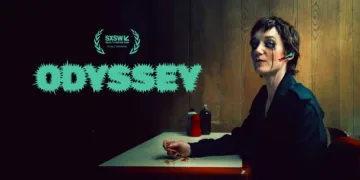





















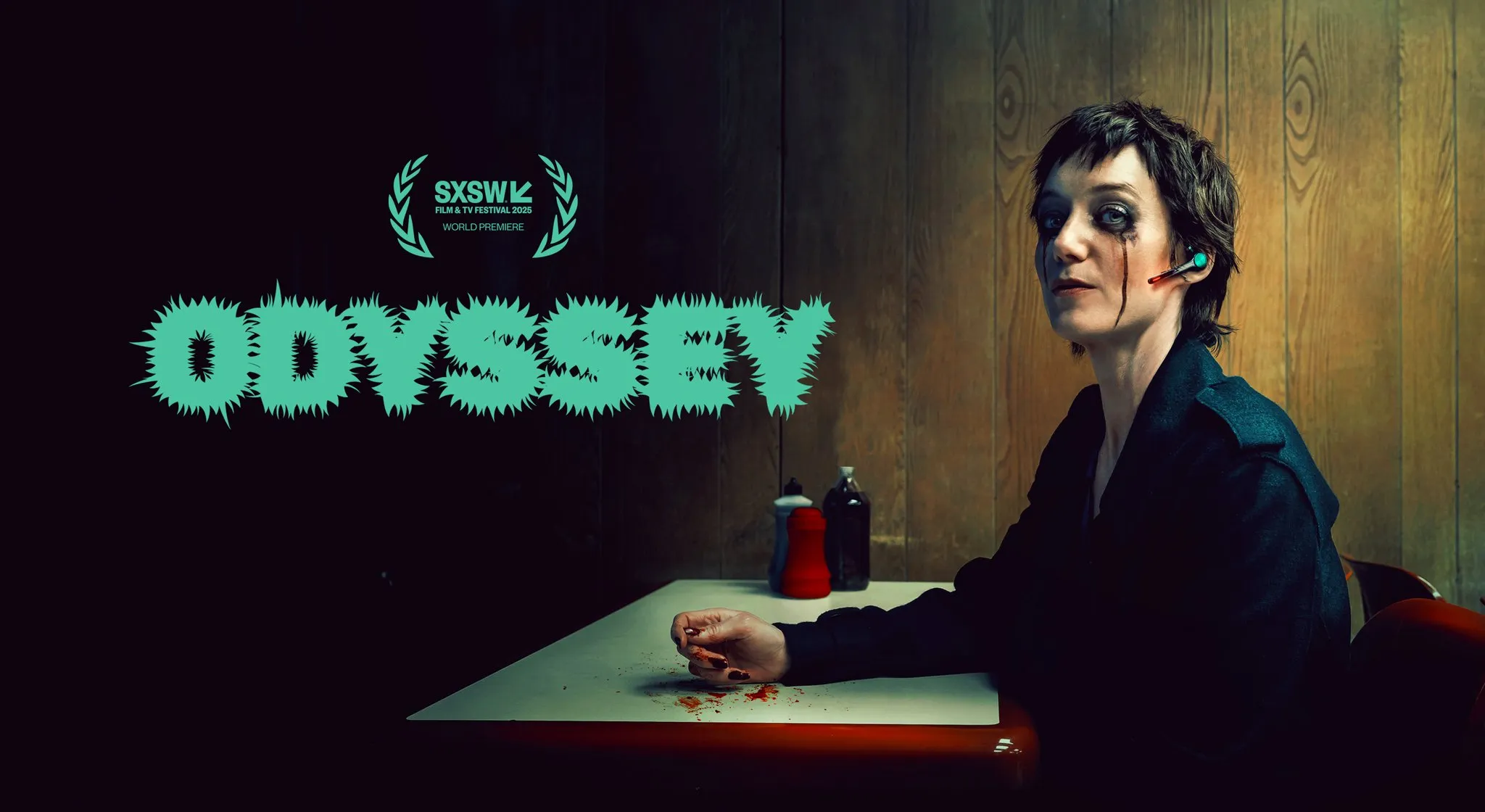

Odyssey yanks us straight into Natasha “Tash” Flynn’s world with surgical precision: a dentist’s chair, a wisdom tooth pulled, and a card decline that feels like a moral indictment. (Nothing says “you’re at rock bottom” like plastic rejection.) Tash is a gladiator in glass towers—an estate agent whose lightning‑fast sales pitch masks a staggering debt.
This is a gritty, high‑octane crime thriller wedded to character study. Writer‑director Gerard Johnson (Hyena, Muscle) applies his signature kinetic lens to London’s underbelly, trading slick cockney charm for cold neon bruises. The film premiered at SXSW 2025, where its raw intensity stood out against more polished genre fare.
Odyssey sits at the darker end of contemporary London crime cinema—a cousin to Uncut Gems in its panic‑driven momentum, yet rooted in the very real housing crisis that has hollowed out communities (call it “estate‑agent ethics,” a new moral calculus). Here, overpriced shoeboxes become Kafkaesque traps, and capitalism reveals itself as a predator in pinstripes.
Why do we watch Tash spiral? Part fascination, part societal mirror. Her crumbling empire echoes global markets teetering on the brink. And at its center: Polly Maberly, whose Tash is simultaneously repellant and magnetic—proof that empathy can sprout in the most inhospitable soil.
Architecting Collapse: Plot & Structure
In Act I we’re thrust into a microcosm of bodily and fiscal agony—Tash’s tooth extraction isn’t just a graphic opener, it riffs on Kafka’s metamorphosis (if Gregor Samsa owed back rent). That swollen jaw mirrors her mounting debts, and the subsequent card decline reads like a personal blacklist. By juxtaposing slick office corridors with her crumbling bank balance, the film establishes its dualities: surface confidence vs. subterranean panic; corporate veneer vs. criminal rot.
Act II accelerates into moral entropy. Tash signs on to the Hayter brothers—loan sharks who treat unsold flats like Foucault’s heterotopias (spaces of otherness). Hiding a kidnapped estate agent within those empty rooms becomes a grotesque parody of property speculation: human collateral in an overbuilt market. Then the Viking arrives—a quasi‑mythic pivot, equal parts deus ex machina and harbinger of Tash’s past debts. His presence reframes her spiral: is she victim or architect of her own downfall? Negotiations collapse, lies accumulate, and the narrative throttle tightens.
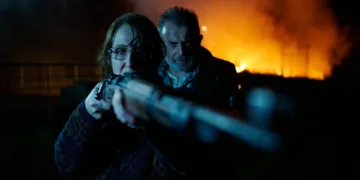
The third act is a frantic chronometer. Deadlines multiply as if summoned by a sadistic banker; every ticking second underscores Tash’s desperation. When the farmhouse finale erupts in a blood‑soaked crescendo (guns lined like twisted exonumia), the film channels Greek tragedy more than London noir. And yet…
There’s a curious lull in the middle—a necessary palate cleanser or an overlong intermission? Opinions waver. Regardless, the final 15–20 minutes reclaim all lost momentum, detonating the thematic fuse Johnson lit in Act I. What remains unanswered at the end is intentional: a narrative open door, inviting us to contemplate Tash’s next move—and, by extension, our own complicity in systems built on endless credit.
Figures in Freefall: Characters & Performances
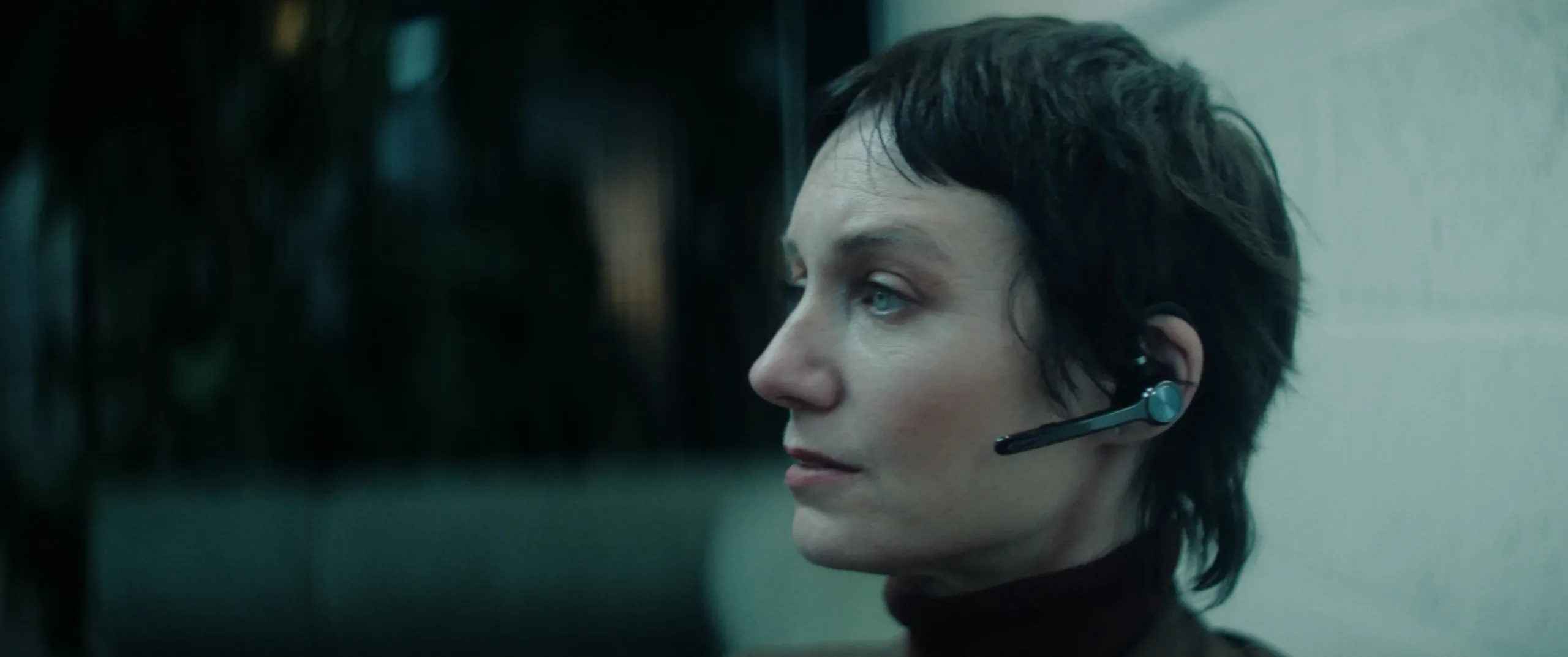
Natasha “Tash” Flynn feels welded to her Bluetooth earpiece and powdered nose—an estate‑agent cyborg whose humanity leaks out in frantic asides. On the surface, she’s razor‑sharp, closing deals with the precision of a neurosurgeon. Beneath that polished veneer, however, lies a debt‑fueled panic (call it “credit nihilism”), each missed payment chipping away at her self‑image.
Polly Maberly threads the needle between bluster and fragility. One moment she’s a corporate gladiator, the next her eyes flicker with the terror of a drowning woman clutching at air. Sympathy? Rarely granted. Magnetism? Unavoidable.
Guy Burnet and Ryan Hayes—Dan and Will Hayter—slip into the frame as predatory twins, their smiles as cold as frozen assets. They don’t so much negotiate as levy moral taxes, reminding us that power often wears a tailored suit. Their presence casts Tash’s ambitions in harsher light: a moral accounting where every pound borrowed demands a pound of flesh.
Enter Dylan Rose (Jasmine Blackborow), the eager mentee whose wide‑eyed optimism cracks against Tash’s cynical reality. When Tash schools her in the art of upselling cramped flats as “cozy sanctuaries,” we glimpse mentorship as a double‑edged sword—empowerment wrapped in exploitation.
Then there’s the Viking (Mikael Persbrandt), an almost mythic interloper whose quiet authority suggests Tash’s entanglements run deeper than this one transaction. His arrival rewrites her narrative arc: she shifts from confident wheeler‑dealer to cornered protagonist in a Greek tragedy of her own making.
Douglas Kelly—a name on a missing‑persons report—hovers like a ghostly creditor, a silent reminder of stakes that extend beyond bank balances. His absence amplifies every deal gone wrong.
The power dynamics crackle. Tash vs. creditors: a dance of intimidation where each step forward accelerates her fall. Mentor vs. mentee: advice that alternately liberates and lures into deeper peril. And Tash vs. “respectable” society: an ongoing collision of corporate polish and criminal grime, where every contract could be a contract for ruin.
Chromatic Haze & Fractured Frames
Johnson’s camera prowls like a restless predator—handheld and jittery—each fleeting composition echoing Tash’s own volatility. One second we’re locked in a tight close‑up of her glazed eyes, the next we’re pushed back by a wide‑angle lens that bends the edges of London into a hall of mirrors. The effect? Urban claustrophobia: a metropolis expanded yet constricted, as if the city itself were conspiring to choke its inhabitants.
Color becomes a silent character. Moody blues saturate boardroom scenes, lending Tash’s corporate realm a funerary chill. Then, in underworld haunts, neon bleeds—acidic pinks and greens that could’ve been lifted from a retro arcade (or an 80s stock‑market fever dream). Even the “Live & Let Live” sign in her office feels ironic—a neon oxymoron that flickers each time her debts mount.
Production design stakes out socio‑economic fault lines: gleaming East London storefronts butt up against crumbling tenements and graffiti‑scarred pubs. It’s Dickensian disparity in 21st‑century dress—housing markets as cruel as workhouses, only with smartphones.
And when we reach the farmhouse finale, the camera steadies for the first time—yet the space is anything but peaceful. Walls lined with weapons cast elongated silhouettes, transforming rustic wood into a stage for desperate theater. Here, the mise en scène becomes a visual metaphor for Tash’s moral armory: each firearm a testament to the violence that steel‑toed boots can deliver.
Editing swings like a pendulum: deliberate pacing in the mid‑film allows character beats to settle; then, in the closing act, rapid cuts detonate tension without warning. It’s a formal reminder that in this world, no one gets to catch their breath.
Under the Weight of Brick and Debt
Odyssey wields estate‑agent vernacular like a surgeon’s scalpel—“compact” suddenly equals shoebox, “luxury” reads as euphemism for expulsion. This sly linguistic subversion (a kind of “gentrification gadfly”) skewers the housing crisis as deftly as any documentary. Tash occupies both sides of the ledger: profiteer and victim of market forces—a dual identity that mirrors 2008’s credit crunch, when bankers and borrowers alike found themselves bound in a Faustian mortgage pact.
Power, greed, desperation. Here, moral corrosion isn’t an abstract concept but a daily expense. Respectable loans from banks blur into “dirty” money from the Hayter brothers, erasing any clear ethical boundary. (After all, both charge interest rates designed to crush the body and spirit.) It’s a hierarchy of debt where collateral can be human—and every promise becomes a ticking time bomb.
Isolation seeps in through Tash’s ever‑present earpiece. Communication functions as both lifeline and addiction—her mantra, “I need it…to be contacted,” doubles as a plea for validation. Substance‑driven numbness offers temporary reprieve, yet amplifies the solitude of a woman surrounded by people but utterly alone.
In a genre traditionally dominated by testosterone‑fuelled antiheroes, Tash stands out: a female protagonist who never quite earns redemption, yet never relinquishes our attention. She defies sympathy and scorns mercy, embodying a new archetype—call her the “profit savant,” a specialist in survival when every deal is a potential death sentence.
Tonally, the film crackles with suffocating energy (think dark‑humor shock therapy). It pivots seamlessly from cut‑throat boardroom banter to bone‑breaking violence, ensuring that no viewer emerges unscathed—or unprovoked.
Symphony of Strain: Direction, Writing & Pacing
Gerard Johnson’s camera never sits still. It swoops, jolts, and circles as if caught in Tash’s frenetic heartbeat. This kinetic cinema—call it “adrenaline diegesis”—reflects her panic more than any interior monologue could. Yet in quieter stretches, Johnson lets shots linger: a rare moment of calm before the next financial ambush.
Tonally, Odyssey is a bold mash‑up. Yuppie satire collides with grime thriller, producing a contrast so sharp it’s almost a schism (imagine a bespoke suit splashed with neon blood). Despite occasional discord—yes, the film dips in Act II—the director muscles through to an explosive finale that justifies every brisk cut and meet‑cute with violence.
On the page, Austin Collings and Johnson craft dialogue that crackles with subtext. Every “compact” apartment pitch doubles as a critique of gentrification. Stakes escalate through chained crises—no side‑plots to distract, only dominoes of disaster. That said, there are moments when momentum wavers, and one wonders if a tighter edit could transform a stumble into a sprint.
Pacing plays with expectation. The opening and climax hook you like a great heist film: no time for small talk, only stakes. Mid‑film, the throttle eases, granting space for character fissures to show. But that pause risks deflating tension—though, ironically, it also deepens our fascination with Tash’s unraveling.
Comparatively, Odyssey feels like Uncut Gems unfiltered through Luther’s London—minus the swaggering cockney quips. It’s Johnson’s first female‑led crime saga, shifting from his earlier male‑centric tales to a protagonist who refuses easy sympathy. And in that evolution lies the film’s cultural echo: a reminder that crime cinema need not center a man’s struggle for power to explore how deeply capitalism can wound us all.
Echoes of Anxiety: Sound & Score
Matt Johnson’s electronic score (yes, that’s The The you’re hearing) operates like a sonic heart monitor—pulsing synth motifs that accelerate as Tash’s debt clock ticks toward zero. These loops aren’t mere background; they’re a kind of “panic symphony,” mapping her adrenaline spikes in real time.
Then there’s “I Need It,” a duet that resurfaces at pivotal moments. Its lyrics—“I want it / I don’t want it / I need it”—become a haunting leitmotif for desire teetering on self‑destruction (capitalist confessions set to melody).
Diegetic layers further the illusion. In club scenes, bass rumbles through your chest like an industrial forge, punctuated by shouted deals and clinking glasses. Contrast that with office ambience: persistent phone rings, half‑heard cubicle chatter, door chimes announcing another potential sale—or another creditor.
Silence, too, is weaponized. After Tash’s card declines, prolonged quiet stretches out, amplifying embarrassment into existential dread. Long stares gain weight when all sound evaporates.
The mix tightens around her psyche. Music and effects merge into an aural vise, intensifying London’s concrete canyons into claustrophobic corridors. Transitions mark her mental shifts: a sudden drop in bass signals a stalled negotiation; a synth swell heralds her next desperate gambit. In Odyssey, sound isn’t decoration. It’s a character—an invisible landlord charging rent on every pulse.
Full Credits
Director: Gerard Johnson
Writers: Gerard Johnson, Austin Collings
Producers: John Jencks, Isabel Freer, Matthew James Wilkinson, Patrick Tolan
Executive Producers: Gerard Johnson, Polly Maberly, Jay Taylor, Kwesi Dickson, Paul Hillier
Cast: Polly Maberly, Mikael Persbrandt, Jasmine Blackborow, Guy Burnet, Ryan Hayes, Charley Palmer Rothwell, Kellie Shirley, Sallieu Sesay, Peter Ferdinando, Tom Davis, Adam Frith, Adam Lawrence, Adrian Derrick-Palmer, Ben Shafik, Cavan Clerkin, Czeslaw Balon, Daisy Louve, Daniel De Bourg, Leon Annor, Nicholas Clarke, Rebecca Calder
Director of Photography: Korsshan Schlauer
Editor: Ian Davies
The Review
Odyssey
Odyssey plunges viewers into a bruising critique of capitalism’s architecture, anchored by Polly Maberly’s mercilessly compelling turn as Tash. Gerard Johnson’s neon‑stained thriller pulses with energy and moral unease—its middle may sag, but the finale detonates with cathartic force. A daring film that feels both eerily familiar and sharply original.
PROS
- Polly Maberly’s riveting, uncompromising lead performance
- Visceral, neon‑tinged cinematography that amplifies tension
- Sharp critique of the housing crisis and debt culture
- Pulse‑pounding score that mirrors Tash’s unraveling
- Bold tonal shift from corporate drama to brutal thriller
CONS
- Noticeable pacing lull in the middle act
- Supporting characters feel underdeveloped
- Occasional tonal discord before the climax
- Some plot twists strain plausibility