





















The air in late 19th-century Paris hangs thick with suspicion, a humidity of political anxiety that clings to every cobblestone. It is in this environment that Roman Polanski’s film begins, not with an explanation but with a ritual. We witness the public degradation of Captain Alfred Dreyfus, a Jewish officer in the French army, as his sword is broken and his insignia are torn from his uniform.
Accused of treason, he is paraded like a broken idol before a contemptuous military audience and shipped off to the infamous Devil’s Island. Our entry point into this historical labyrinth is not the victim himself, but Colonel Georges Picquart, a man who watches the proceedings with the detached approval of his class.
Freshly promoted to head the military’s intelligence unit—the very one that condemned Dreyfus—Picquart soon stumbles upon a thread of evidence that, if pulled, threatens to unravel the entire fabric of the army’s honor. The film establishes itself immediately as a historical thriller, a dogged exploration of one man’s confrontation with a deeply corrupted institution.
The Unlikely Detective
The film unspools as a meticulous and sober procedural, an espionage story from an age before digital footprints. It eschews the kinetic pacing of modern thrillers for something more patient and arguably more unnerving. Here, spying is an analog craft of steaming open letters, of deciphering handwriting, of painstakingly reassembling torn correspondence fished from the wastebaskets of foreign attachés.
The investigation is a tactile and cerebral affair, a world of paper trails and whispers where the truth is buried under stacks of misfiled documents. Our guide, Colonel Georges Picquart, is no crusader for social justice. He is a man of his era: a conservative, career-military officer who harbors the same thoughtless antisemitism as his peers.
His quest is not born of a sudden enlightenment or a bloom of empathy for the persecuted Dreyfus. Instead, his motivation is a rigid, almost pathological, adherence to his own code of honor and procedural correctness. A lie at the center of the army he serves is an administrative error that offends his sense of order, a dissonance he cannot tolerate.
Jean Dujardin’s performance is a masterclass in precision and restraint. He gives Picquart a stoic calm, his unwavering resolve visible in the stiffness of his posture and his focused gaze, not in grand speeches. Dujardin offers a man of unbending principle, not of warmth, whose cold integrity provides the film’s steady, unyielding core.
A Portrait of Institutional Decay
The true antagonist of the picture is not a single villain but the French military establishment itself, presented as a kind of lumbering, self-preserving leviathan. It is depicted as a calcified boy’s club where devotion to the institution has completely supplanted any allegiance to truth.

Its unspoken codes and comfortable complicity create an environment where admitting a mistake is a greater sin than perpetuating an injustice. The generals Picquart confronts are monuments of arrogance, men so insulated by status and steeped in self-importance they believe the army simply cannot be permitted to look weak.
Their rationalization is a twisted form of patriotism; they are protecting the “honor” of France, and what is one man’s life compared to that? The physical world of the film becomes a direct metaphor for this moral decay. The intelligence headquarters is a character in its own right: a villa of musty, mud-colored offices that smell of the sewers, where dust motes dance in the slivers of light and secrets are guarded behind layers of bureaucratic grime.
Systemic antisemitism is presented not as overt, mustache-twirling villainy but as a foundational element of the culture, a kind of thoughtless bigotry that made Dreyfus the perfect scapegoat. Figures like the duplicitous Major Henry and the dismissive Général Gonse are not criminal masterminds; they are functionaries of a corrupt system, cogs in a machine that actively, and logically from their perspective, resists any attempt at correction.
Painting with Gloom
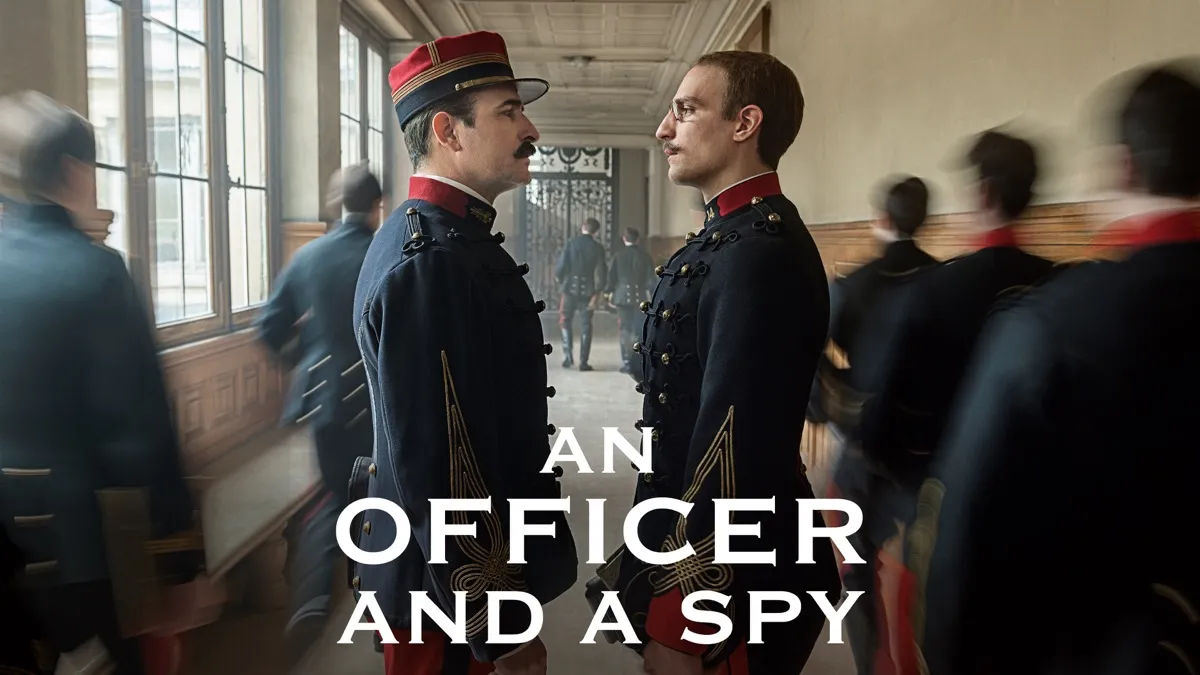
The film’s visual style is one of its great strengths, creating a world that is at once handsome and deeply oppressive. The cinematography gives the proceedings the look of a classical painting left too long in a damp, dark room, a canvas in need of cleaning.
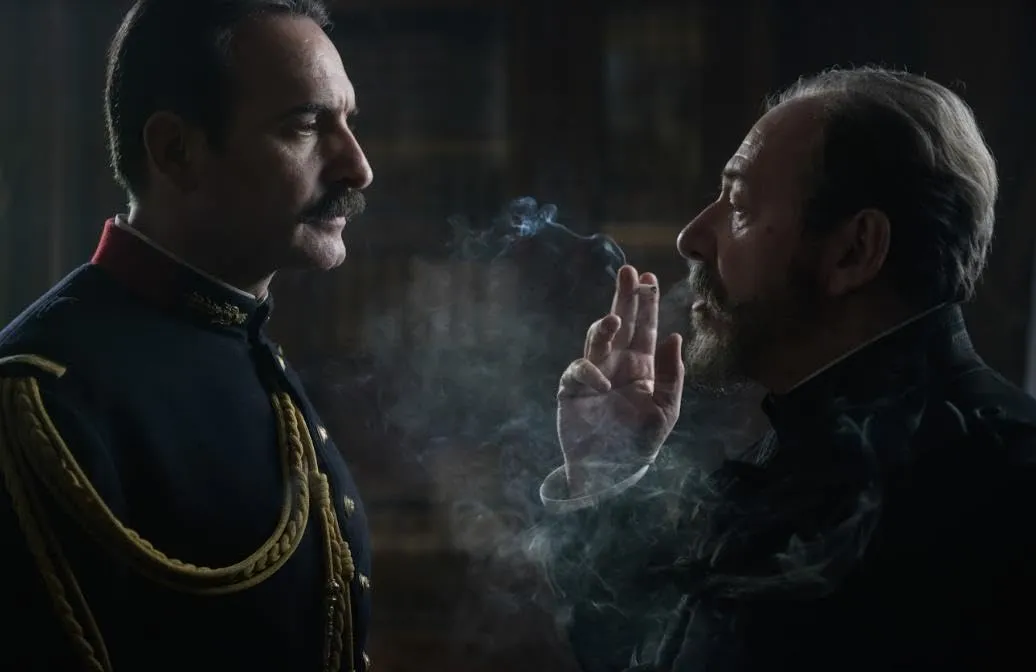
The palette is dominated by somber browns, grays, and murky greens, while the lighting, often appearing natural, casts long shadows that seem to swallow the characters whole. This is a world of moral twilight, and the visuals reflect that perfectly.
The camera is often static and observant, trapping characters in meticulously composed frames of oppressive architecture or moving in for tight close-ups that study their worried faces. This meticulous production design grounds the story in its historical moment, from the cold grandeur of military courtyards to the cramped, claustrophobic quarters of the intelligence office. Alexandre Desplat’s score complements this aesthetic perfectly.
The music avoids any cheap sentimentality or manufactured tension, instead reinforcing the film’s deliberate pace and the quiet dread of its descending moral darkness. Beyond the score, the sound design is subtle yet effective: the constant rustle of paper, the ticking of clocks, the distant, indifferent sounds of Parisian life. All these technical components work in concert to build a sober, immersive world, making the historical events feel disturbingly tangible and immediate.
The Cold Comfort of Truth
There is a striking emotional restraint here, a stark refusal to provide a cathartic, feel-good resolution. Justice, when it finally limps into view after years of struggle, feels heavy and complicated, not triumphant.
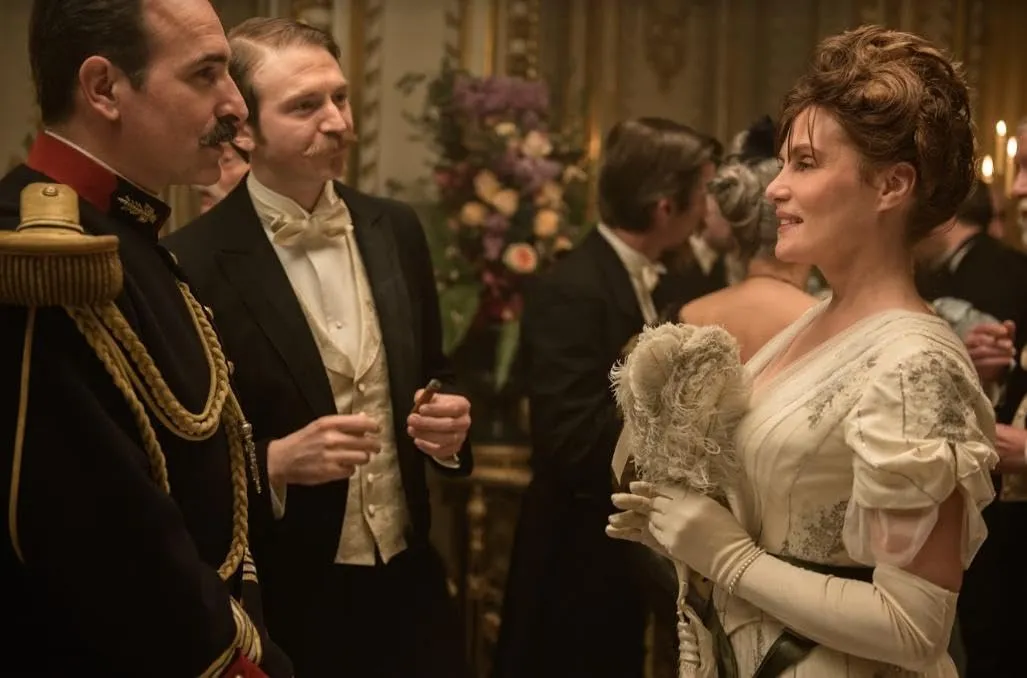
The film’s final meeting between Picquart and the exonerated Dreyfus is a masterpiece of discomfort. It is not a warm reconciliation but a chilly, formal truce between two men scarred by the same ordeal. A shared trauma has not created a bond; the underlying prejudices and power dynamics remain. Picquart may have saved Dreyfus’s life, but he never truly saw him as an equal.
The film’s quiet statement is that the restoration of fact is a grueling, thankless process, one that exacts a severe personal and institutional price. Exoneration is a legal and historical correction, a footnote amended, but the human damage is permanent. There is no joy in this victory, only the cold comfort of a record set straight.
“An Officer and a Spy” premiered at the Venice Film Festival on August 30, 2019.
Full Credits
Director: Roman Polanski
Writers: Robert Harris, Roman Polanski
Producers: Alain Goldman, Luca Barbareschi
Executive Producers: Roman Abramovich, Zbigniew Raczynski, Lukasz Raczynski, Kasia Nabialczyk, Constantino Margiotta
Cast: Jean Dujardin, Louis Garrel, Emmanuelle Seigner, Grégory Gadebois, Olivier Gourmet, Hervé Pierre, Didier Sandre, Melvil Poupaud, Mathieu Amalric, Eric Ruf, Wladimir Yordanoff, Laurent Stocker, and others.
Director of Photography (Cinematographer): Paweł Edelman
Editors: Hervé de Luze
Composer: Alexandre Desplat
The Review
An Officer and a Spy
An Officer and a Spy is a masterfully crafted and intellectually demanding historical procedural. While its deliberate pacing and emotional coldness may deter those seeking catharsis, it is an impeccably directed and soberly intelligent film. Anchored by a superb, restrained performance from Jean Dujardin, it stands as a chillingly relevant portrait of institutional decay and the thankless, grinding pursuit of truth. A handsome, formidable, and deeply impressive piece of cinema.
PROS
- Meticulous, confident direction that creates a deeply immersive and oppressive atmosphere.
- A powerful and precise central performance by Jean Dujardin as the principled Colonel Picquart.
- Intelligent script that favors sober historical detail over simplistic melodrama.
- Superb production design and cinematography that realistically capture the era's gloom.
CONS
- Emotionally distant and cold, which can make it difficult to connect with the characters.
- The deliberate, slow pace of the procedural narrative may feel tedious to some viewers.
- Its focus on process over passion results in a lack of traditional cinematic release or triumph.