
















![Kingdom Hearts Collection [I-III] Review](https://gazettely.com/wp-content/uploads/2026/10/Kingdom-Hearts-Collection-I-III-1-360x180.webp "Kingdom Hearts Collection [I-III] Review: KHII Holds Steady as Newer Entries Fluctuate 33")








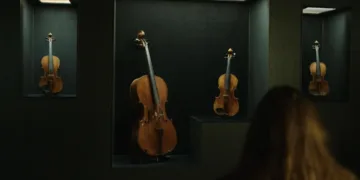
Is there a heavier burden than the ghost of another’s dream? In The Musicians, a daughter, Astrid, inherits not a fortune but a fixation: her late father’s quest to unite four legendary Stradivarius instruments, siblings cut from the same tree centuries ago, for a single, impossible concert.
The task is an act of meticulous necromancy. It requires a phantom score, a piece of music unheard for decades, to be given breath by four brilliant, solitary souls who have never before shared a stage.
They are to perform this resurrection once, under the unblinking eye of a live broadcast, a fleeting moment of communion against the vast expanse of silence that precedes and follows it. The premise hums not with the energy of creation, but with the quiet desperation of chasing an echo.
Four Solitudes in a Single Room
The film assembles its quartet not as an ensemble, but as a collection of dissonant, self-contained worlds, each orbiting the unsteady sun of its own ego. At the center of this vortex is Astrid, a woman whose fierce determination feels less like passion and more like a frantic attempt to impose an elegant order on the chaos of grief.
She wrestles with the cold logic of her brother’s corporate world and the far more volatile physics of artistic temperament, a frazzled priestess presiding over a chaotic ritual meant to honor a dead god. Her chosen acolytes are studies in isolation. There is George, the first violinist, a man whose virtuosity is matched only by a vanity so profound it acts as a shield against the existential terror of being forgotten.
He begins every sentence with “I,” a constant, desperate affirmation of the self in a profession that discards its masters with brutal unsentimentality. He is orbited by the quiet ghosts of Peter and Lise, a violinist and cellist bound by the scar tissue of a shared past.
Their history is an unspoken score playing beneath the official one, a counter-melody of regret. His blindness seems less a handicap and more a willed retreat from a world of surfaces, while her elegant reserve is a fortress built around the silence of a conversation that ended badly long ago. Into this fragile ecosystem crashes Apolline, the violist, a creature of the chaotic, image-driven present.
Her fame, born of social media’s vast and shallow sea, is an alien language in this room heavy with history. She represents a new form of existence—a curated, broadcasted self—and her presence forces the others to confront their own notions of authenticity. Is a legacy carved in wood and vellum more real than one written in pixels?
The Tyranny of an Unheard Song
The true antagonist of the piece is not human. It is the music itself—a difficult, forgotten score that lies on the stands like the tyrannical blueprint for a structure no one knows how to build. It is a map of a forgotten country, full of dissonant junctions and melodic dead ends, and the struggle to play it is the struggle to navigate the labyrinth of another man’s soul.

To exorcise this phantom, Astrid summons its creator, the composer Charlie Beaumont, a man in exile from his own art. He is a recluse who fled into the solace of nature to escape the structured failure of his work, confessing with unnerving peace, “I hate my piece.” This is the cry of an artist confronting the chasm between a youthful vision and the flawed, mortal object he created. His return is a reluctant confrontation with the ghost of his younger self; he must teach the quartet a language he has tried to unlearn.
It is telling that the first moment of genuine connection between these artists comes not from his esoteric score, but from a raw, impromptu performance of “In the Pines.” In the shared darkness of that old folk song, steeped in death, jealousy, and loss, they find a primal harmony. It is an elemental cry that requires no interpretation, only surrender, a moment where they stop performing art and begin, briefly, to embody it.
The Texture of Being
Director Grégory Magne refuses us the fantasy of effortless creation. By casting professional musicians, he grounds the film in a visceral reality, making the abstract struggle for harmony painfully concrete. We see the tremor in the hand, the tightening of a jaw, the slick of sweat on a brow.

This is not the illusion of art; it is its messy, physical truth, the labor of forcing horsehair and gut to sing. The camera captures this struggle within spaces that feel like psychological states. The manor, with its deliberate lack of internet, is a gilded cage, an anachronistic pocket outside of time that becomes a pressure cooker of resentment and ambition.
The corporate boardroom is a world of cold glass where the language of art is translated into the brutal dialect of commerce, a place where the soul of the project is always at risk. The ancient church, the venue for the concert, is a hollow, waiting witness.
Its stones have absorbed centuries of human hope and despair, and now they wait for this new sound. The film’s opening shot, a journey from inside the resonant darkness of a cello’s body out into the light, is a birth into this world of wood, tension, and history.
A Fleeting Concord
The final concert, when it arrives, is not a victory. It is a truce, a temporary suspension of the self. For those few minutes, the four warring egos dissolve. There is no George, no Lise, no Peter, no Apolline—only the Quartet, this singular, temporary life form created in the space between them.

This is the paradox of collaboration: true connection requires a small death of the individual. The film’s central metaphor, invoked by the composer, is of a flock of starlings—a swirling entity that moves as one through some mysterious, shared instinct.
It is an act of surrender to something larger than the self. But what happens when the last note hangs in the air and fades? The return of the ego is inevitable. The film does not promise transformation; it suggests they will walk out of the church and back into their separate solitudes.
The meaning, then, is not a life-altering epiphany. It is the quiet, lingering knowledge that such a connection, however brief, was possible. It is an echo that now resides within their individual silences, a bittersweet truth about our condition: our most profound moments of unity are often the most transient.
“The Musicians” is a film scheduled for release in the United States on August 8, 2025.
Full Credits
Director: Grégory Magne
Writers: Grégory Magne
Producers: Frédéric Jouve, Pierre-Louis Garnon
Cast: Valérie Donzelli, Frédéric Pierrot, Mathieu Spinosi, Emma Ravier, Daniel Garlitsky, Marie Vialle, Valentin Pradier, Fred Scotlande, Nicolas Bridet, François Ettori
Director of Photography (Cinematographer): Pierre Cottereau
Editors: Beatrice Herminie
Composer: Grégoire Hetzel
The Review
The Musicians
The Musicians is less a celebration of harmony and more a quiet meditation on its fleeting nature. It trades overt triumph for the more resonant, bittersweet truth that connection is a transient state, forged in conflict and destined to return to solitude. While its intellectual grace may feel emotionally distant at times, the film succeeds as a poignant, authentic portrait of the difficult, messy, and ultimately ephemeral act of creating something beautiful out of chaos. A thoughtful and haunting chamber piece for the philosophically inclined.
PROS
- A philosophically rich screenplay that explores complex themes of ego, creation, and collaboration.
- The casting of professional musicians lends a powerful authenticity to the artistic struggle.
- Atmospheric cinematography and production design that effectively create distinct, meaningful spaces.
- An intelligent, bittersweet tone that avoids simple sentimentality in favor of a more profound emotional truth.
CONS
- The contemplative and analytical approach may feel emotionally distant or cold to some viewers.
- A deliberate, subtle pacing that might be perceived as slow.
- Despite its thematic depth, the core narrative structure remains somewhat conventional.