





























The modern streaming landscape has a certain affection for the sun-drenched heist caper, and Suspicious Minds arrives as a polished entry in the field. The series introduces us to Amber Deval and Javier “Rui” Ruiz, two thieves at the top of their game whose professional partnership was complicated by a romance and shattered by a presumed death. Years later, their paths cross again on an exclusive private island, where a billionaire’s daughter is set to be married while wearing the priceless St. Agatha’s Tiara.
Amber has a meticulous plan to steal it; Rui’s sudden reappearance makes him an immediate obstacle and a reluctant, untrustworthy ally. Their reunion forces a fragile truce, built on a history of betrayal. The central question is not whether they can bypass the layers of security, but if they can manage to trust each other long enough to survive the job.
The Central Conflict – A Heist of the Heart
The $240 million tiara is little more than an elaborate MacGuffin. The show’s narrative engine, its entire reason for being, is the volatile, unresolved relationship between its two leads. The real jeopardy in Suspicious Minds comes not from laser grids or armed guards, but from the fractured trust between two people who know each other’s weaknesses intimately.
Their disastrous final job in Las Vegas, which ended in gunfire and separation, provides a constant undercurrent of resentment that ripples through every shared glance. Each plot development hinges on this dynamic; a plan succeeds when they achieve a moment of genuine synergy, and it fails spectacularly when one’s suspicion of the other causes them to hesitate or act alone.
As Amber, Silvia Alonso anchors the story with a sharp, controlled performance that avoids easy archetypes. Her character is a study in professionalism under duress. She spent three years mourning Rui and channeling that grief into a tribute heist, a testament to her methodical nature. His return is not just an emotional shock; it is a fundamental disruption of her operational principles. She is a planner forced to improvise, a loner forced into a partnership, and her struggle to reconcile the man she remembers with the man standing before her is the show’s most textured element.
On the other side, Álex González offers a charismatic counterpoint as Rui, his relaxed swagger a carefully constructed mask. The writing leaves his motives deliberately ambiguous. Is his desire to reconcile genuine, or is he simply a masterful manipulator leveraging their shared history? His actions often feel contradictory, suggesting a man at war with his own regrets.
Their dialogue is less witty banter and more a series of strategic negotiations, each line a probe for weakness or a test of loyalty. This is where the story finds its footing—not in the mechanics of the theft, but in the intricate, unpredictable dance of two people who cannot live with or without each other.
Style and Setting – A Paradise Built for Lies
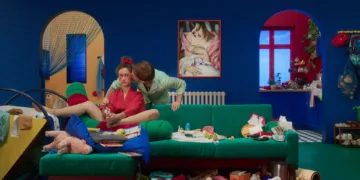
The series is constructed with a distinct and self-aware visual flair, a calling card of a certain brand of European streaming thriller. The aesthetic is pure escapism, defined by bright, sun-soaked cinematography, rapid-fire editing, and a near-constant soundtrack of pop songs that inject a restless energy into the proceedings. The filmmakers show a particular fondness for moments of performative style, such as a flashback to a peppy dance number where the leads, disguised as Elvis and Marilyn, find a moment of connection.
These choices telegraph the show’s intent to be fun and breezy. The setting itself, a luxurious private island, becomes an active participant in the deception. Its pristine beaches and opulent, modernist mansions form a beautiful facade, a perfect stage for the con artists operating in its midst. The isolation creates a hermetically sealed world, while the lavishness fosters an atmosphere of unreality where a grand deception feels entirely plausible.
Yet, this commitment to a sleek presentation is a double-edged sword. At times, the gloss feels less like a storytelling choice and more like a brand identity. The relentless polish, slow-motion flourishes, and perfectly curated color palette can create a detached, decorative quality. This threatens to insulate the viewer from the emotional narrative the show works so hard to establish, flattening the messy, desperate conflict between Amber and Rui. It is a production style that prioritizes a consumable, marketable “look” over a more textured atmosphere.
While it succeeds in making the series visually appealing and easy to watch, one is left to wonder if the beautiful surface is amplifying the story or simply encasing it, preventing the grit of the characters’ internal struggles from truly breaking through. The visual language is confident, but it occasionally speaks louder than the characters themselves.
The Supporting World and Caper Mechanics
Beyond the central duo, the world of Suspicious Minds is populated by characters who serve clear, if limited, narrative functions. The antagonist, billionaire Emilio Villegas, is a source of menace and raises the physical stakes appropriately. He is the immovable object against which the protagonists test their skills, representing a brand of old-world, fatalistic brutality. He exists as an effective external pressure point, though the script shows little interest in his psychological makeup. The more immediate tactical threat comes from his hyper-competent head of security, a formidable figure who engages the thieves in a direct cat-and-mouse game.

The wider cast functions with a certain narrative convenience. The cartoonishly clueless bride-to-be and her nerdy fiancé provide broad comic relief, their obliviousness a necessary lubricant for the plot. Other members of the heist team are recruited with an amusing lack of ceremony; when a new skill is needed, a character with that exact skill promptly appears. This lends the proceedings a slightly contrived feel, as if the world is bending to the protagonists’ needs.
The structure of the heist itself reflects a modern, serialized approach. Stretching a single theft across six episodes requires a constant stream of new complications, turning the overarching plot into a sequence of mini-missions. Each installment introduces a fresh obstacle that must be overcome, keeping the pace snappy even if it makes the core plan feel needlessly convoluted.
This episodic framework prioritizes momentum over rigorous logic, asking the audience to simply enjoy the ride. The schemes are nimble and the sleight-of-hand is clever enough to entertain. The humor is inconsistent, but the show understands that its primary asset is the charged chemistry of its leads. The supporting elements are the scaffolding, built to give that central relationship a dangerous and glamorous playground.
Full Credits
Directors: Inma Torrente, Alejandro Bazzano
Writers: Verónica Marzá, Pablo Roa, Fernando San Cristóbal
Producers and Executive Producers: Ángel Armada, César Benítez, Álex González, Verónica Marzá, Javier Pascual, Pablo Roa, Marco Sroka
Cast: Silvia Alonso, Álex González, Asier Etxeandia, Antonio Pagudo, Olga Hueso, Albert Baró, Alicia Jaziz, Jan Buxaderas, Eduardo Gómez, Cumelén Sanz, Oliver Ruano, Milena Radulovic, Saibon Wang, Ainhoa Santamaría
Director of Photography: Miguel P. Gilaberte
Editors: José Luis Picado, David Nieves
The Review
Suspicious Minds
Suspicious Minds succeeds almost entirely on the strength of its two leads, whose charged dynamic provides a compelling emotional core that the surrounding heist plot serves. While its slick, polished aesthetic delivers genuine escapist fun, it sometimes smothers the narrative's emotional grit. The result is a highly watchable caper that prioritizes style and romantic tension over narrative depth. It knows its formula and executes it with confidence, making for a diverting, if familiar, experience.
PROS
- Potent chemistry between the lead actors.
- Slick, visually appealing production and setting.
- The central relationship provides strong emotional stakes.
- Entertaining, low-stress escapist fun.
CONS
- Style sometimes overwhelms the story's substance.
- Supporting characters and the villain are underdeveloped.
- The heist plot feels stretched and relies on convenience.
- Follows a familiar genre formula without much innovation.