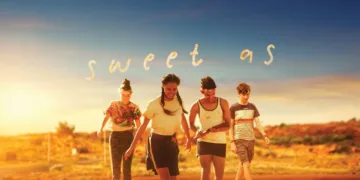











In a remote Western Australian mining town, 16-year-old Murra finds her world shrinking. Her existence is a tightrope walk of self-preservation, navigating the domestic chaos fueled by her mother’s struggles with addiction.
For Murra, played with a quiet intensity by Shantae Barnes-Cowan, home is a place to be barricaded against. Relief, or at least a change of scenery, arrives through the intervention of her police officer uncle, Ian. He secures her a spot on a photo safari for at-risk teens, an imposed solution she accepts with visible reluctance.
This excursion into the vast, ochre-hued outback becomes the film’s central conceit. What begins as an escape from an untenable situation slowly transforms into a critical act of discovery, where the simple mechanics of an old camera provide a new aperture through which to see the world, and her place within it.
An Unsteady Home
The film’s opening act is grounded in a specific, palpable hardship that feels both distinctly Australian and sadly universal. The visual language of Port Hedland establishes Murra’s confinement; giant machines of the mining industry dominate the horizon, standing in harsh, metallic contrast to the endless blue sky.
This industrial presence makes the vast landscape feel less like a space of freedom and more like a cage. Life for Murra is defined by the parties that overrun her house, and the film captures her ritual of barricading her bedroom door not as a dramatic flourish, but as a practiced, weary necessity.
The depiction of her mother, Grace, is handled with remarkable complexity, avoiding the trope of the one-dimensional villain. Instead, she is a woman lost to her own afflictions, a product of circumstances that the film hints at but never over-explains.
This choice reflects a mature understanding of cyclical trauma, where the damage inflicted on one generation inevitably spills onto the next. Uncle Ian, as a figure of caring authority, embodies a difficult duality. As an Indigenous man wearing a police uniform, he is both an agent of the state and a protector from it, navigating a complex space to shield his niece from a system that could easily swallow her. His intervention is an act rooted in kinship, a desperate attempt to create a circuit-breaker.
The Outback as Canvas and Crucible
Once on the bus, the film shifts its focus to the dynamics of the group and their relationship with the land. Murra is thrown together with a collection of strangers who fit loose archetypes: the quietly melancholic Sean, the city-wise Kylie with her tough facade, and the seemingly jovial Elvis, whose humor masks a deeper pain.

Each carries their own distinct burdens, creating a believable friction that defines their early interactions. The core activity, learning to use an analog camera with only 24 exposures, functions as a brilliant narrative mechanic. In an era of infinite digital content, this limitation is a powerful counterpoint. It forces a deliberate, mindful engagement with the present moment, asking the teens to decide what is truly worth preserving.
This act of slowing down and choosing a frame is a form of empowerment. The Pilbara region, or Country, is rendered as far more than a backdrop; it is an active participant in their healing. For a global audience, the film subtly explains that “Country” is not just landscape, but a living entity infused with ancestry, story, and spirit. The journey across it becomes a crucible where rebellious detours and shared vulnerability dismantle their defenses, forging an unexpected and resilient community.
A Cast of Lived-In Realities
The film is anchored by the profound naturalism of its performances, which makes its culturally specific story feel universally accessible. Shantae Barnes-Cowan’s portrayal of Murra is a masterclass in quiet resilience. She conveys a universe of emotion through her watchful posture and guarded expressions, allowing glimpses of vulnerability to surface with immense impact.

She embodies a young person who has learned to observe before acting, a survival skill that becomes an artistic strength. The supporting young cast is equally strong, creating a dynamic that feels entirely authentic. Kylie’s attachment to a secret phone connecting her to a controlling boyfriend is not just a plot point; it’s a sharp commentary on modern attachment and the performance of sophistication as a defense mechanism.
Pedrea Jackson gives Elvis a restless energy that hints at a deep trauma without needing explicit exposition. Their interactions—shifting from sharp insults to unspoken alliances—are a perfect reflection of the messy, contradictory nature of teenage relationships. The adult guides provide a crucial, stable framework. Mitch is the pragmatic anchor, while the charismatic photographer Fernando represents a positive, empowering form of mentorship. He introduces the tools, but wisely steps back to let Murra find her own vision.
An Autobiographical Aesthetic
The film’s emotional honesty is a direct result of director Jub Clerc’s vision, which draws from her own teenage experiences to create a story that feels witnessed rather than invented. This semi-autobiographical foundation allows the film to balance a warm, hopeful tone with an unflinching look at reality, a hallmark of a growing canon of contemporary Indigenous Australian cinema.
The visual storytelling works in perfect synergy with this personal approach. The cinematography by Katie Milwright is patient and respectful; its gaze doesn’t exoticize the landscape for a tourist’s consumption but captures it with an intimacy that mirrors Murra’s growing connection. When Murra lifts the camera, the act signifies a reclaiming of the gaze.
She is no longer merely an object of her difficult circumstances but the creator of her own narrative, deciding what to frame and what to leave out. This powerful visual metaphor is deepened by the all-Indigenous soundtrack, which functions as a form of auditory storytelling. It asserts a sonic sovereignty over the landscape, embedding the film in a vibrant cultural expression that is at once ancient and thoroughly modern.
“Sweet As” is a 2022 Australian drama film directed by Jub Clerc. It’s a semi-autobiographical, coming-of-age story about a 16-year-old girl, Murra, who finds a lifeline on a photo-safari for “at-risk kids” in Western Australia’s Pilbara region. The film premiered on August 13, 2022, at the Melbourne International Film Festival.
Full Credits
Director: Jub Clerc
Writers: Jub Clerc, Steve Rodgers
Producers: Liz Kearney
Executive Producers: Robert Connolly, Robert Patterson
Cast: Shantae Barnes-Cowan, Tasma Walton, Mark Coles Smith, Pedrea Jackson, Carlos Sanson Jr., Ngaire Pigram, Mikayla Levy, Andrew Wallace
Director of Photography (Cinematographer): Katie Milwright
Editors: Katie Flaxman
The Review
Sweet As
Jub Clerc's debut is a remarkable achievement, a coming-of-age story that feels both specific to its Indigenous Australian roots and universal in its emotional honesty. Anchored by a stunning lead performance and breathtaking cinematography, the film intelligently uses the metaphor of photography to explore themes of healing, perspective, and finding one's own voice. It is a heartfelt, visually rich, and deeply authentic piece of cinema that resonates long after the credits roll.
PROS
- A powerful and natural lead performance from Shantae Barnes-Cowan.
- Stunning cinematography that beautifully captures the Western Australian landscape, making it a character in the story.
- An intelligent script that uses photography as a meaningful metaphor for agency and healing.
- Authentic direction from Jub Clerc, bringing a lived-in, personal quality to the narrative.
- A rich and respectful exploration of contemporary Indigenous identity and connection to Country.
CONS
- The narrative follows some familiar beats of the coming-of-age genre, which may be predictable for some viewers.
- Its patient, observational pacing might feel slow to audiences accustomed to more plot-driven films.