




























Before she was a legal combatant, E. Jean Carroll was a certain kind of American oracle. With a mischievous intellect and a gonzo journalist’s spirit, she was a fixture of the cultural landscape, known for her candid advice column in Elle magazine. For years, she served as an unflinching guide through the wilderness of modern life for her readers.
The documentary “Ask E. Jean” is not a simple biography of this figure. It is an examination of a uniquely modern trial by fire, a deep look into what happens when a professional truth-teller has her own story publicly and powerfully denied. The film presents a profound question: what is a person whose entire career is built on credibility to do when that very credibility is assaulted on a global stage? The fight is for her name, which is to say, for her self.
An Archive of Selves
Director Ivy Meeropol resists a linear telling of Carroll’s life, a choice that proves to be the film’s defining, if occasionally disorienting, feature. The documentary operates as a temporal collage, a deliberate shuffle of timelines that places vibrant, saturated footage of Carroll’s past against the severe, clinical reality of her recent legal depositions.
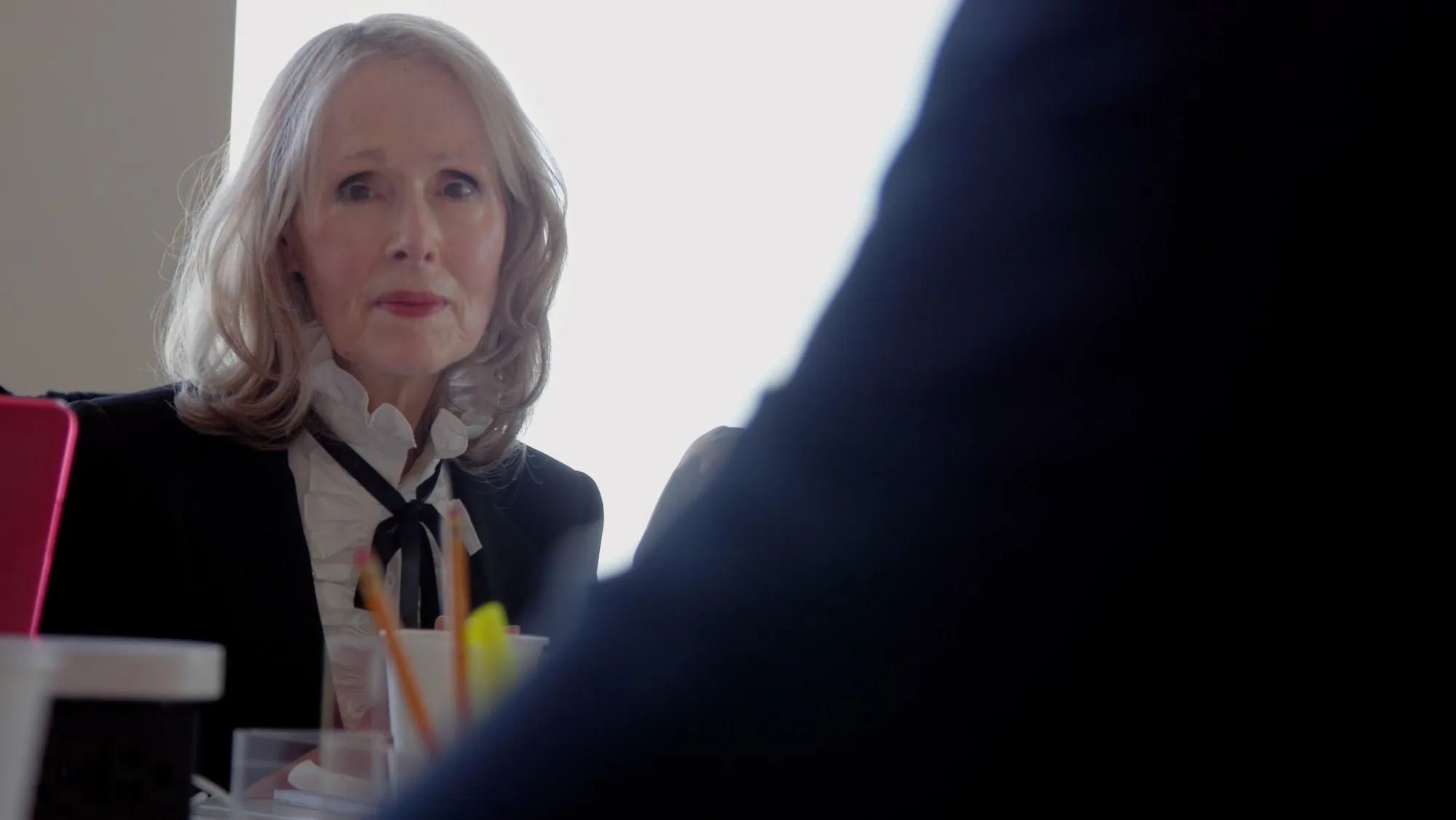
This method is a form of archival psychoanalysis, forcing the viewer to constantly re-evaluate the subject through the clashing textures of her own history. We see the firebrand of the 1990s, all kinetic energy and sharp wit on her own talk show, and then we are immediately cut to the composed but visibly strained woman of today, fighting a quiet battle under the harsh lights of a conference room.
The effect is a potent juxtaposition. This non-linear approach builds a multifaceted portrait, showing how the past self informs, haunts, and strengthens the present one. The structural fragmentation mirrors the psychological fragmentation that can follow trauma. The wealth of source material (talk show clips featuring a young Fran Lebowitz, interviews with lifelong friends, forgotten photographs) creates a specific kind of media nostalgia.
It paints a picture of a bygone New York journalism world, a universe of glossy magazines and boisterous personalities that served as the ecosystem for Carroll’s professional ascent. The film almost mourns this lost world (a time when a writer could become a household name), even as it implicitly critiques the patriarchal systems that allowed predators to flourish within it.
The Adviser’s Paradox
The film’s thematic core is the battle for reputation in an age of weaponized disinformation. Carroll’s lawsuit, as the documentary frames it, was an existential necessity. The accusation that she was a liar was an attack on the very foundation of her career and identity.
This is where the film finds its most profound and unsettling power: exploring the contradictions within its subject. We are confronted with the Adviser’s Paradox. The “Ask E. Jean” of the 1990s was full of confident, direct advice for women; a clip shows her telling a reader to “always press charges.” Yet, for decades, Carroll herself remained silent about her own assault.
This tension is painful to watch, and the film wisely avoids easy judgments. It explores the immense societal pressure on public figures, especially female advice-givers, to live flawless lives that perfectly align with their teachings.
The film compassionately links her personal evolution to the broader cultural shift of the #MeToo movement, suggesting that even a famously self-assured woman needed the ground to move beneath her feet before she could find her own voice. It expertly depicts the psychological toll of the ordeal through subtle visual cues: the slight tremor in her hands during an interview, the long pauses before answering a lawyer’s question, the mask of weary fortitude she wears into court.
The documentary illuminates how the legal system, with its demand for linear narratives and perfect recall, is often a poor instrument for processing the messy, circular nature of traumatic memory. The setting of the assault itself, a Bergdorf Goodman dressing room—a liminal space of fantasy and transformation—becomes a tainted symbol of vulnerability within a temple of female aspiration.
An Incomplete Victory
“Ask E. Jean” succeeds because it refuses to reduce its subject to a simple symbol. Carroll is not presented as a perfect victim or a flawless hero; she is a complex, witty, and sometimes difficult person, captured in her full humanity.
The documentary skillfully balances a celebration of her formidable spirit with a sober acknowledgment of the trauma she has endured. It shows her frankness about her own perceived failings, like her anxiety over whether a jury would find an 80-year-old woman credible, which makes her far more relatable than any polished icon.
The film’s message about her legal victory is appropriately complicated. It is a triumph, certainly, but an incomplete one. The monetary judgment remains a remote concept, a number on a page, while her attacker continues to command a global stage. This reflects a broader societal truth: there is often no satisfying final act in these stories. The battle for one’s own narrative never really ends.
The quiet optimism of the film’s final moments feels almost like a relic from another time, a dispatch from before the full force of the anti-#MeToo backlash was felt. Its lasting impression is not about a single legal case. It is the intricate portrait of a woman’s resilience and the immense personal cost of holding onto one’s own story in an era that seems determined to tear it apart. The film’s greatest value may be as a historical document, a clear-eyed testament to one woman’s experience inside a massive social upheaval.
Full Credits
Director: Ivy Meeropol
Writers: Leah Goudsmit, Ivy Meeropol, Ferne Pearlstein
Producers and Executive Producers: Ivy Meeropol, Andrew Herwitz, Daniel J. Chalfen
Cast: E. Jean Carroll
The Review
Ask E. Jean
"Ask E. Jean" is a thoughtful and psychologically astute portrait of a public figure reclaiming her own story. Its fragmented, non-linear structure powerfully contrasts a vibrant past with a harrowing present. While its optimism can feel slightly dated against the current political climate, the film is an essential document of personal resilience and the complicated fight for one’s name in a deeply fractured time. It succeeds by focusing on the woman, not just the headline.
PROS
- A nuanced and complex portrait of its subject, avoiding simple hero or victim tropes.
- Intelligent non-linear structure that deepens the psychological exploration.
- Excellent use of rich archival footage to build a sense of character and time.
- A sharp focus on the central theme of reputation versus reality.
CONS
- The non-chronological storytelling may be disorienting for some viewers.
- Its concluding tone feels slightly out of step with the current political backlash, making its optimism feel tentative.