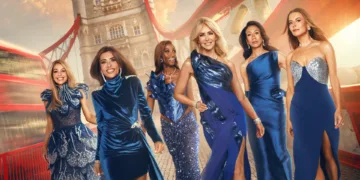

























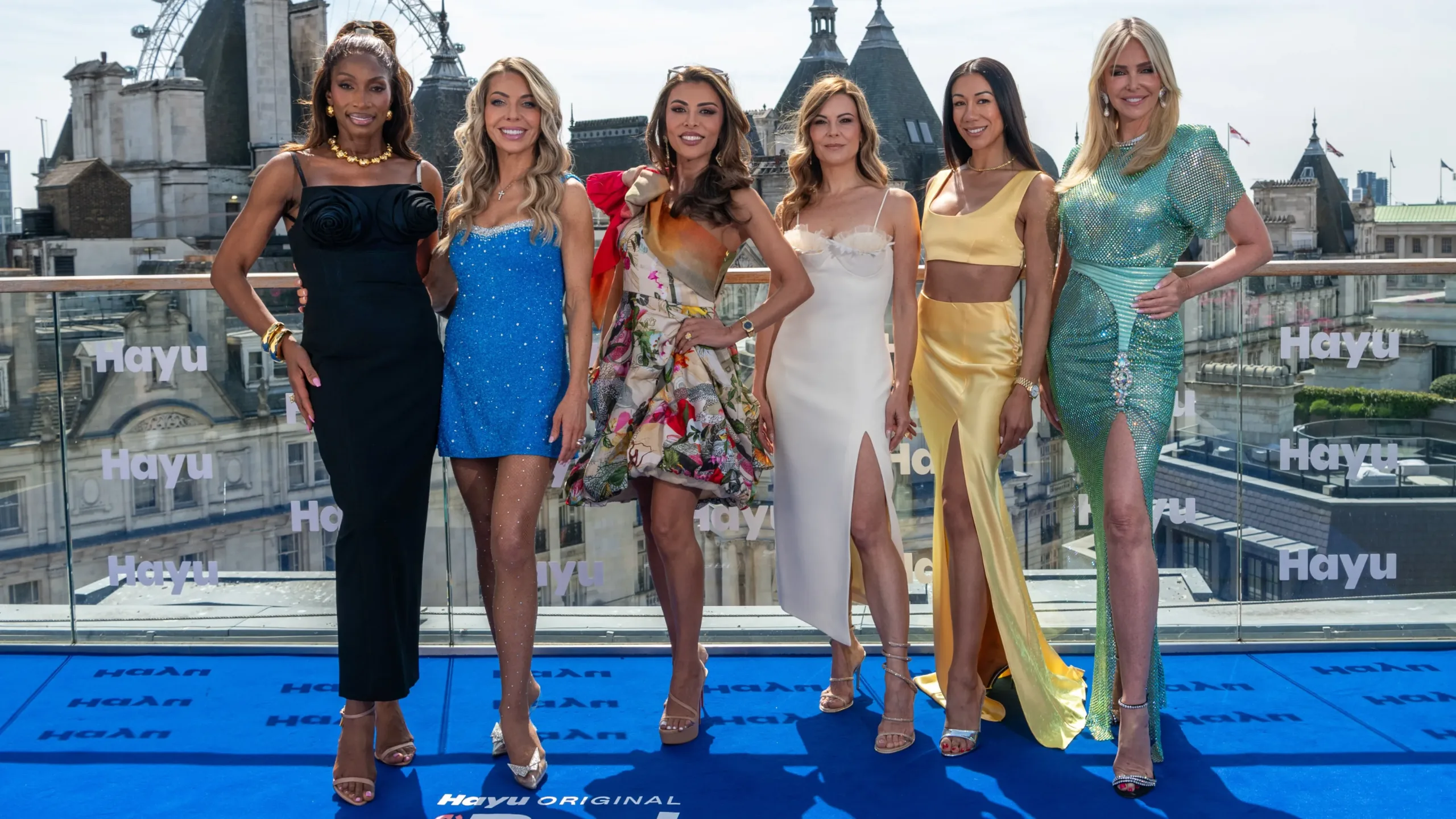
After nearly two decades, the Real Housewives franchise has finally crossed the Atlantic. It has landed, with the clatter of a diamond dropping on a marble floor, in the heart of London. The series wastes no time establishing its territory, a version of the city seen only from the plush leather interior of a Bentley convertible.
This is a London of exclusive postcodes, private members’ clubs, and palatial townhouses where the biggest concern is stationary traffic. Real Housewives of London presents a world so hermetically sealed by privilege that it functions as a piece of speculative fiction. It is a glimpse into the lives of six intensely wealthy women navigating a social ecosystem built on status, lineage, and impeccable floral arrangements.
Lifestyles of the Rich and Ridiculous
The show’s guiding principle is unrelenting extravagance, a visual feast of assets that feels both alienating and hypnotic. The editing works at a brisk pace, cutting between property-porn montages of walk-in shoe closets and aerial shots of royal palaces. It’s a language of pure capital.
This aesthetic is perfectly captured when Amanda Cronin, gliding through Belgravia in her gleaming Bentley, coolly announces, “No cost of living crisis here.” The line is a perfect mission statement, delivered with a serene detachment that borders on performance art. The series understands that its appeal lies in this very disconnect. It offers a form of escapism so extreme it becomes camp.
This sense of theater is everywhere. We are introduced to a taxidermied swan named Gertrude holding court in a drawing room. We watch a labrador named Portia receive a professional spa facial. Amanda’s poodle, Monty True Madness, is waited on “paw and paw,” carried everywhere by staff, his feet seemingly too valuable to touch a public pavement.
The financial disclosures are just as surreal. Panthea Parker recalls a single shopping trip to Harrods where she spent £140,000, helpfully adding her own inflation calculation that this sum would be “equivalent to 300-and-something thousand” today.
Also Read






Elsewhere, Karen Loderick-Peace is installing a swimming pool in her home, a standard feature for the rich, except for the small detail that she cannot swim. This is the show’s central magic trick: it presents a lifestyle so absurd, so cartoonishly opulent, that the audience is invited not to envy it, but to simply stare in bewildered amusement.
A Tour of the Menagerie
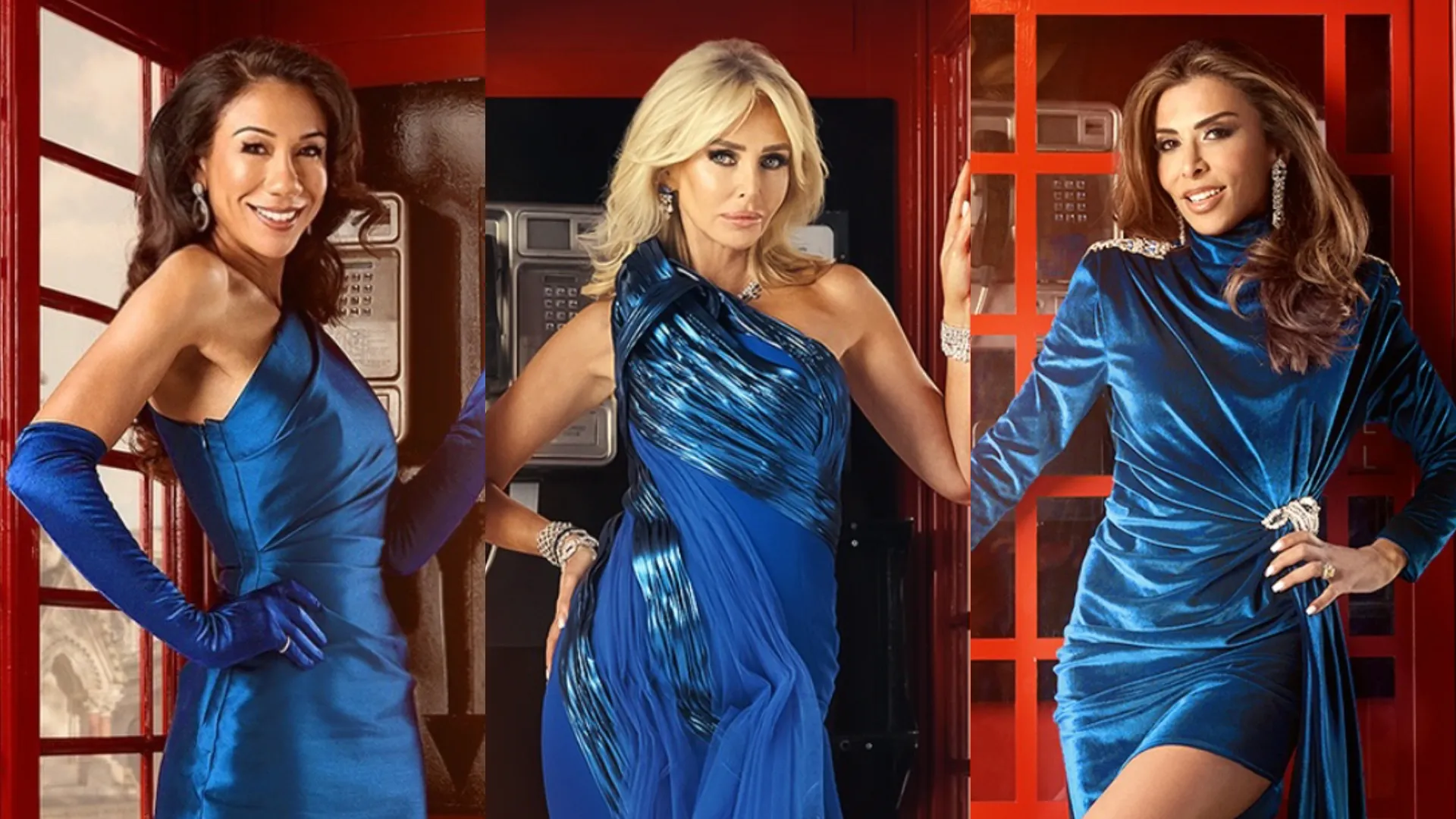
The series assembles a cast of characters who feel both archetypal and uniquely bizarre, each a carefully curated specimen for this London social experiment. Amanda Cronin, a skincare entrepreneur with a brand described as “underperforming,” positions herself as the queen bee.

She demonstrates a masterful grasp of the reality genre’s paradoxes, declaring herself “a really private person” directly to the camera with a straight face. Her most significant relationship appears to be a co-dependent one with her poodle-stylist, Monty. Before a party, she meticulously instructs her housekeeper: “This loo needs to be checked every 15 minutes… Remember. Because it will be carnage in there.” It is a glimpse into a mind for which social presentation is a battlefield.
Then there is Juliet Mayhew, an event planner who accessorizes her life with historical grandeur. Her partner, Tiggy, is a distant relative of William ‘Braveheart’ Wallace, a fact shared with the gravity of a state secret.
Her fashion choices are a spectacle, appearing in a full Elizabethan ruff for a confessional segment, an outfit one might describe as Poundland Elizabeth I. Panthea Parker serves as a primary catalyst for conflict. A stay-at-hearth mother married to a lawyer, she possesses a disarming self-awareness, sighing, “I just feel exhausted! I don’t even do anything! I don’t even work!” before instigating a fight.
From the sidelines, Jamaican fashion designer Karen Loderick-Peace offers a running commentary of sharp, teeth-kissing side-eye. Her motto: “I may be from the Commonwealth, but there’s nothing common about me!”
Rounding out the group is Nessie Welschinger, a baker with royal connections whose husband is an “entrepreneur in the mining industry.” She exemplifies the English “wealth whispers” approach, comparing Amanda to “Snow White and the seven dwarfs, if you were to replace the dwarfs with personal assistants.”
Much Ado About Dentistry
For a show built on conflict, the first major feud is a masterclass in convoluted pettiness. The drama, a multi-layered disagreement involving a mutual friend dentist, is so unnecessarily complex it nearly requires a corkboard and string to decipher.
The alleged crime: the dentist refused to fix Panthea’s son’s braces and instead gave him fillings. Why this is Juliet’s fault remains a mystery the show never bothers to solve. Panthea snarls, “Ever since Teethgate, Juliet’s been fake with me at every single soiree,” but the narrative groundwork is absent. The argument feels awkwardly reverse-engineered into the plot, a pre-existing squabble awkwardly inserted to meet the franchise’s drama quota. It is a structural flaw that makes the conflict feel hollow.
Yet, the flimsy narrative gives way to moments of inspired verbal sparring. The dialogue is often sharper than the plots that generate it, revealing the performers’ skill at landing a punch. An argument about one person’s alcohol intake is met with the acid-tongued retort, “How’s that Ozempic you’ve shot in your body for the last five years?”
The comeback is swift and shameless: “Pretty good, I lost eight kilos.” Another heated exchange produces the instantly iconic yell of “Back to Paddington!” a line that became an internet meme before its episode even aired. These quick, cutting remarks provide genuine entertainment.
Another conflict, where a cast member is ridiculed for borrowing clothes, feels dated in an era of sustainability but is perfectly calibrated for reality television’s economy of shame. The show’s entertainment value, it seems, is found not in the substance of its fights, but in the style of its insults.
An Uneasy Throne
The show’s existence creates a fascinating cultural experiment. It attempts to impose the loud, table-flipping grammar of American reality television onto the famously reserved British upper class. The result is a palpable tension.
American housewives throw wine in each other’s faces; the British tradition, as one observer noted, is for disputes to remain unresolved for decades, simmering in a pot of passive aggression and snarky WhatsApp messages between mutual friends.
The London cast attempts the theatrics, but a sense of national character still bubbles underneath. This is the land of “wealth whispers,” a stark contrast to the loud consumption of their American counterparts.
This cultural friction is the show’s most compelling long-term question. The failure of other luxury-focused British shows has often come down to tone; when the extravagance feels crass instead of camp, audiences recoil. Real Housewives of London walks this line carefully.
Will it force its cast to become more Americanized in their confrontations, shedding their reserve for the sake of good television? Or will it find a new, distinctly British rhythm for its drama, one built on the subtle digs and unspoken resentments that define the nation’s social conflicts? Can a series predicated on direct, explosive arguments truly thrive in a culture that has perfected the art of the insult disguised as a compliment?
The Real Housewives of London is a British reality television series that premiered on Hayu on August 18, 2025. It follows the lives of six women residing in London, England. It is available to stream on Hayu.
Full Credits
Producers and Executive Producers: Monkey Kingdom Productions, Universal Television Alternative Studios.
Cast: Juliet Angus, Amanda Cronin, Karen Loderick-Peace, Juliet Mayhew, Panthea Parker, Nessie Welschinger.
Director of Photography (Cinematographer): Darren Lovell.
The Review
Real Housewives of London
Real Housewives of London succeeds as a spectacle of absurd wealth and campy personalities. The show is at its best when leaning into its ridiculousness, powered by sharp dialogue and a bizarre cast. However, the flimsy, manufactured plots keep it from reaching the franchise's dramatic heights. It is an enjoyably hollow confection, perfect for viewers seeking pure, mindless escapism.
PROS
- Hilariously over-the-top displays of wealth and extravagance.
- A memorable and eccentric cast of characters.
- Sharp, witty one-liners and genuinely funny dialogue.
- Functions as enjoyably mindless, camp entertainment.
CONS
- The central conflicts feel forced, confusing, and lack substance.
- Can be tone-deaf with its flaunting of extreme privilege.
- The pacing sometimes struggles to create genuine dramatic tension.
- An awkward tension exists between British social norms and the American format.