








There is a necessary, almost sacred, function for the court jester, the one figure granted permission to speak unfiltered truth to the king. His weapon is not a sword but a barb, his armor not steel but wit. When this figure vanishes, the court becomes an echo chamber, and the king’s follies metastasize into calamities. A Savage Art, Bill Banowsky’s portrait of the political cartoonist Pat Oliphant, is a chronicle of arguably the 20th century’s most formidable court jester.
It tracks the life of a man who appointed himself the chief mocker of the American empire, a Pulitzer-winning artist who saw hypocrisy as a raw material to be rendered into ink. The documentary serves a dual function: it is a biography of this ferocious Australian import and an autopsy of the art form he so thoroughly dominated, examining what happens when the jesters are all dismissed from the court.
Portrait of the Provocateur
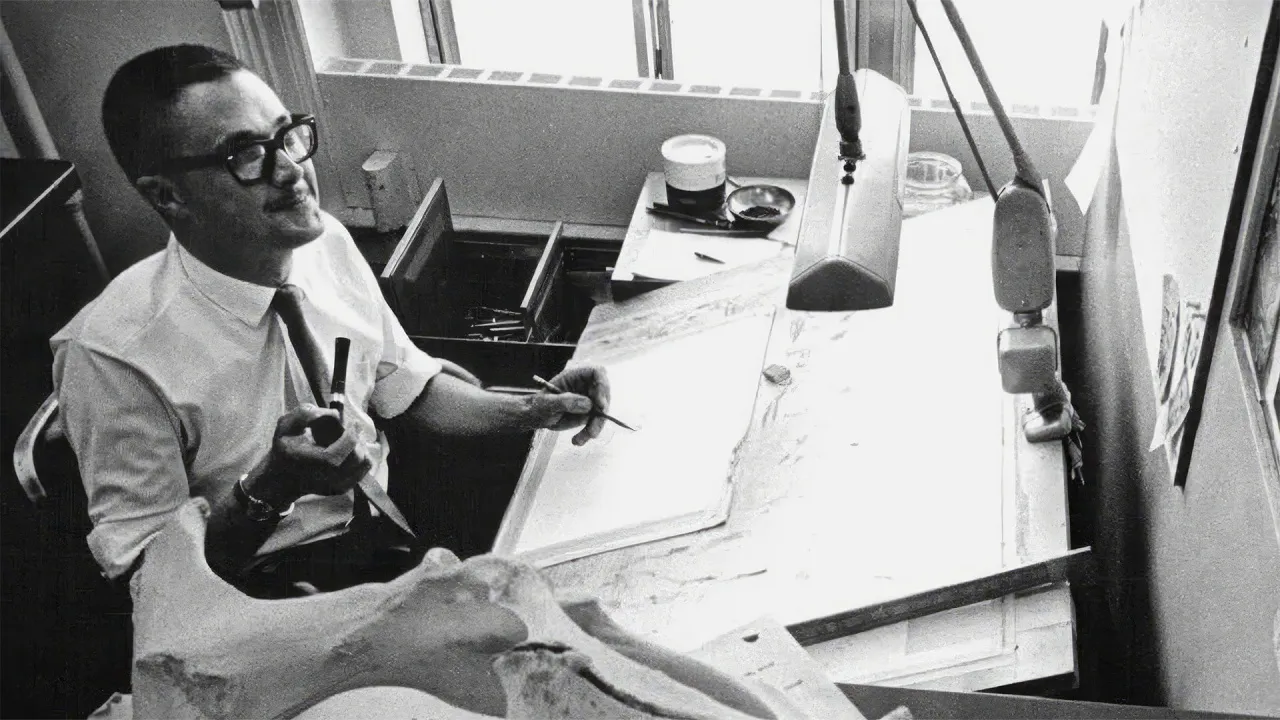
The film traces an unlikely trajectory, following Oliphant from the relative quiet of Australia, where he chafed under the constraints of family papers, to The Denver Post, and finally into the belly of the beast: Washington, D.C. His outsider status proved to be an essential tool, granting him a clarity on American political absurdity that natives often miss.
Here, we see a man fueled by a perpetual state of productive anger. His artistic philosophy was a trinity of demands: the idea must be sharp, the image must register instantly, and the caption must land like a punchline. He confessed he rarely achieved all three, a telling admission from an artist obsessed with perfection.
The documentary lingers on his process, a kind of predatory observation. He deconstructed his subjects, studying a politician’s tics and posture to find the physical manifestation of a moral flaw, boiling down a complex figure like Jimmy Carter to his ever-widening teeth or Ronald Reagan to an increasingly hollowed mask.
This obsessive focus, however, casts long shadows. Friends and family sketch a portrait of a difficult, exacting man, suggesting his relentless public scrutiny was not always left at the office. The film hints that the same impatience with falsehood that made him a great cartoonist made him a challenging presence in private life. Nothing encapsulates his character’s beautiful, infuriating rigidity better than his reaction to winning the Pulitzer Prize in 1967.
He publicly criticized the board, disgusted that they had chosen what he considered his weakest work, a piece whose caption had been altered by an editor. He then refused to be considered for any future Pulitzers. This was not just integrity; it was a form of artistic petulance, a refusal to be defined or validated even by the establishment’s highest honor. Such is the curse of the true provocateur.
A Weaponized Art Form
A Savage Art correctly places Oliphant in a lineage of ink-stained agitators stretching back centuries. The film gives a brief but effective history lesson, invoking Thomas Nast, the artist who famously toppled New York’s corrupt Boss Tweed. Nast’s genius was in creating a single, damning iconography, portraying Tweed as a vulture or a bloated Roman emperor, images that bypassed the need for literacy and spoke directly to an immigrant populace.
His work was a powerful demonstration of the cartoon as a democratic weapon, a way to hold power accountable when written journalism failed. Oliphant was a modern heir to this tradition, updating the tools for a media-saturated age. He understood that his role was not merely to illustrate the news but to give it a moral and emotional shape.
The film’s title is earned through its exploration of this power. Oliphant famously stated that a cartoonist’s job is to “articulate their hate,” a phrase that sounds brutish until you unpack its philosophical weight. He was not advocating for blind rage, but for the act of giving coherent, intelligent form to the public’s latent anger at injustice and hypocrisy. His art was indeed savage because it was meant to wound.
The documentary notes the inevitable blowback, the death threats and furious phone calls from the White House, all of which Oliphant seemed to collect as trophies. He understood that a politician’s comfort was inversely proportional to his own effectiveness. For a cartoonist of his temperament, the silence of the powerful would have been the only true sign of failure, a far worse fate than any angry letter or canceled subscription.
The Twilight of the Cartoonist
The documentary’s final movement is its most melancholic, shifting from a celebration of a career to a postmortem for a craft. The threats are cataloged with grim familiarity: the collapse of newspapers, the consolidation of media into risk-averse corporate behemoths, and the editorial timidity that fears alienating any sliver of the audience.

The internet presents its own cruel paradox, a space where a cartoon can achieve global virality in an hour yet fail to earn its creator a living wage, its authorship stripped away as it becomes another piece of digital flotsam. The film draws an unspoken but devastating contrast between Oliphant’s handmade, intellectually rigorous satire and the contemporary flood of disposable memes.
What we are witnessing is the memeification of dissent, a process that replaces the authored, accountable critique of an Oliphant with the anonymous, fleeting catharsis of a shared image. A meme requires no courage; it has no author to threaten, no career to endanger. Oliphant’s name was on every piece, a declaration of responsibility. This new landscape favors partisan cheerleading over the non-partisan takedowns that were Oliphant’s specialty.
The final, poignant irony the film touches upon is Oliphant’s failing eyesight. A man who built a legacy on the act of seeing, of observing the world with an unforgiving eye, slowly loses his vision just as the world seems to be losing its appreciation for his kind of sight. The film leaves us with the unsettling question of what happens to a society when the assassins of the page are gone, leaving the emperors with no one to point out they have no clothes.
A Savage Art: The Life & Cartoons of Pat Oliphant is a feature-length documentary chronicling the life and celebrated five-decade career of the Australian-born, Pulitzer Prize-winning political cartoonist Patrick Oliphant. Known for his biting wit and sharp drawings, Oliphant fearlessly took on ten U.S. Presidents, popes, and the American corporate class. The film was released in a limited capacity starting on September 5, 2025, and runs for 88 minutes. It was distributed by Magnolia Pictures, and availability for streaming or purchase can typically be found through major digital video platforms or services that carry Magnolia Pictures titles.
Full Credits
Director: Bill Banowsky
Writers: Dean Alioto, Bill Banowsky, Paul O’Bryan
Producers and Executive Producers: Bill Banowsky, Paul O’Bryan, Dean Alioto, Michael Linn
Cast: Pat Oliphant, Terry Allen, Everett Byram, Susan Conway, Maureen Dowd, Eric Gibson, Tom Gibson, Adam Zyglis
Director of Photography (Cinematographer): Mayo Whaley
Editors: Dean Alioto, Michael Linn, Mayo Whaley
Composer: Geneviève Gros-Louis
The Review
A Savage Art: The Life & Cartoons of Pat Oliphant
A Savage Art is a sharp, intelligent portrait of a uniquely ferocious artist and a somber reflection on the disappearing world of print journalism. While structurally a conventional documentary, it excels as both a compelling biography of the uncompromising Pat Oliphant and a vital elegy for the art of political cartooning. The film powerfully argues for the necessity of pointed, handmade satire in an age of disposable digital anger. It is a thoughtful and melancholic tribute to a man and a medium that held power accountable, one scathing drawing at a time.
PROS
- A fascinating and complex portrait of its central subject, Pat Oliphant.
- Provides insightful historical context on the power and purpose of political cartooning.
- Effectively explores the timely theme of the decline of print media and thoughtful satire.
- Features a compelling gallery of Oliphant's witty and ferocious artwork.
CONS
- Follows a conventional documentary structure that may feel familiar to viewers.
- The focus on Oliphant's personal life is somewhat brief, leaving the man partially obscured by his work.
- The tone can feel more like an academic appreciation than an intimate cinematic story.