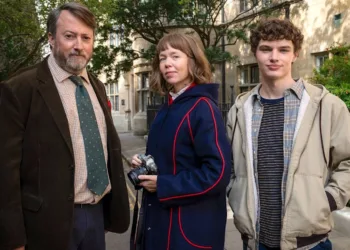














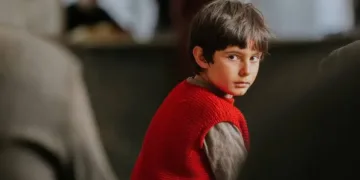











The school year begins with an ascent. The camera climbs a steep road to a building where a new life awaits. It is a fitting start for a story about the challenges of finding one’s footing. For Frederika, a 17-year-old Swedish transplant nicknamed Fred, this climb is both literal and metaphorical.
Having moved to the Italian port city of Trieste with her father, she enrolls in the local technical high school for her final year. She soon discovers she is the only girl in a class filled with boys. The film, set in 2007 against a backdrop of a changing Europe, immediately establishes its central tension. It poses a sharp question about how a young woman can navigate a deeply masculine environment, attempting to build friendships while defending her own identity.
The Geography of Belonging
Trieste is not merely a setting in A Year of School; it is a thematic core, a city whose very identity is built on a history of contested and dissolving lines. This port was once the gateway to the Austro-Hungarian Empire, a melting pot of Italian, Slavic, and Germanic cultures.

Director Laura Samani situates her story in 2007, the precise year that Slovenia’s entry into the Schengen Area erased the hard border just beyond the city’s suburbs. This political act of dissolution echoes throughout the film, which is itself preoccupied with the crossing of boundaries. The most pronounced is the gendered line Fred crosses each morning as she walks into a male institution.
Another is linguistic. Her progression from the neutral English of an outsider to functional Italian and finally to the intimate, almost impenetrable Triestine dialect is a map of her social journey. Each new word is a step deeper into a world that is not her own.
The film captures this preoccupation with frontiers in quiet, potent moments, such as a tender scene staged in a defunct border guard post. The external landscape of shifting frontiers perfectly mirrors the internal world of adolescents, who live on the fraught border between childhood and the people they are about to become.
A Four-Sided Triangle
At the film’s center is an unstable quartet of characters, brought to life with a raw authenticity by its first-time actors. Stella Wendick’s Fred is a magnetic presence, full of spirited curiosity and a deep, sometimes painful, desire for connection. She is not a passive object of attention but an active agent trying to shape her own social world.

Her arrival shatters the comfortable equilibrium of three inseparable friends, a classic triumvirate of adolescent archetypes. There is Antero, the gentle, poetry-reading intellectual; Pasini, a handsome womanizer whose swagger masks a private sorrow over his brother’s death; and Mitis, the group’s protective, good-natured leader.
Fred seeks entry into their circle, a camaraderie that promises acceptance as an equal. The boys, however, see her as a prize to be won, and their individual desires quickly curdle their friendship into jealousy and conflict.
Fred endures a stream of aggressions, from the casual cruelty of sexist graffiti on a school wall to the profound humiliation of having her clothes stolen after a shower. Her resilience in these moments is a defining trait; she refuses the mantle of victimhood, fighting to be seen as a peer in a place that only wants to see her as prey or a trophy.
The Perils of Charm
Laura Samani frames her story with an aesthetic of youthful vibrancy, a stylistic choice that creates the film’s central, troubling contradiction. The screen is often filled with natural light and warm colors, accompanied by an energetic, era-specific indie pop soundtrack and punctuated by day-glo opening credits. This gives the film the appealing surface of a breezy, optimistic coming-of-age tale.

A difficult tension arises from this approach, as the charming atmosphere frequently clashes with the story’s darker undercurrents of sexism and emotional cruelty. The film presents the boys’ toxic behavior but seems hesitant to hold them truly accountable, sometimes leaning into a forgiving “boys will be boys” attitude that feels starkly dated.
Moments of victim-blaming, including from her teacher and father, are introduced and then brushed aside as she is pulled back into the boys’ orbit. This raises a critical question: is the tonal dissonance a deliberate, sophisticated choice to depict the moral messiness of youth, or is it a significant miscalculation that undermines the severity of Fred’s experience?
The film’s strengths are many, from its powerful performances to its thematic depth. It leaves, however, a lingering unease about whether its undeniable charm is enough to offset its questionable moral stance.
A Year of School had its premiere in the Orizzonti section of the 82nd Venice International Film Festival on August 31, 2025. The movie will be released in Italy by Lucky Red. Currently, there is no information about its streaming availability.
Full Credits
The Review
A Year Of School
A Year Of School is a film of frustrating contradictions. It is beautifully shot, thematically rich, and anchored by four stunningly natural performances from its young leads. Yet, its breezy, sun-drenched charm creates a dissonant shell for a story that fails to reckon with the toxicity at its core. By excusing its male characters' cruelties with a nostalgic shrug, the film trades moral clarity for an unearned optimism, leaving a potent but unsettling final impression.
PROS
- Four excellent and authentic lead performances.
- Intelligent use of the Trieste setting to explore themes of borders and identity.
- Warm, naturalistic cinematography.
- A compelling central premise about a young woman navigating a masculine space.
CONS
- A significant tonal clash between its lighthearted style and serious subject matter.
- Fails to hold its male characters accountable for sexist and cruel behavior.
- The narrative ultimately presents a troubling and dated message.