





















There are places on a map that seem to exist purely as a dare. Remis, the setting for Paolo Strippoli’s The Holy Boy, is such a place. A remote Alpine village that ironically brands itself “The Valley of Smiles,” it carries the ghost of a past train crash that decimated its population.
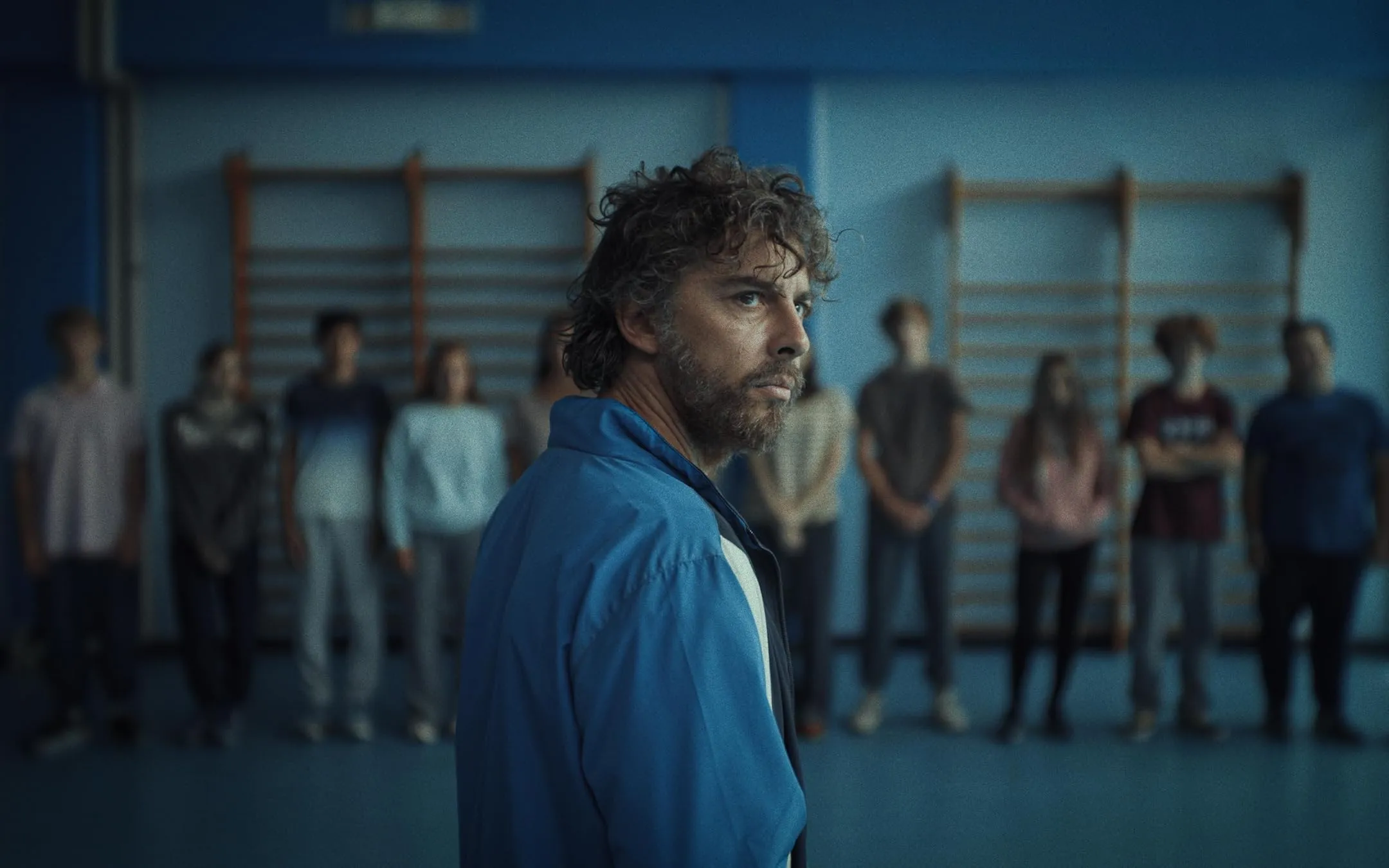
Into this pocket of performative contentment arrives Sergio (Michele Riondino), a former judo champion whose own soul has been pile-drived by grief. He is here to be a substitute teacher, an occupation for which his abrasive misery makes him uniquely unsuited. He is the discordant note in the town’s forced harmony.
At the center of this strange peace is Matteo (Giulio Feltri), a solitary fifteen-year-old boy who is regarded with a reverence usually reserved for relics or lottery winners. The film soaks itself in a particularly Italianate dread, a kind of weird Catholicism where serenity is the most sinister state of all. The quiet streets and fixed smiles suggest a social contract written in blood, or at least in tears. One is left to wonder what currency pays for this much happiness, and what happens when a man like Sergio, who is emotionally bankrupt, shows up to audit the books.
The Saint of Transferred Pain
The film hangs on the gravitational pull between its two poles: the outsider and the saint. Sergio is a fascinatingly difficult protagonist, a man whose attempt to “save” Matteo is hopelessly tangled in his own selfish need for paternal redemption. A former champion, a specimen of masculine action, he is now adrift, rendered inert by sorrow.
His mission to protect the boy is a desperate gambit to reclaim a sense of purpose. Riondino’s performance is powerfully physical; he carries his grief in the slump of his shoulders, a man literally weighed down by the invisible. He wants to protect the boy from the town’s exploitation, yet he also uses him to fill the son-shaped crater in his own life.
Then there is Matteo, the boy-god. His is a case of what one might call empathic vampirism; he absorbs the pain of others, leaving them blissfully empty in a transaction that raises troubling questions of consent and emotional labor. It is a miracle that is also a prison. Newcomer Giulio Feltri is a revelation, his non-actor status lending an authentic strangeness to the role that a more polished performer might miss.
Also Read





He makes Matteo an unnerving blank slate, a quiet cipher hovering perpetually on the knife’s edge between savior and monster. His isolation is sharpened by a queer longing for a bullying classmate, a secret that mirrors the town’s larger, foundational repression. Their relationship, Sergio and Matteo’s, becomes a fragile, dangerous surrogate bond. It is a folie à deux fueled by shared loneliness, a connection that feels both redemptive and certain to curdle.
The Architecture of Denial
The Holy Boy stages a philosophical referendum on pain itself. Is suffering a sickness to be cured or a fundamental component of a meaningful existence? Remis has chosen the former, outsourcing its collective trauma to a child in a ritual of communal grief-laundering.

The horror here is not a creature but an ideology, a chilling precursor to our own wellness culture that insists on good vibes only. It is a critique of the curated perfection seen on social media, a “Valley of Smiles” on a global scale, where any admission of sorrow is a crack in the facade.
The film’s entire aesthetic is built to serve this theme. Strippoli’s direction takes Catholic ritual—confession, the veneration of saints—and twists it into something grotesque and pagan. The town has formed its own schismatic sect with Matteo as its unwilling messiah, a commentary on how institutions can be co-opted to serve communal pathology.
Cinematographer Cristiano Di Nicola constructs this world with suffocating precision. The desaturated Alpine vistas are both majestic and imprisoning, the mountains serving less as scenery and more as prison walls. Wide-angle lenses turn cozy, wood-heavy interiors into claustrophobic pressure cookers. This feeling is amplified by a score heavy with liturgical overtones, the literal soundtrack to the town’s self-deception. The film moves with the patience of a predator, its horror emerging from the slow, agonizing peel of a social order revealing the rot underneath.
When the Reservoir Overflows
Predictably, the reservoir of repressed agony cannot hold. When the town’s fragile system finally shatters, it does not do so with a whisper but with a shriek. The violence that erupts is the inevitable physical manifestation of suppressed psychological pain, a societal panic attack made flesh.

The townspeople are not fighting a monster; they are imploding from the immense pressure of their own lie. Sergio’s meddling acts as the detonator, and the resulting explosion is one of communal hysteria. Strippoli smartly stages the film’s climax less as a special-effects showcase and more as a terrifying piece of crowd choreography, a portrait of a mob turning on its own magical thinking.
The finale stacks one frantic set piece upon another. This might be a flaw in a lesser film, but here it feels like a deliberate choice to deny the audience a simple catharsis. The chaos continues because the root problem—the refusal to accept pain as part of life—is not something that can be vanquished in a final battle.
The film’s structure mimics the messy, unresolved nature of trauma itself. The Holy Boy is a potent, uncomfortable reminder that in an age of quick fixes, there are no shortcuts through grief. It suggests that a society that pathologizes sadness will inevitably create its own monsters. An angel’s embrace, it turns out, can inflict a wound far deeper than any claw or tooth.
“The Holy Boy” is a 2025 horror film that premiered at the 82nd Venice International Film Festival on August 30, 2025. The movie had a theatrical release in Italy on September 17, 2025. At this time, a streaming release date has not been announced.
Full Credits
Director: Paolo Strippoli
Writers: Jacopo Del Giudice, Paolo Strippoli
Producers: Laura Paolucci, Domenico Procacci
Executive Producers: Ines Vasiljević
Cast: Michele Riondino, Giulio Feltri, Paolo Pierobon, Romana Maggiora Vergano, Sergio Romano, Anna Bellato, Sandra Toffolatti, Gabriele Benedetti, Diego Nardini, Roberto Citran
Director of Photography (Cinematographer): Cristiano Di Nicola
Editors: Federico Palmerini
Composer: Federico Bisozzi, Davide Tomat
The Review
The Holy Boy
A deeply intelligent and unsettling piece of folk horror that smartly critiques modern society's aversion to pain. While its frantic finale occasionally muddles its profound ideas, The Holy Boy is a masterfully crafted and chilling meditation on the necessity of our own demons. It is a haunting film that lingers long after the manufactured smiles have faded.
PROS
- A thought-provoking premise that explores complex themes of grief, faith, and communal repression.
- Strong, atmospheric direction and moody, effective cinematography.
- Excellent central performances, particularly from newcomer Giulio Feltri as the enigmatic Matteo.
- Builds a palpable sense of psychological dread and sustained tension.
CONS
- The narrative feels overstuffed at times, with a climax that verges on chaotic.
- Some supporting characters are underdeveloped.
- Its philosophical, slow-burn pace may not appeal to all horror audiences.