
















![Kingdom Hearts Collection [I-III] Review](https://gazettely.com/wp-content/uploads/2026/10/Kingdom-Hearts-Collection-I-III-1-360x180.webp "Kingdom Hearts Collection [I-III] Review: KHII Holds Steady as Newer Entries Fluctuate 40")

The fear of what lies beneath the bed is a primal, near-universal childhood anxiety. Bryan Fuller’s Dust Bunny gives that fear teeth. Big ones. The film posits a world where a child’s conviction can physically manifest its subject, and for young Aurora, the monster under her floorboards is terrifyingly real.
After it consumes her parents, she does the only logical thing a hard-boiled ten-year-old can do: she empties her piggy bank to hire the hitman across the hall to kill it. What follows is an exquisite dark fable, a story that balances genuine sweetness with a sharp, macabre edge. The film operates as a fractured bedtime story, one where the moral is written in blood and the princess must negotiate a contract on her own personal demon.
A Chiaroscuro Nursery
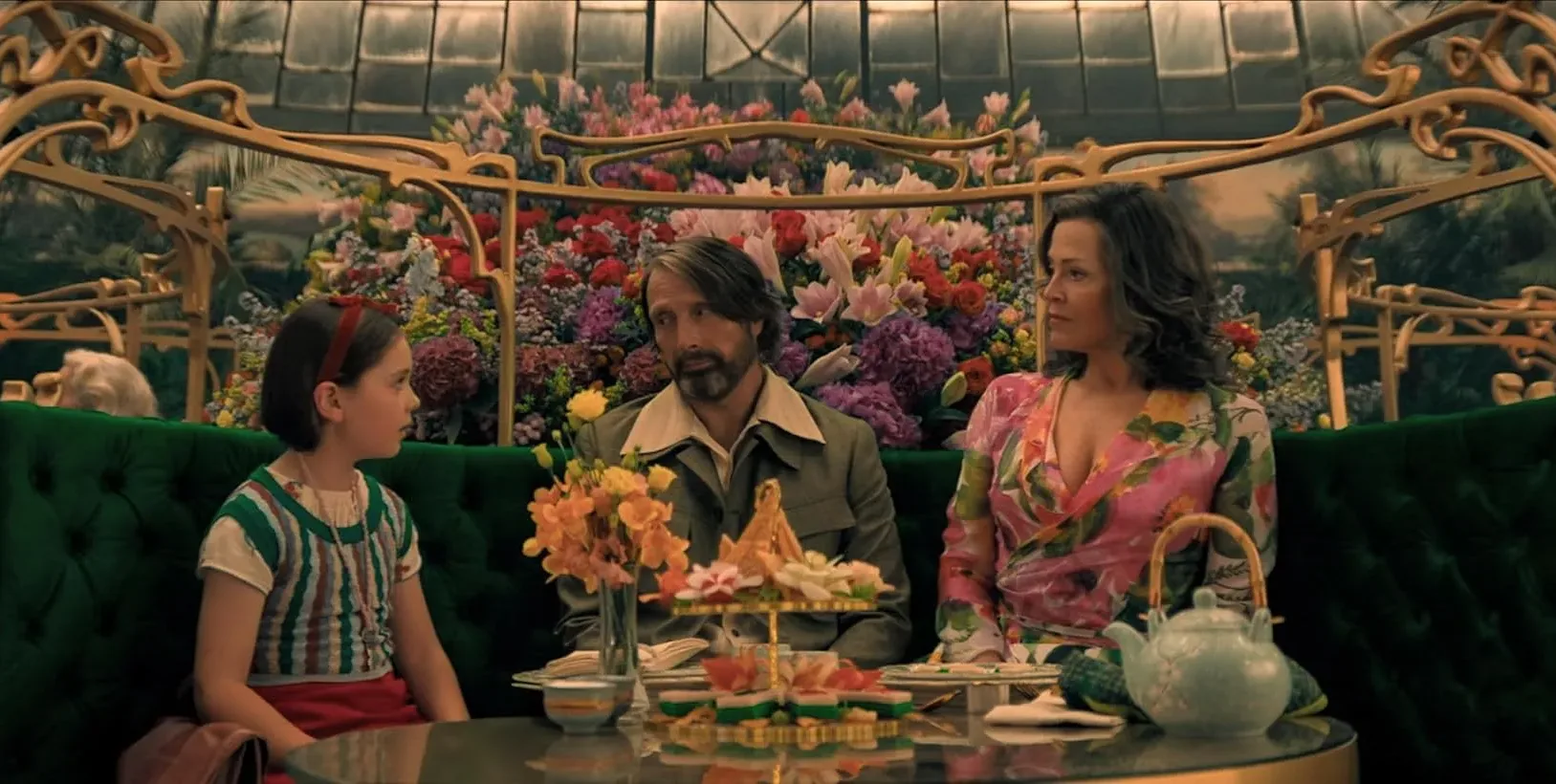
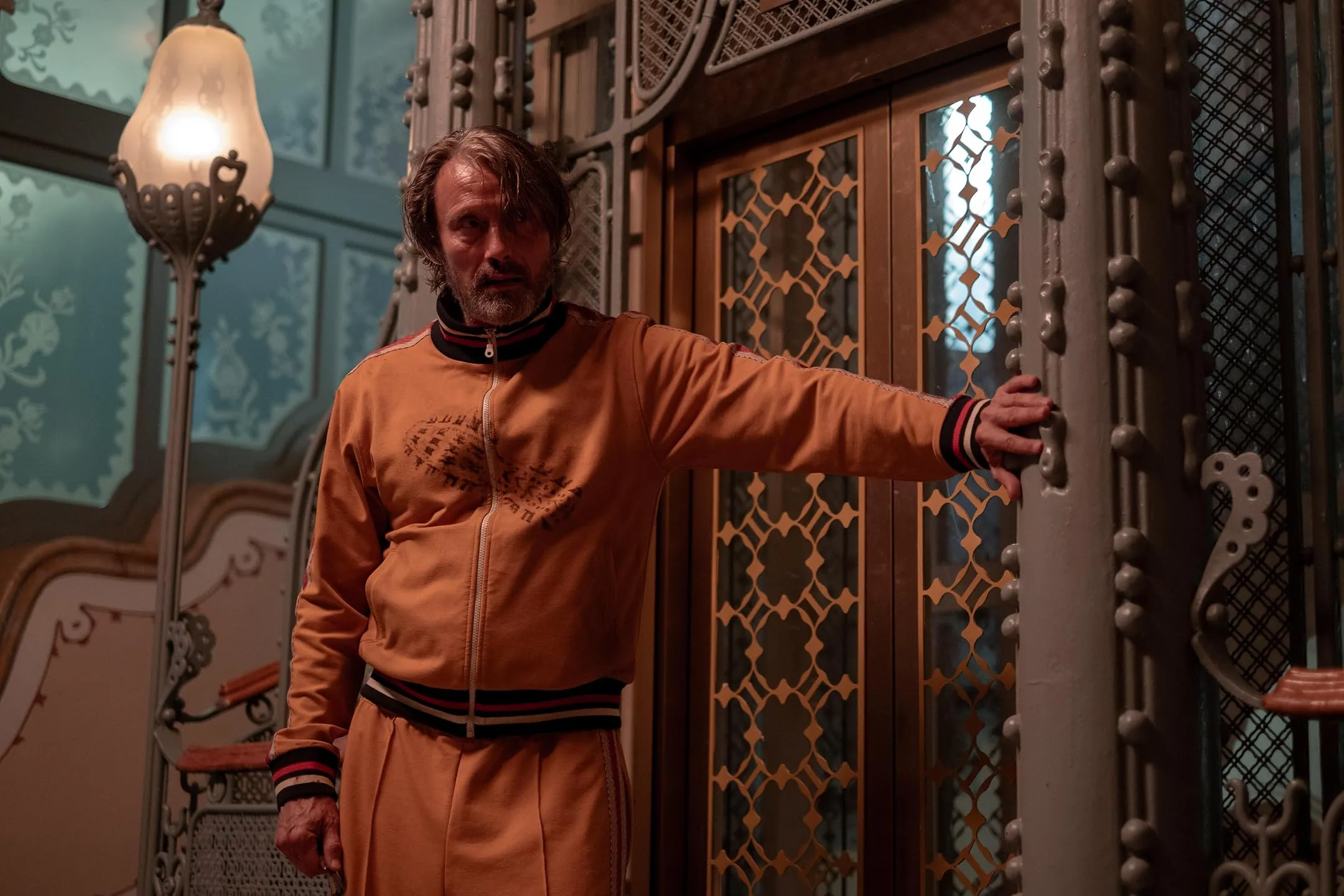
Fuller’s aesthetic has always been one of manicured excess, and here it is weaponized into a full narrative principle. The film is a masterclass in whimsical decay, a visual style where beauty is inseparable from rot. The central apartment building is an impossibly ornate pre-war labyrinth, its interiors suffocating under layers of floral wallpaper and dusty, intricate patterns that seem to actively encroach on the characters.
Cinematographer Nicole Hirsch Whitaker saturates the frame in a deliberately sickly palette; putrid Pepto-Bismol pinks and deep, shadowy crimsons feel less like a fairy tale and more like a fever dream. This carefully controlled world is rendered through a lens of deep subjectivity. The camera refuses to be a passive observer, instead gliding through rooms with an unnerving smoothness and employing antiquated techniques that heighten the artifice.
Split diopter shots create jarring compositions, forcing foreground and background into an unnatural, tense relationship. Classic iris wipes and deep chiaroscuro lighting give the proceedings an expressionistic, almost noirish texture that recalls the cinematic language of the 1920s. This is not objective reality.
It is Aurora’s world, a place where the architecture of her mind dictates the laws of physics. The visual language is the film’s first argument: belief shapes reality, and a child’s psyche is a powerful, dangerous force of creation.
An Unsentimental Education
At the story’s turbulent center is the unlikely pact between the child and the killer, a relationship built on transaction rather than sentiment. Sophie Sloan’s Aurora is no innocent victim; she is a precocious, almost unnervingly direct protagonist, forged into a pragmatist by a life of instability.
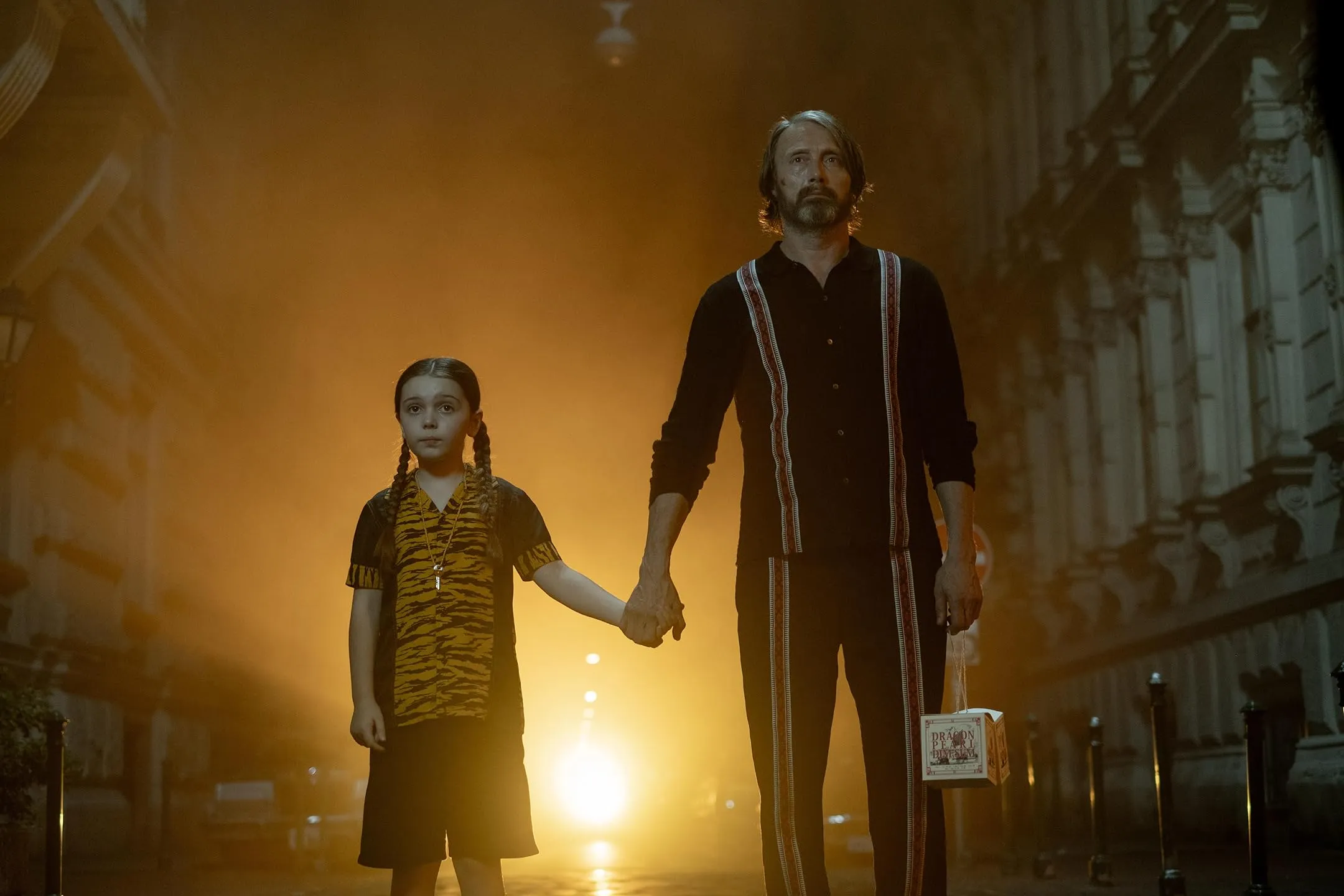
Her dialogue is clipped, her gaze steady. Across from her sits Mads Mikkelsen’s unnamed hitman, a man of stoic professionalism whose icy reserve is pricked by a strange, unplaceable sense of guilt. Their chemistry is magnetic, born not of affection but of a shared wavelength of grim purpose. He is a man who eliminates problems; she has a problem that needs eliminating.
Their strange bond solidifies over a lesson in body dismemberment in a bathtub, a moment of such deadpan absurdity that it becomes perversely tender. It is a practical education for an impractical world. Surrounding them are perfectly pitched caricatures who amplify the film’s tonal dissonance.
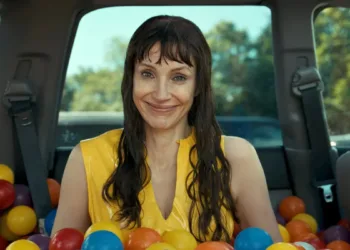
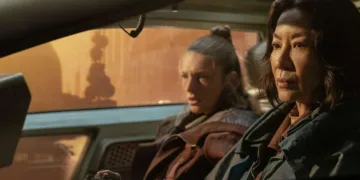
Sigourney Weaver’s handler is a vision of corporate amorality, discussing murder with the same cool detachment as a quarterly report. She represents a clean, professional evil that contrasts sharply with the messy, emotional chaos of Aurora’s monster. David Dastmalchian’s brief appearance as a sensitive goon further illustrates the film’s high-wire act.
The Metaphysics of Malevolence
The monster is, of course, a metaphor, but the film smartly treats it as a literal, ravenous threat. This approach allows the philosophical subtext to surface organically, without didacticism. The creature is the physical embodiment of Aurora’s profound self-loathing, a child who states with chilling certainty that she is “wicked” and undeserving of a family.
Her trauma is given form, a hungry beast that consumes anyone who tries to love her. This raises potent questions about culpability and creation. Did she will this monster into existence through her own anger, or is she merely the victim of a malevolence she cannot control? Dust Bunny expertly navigates its tonal tightrope, functioning as an approachable gateway horror film without sacrificing its darker thematic currents.
It is an action film with a body count, yet also a poignant story about the messy business of psychic integration. The film argues against simple exorcism. One does not kill their monsters; one learns to live with them, perhaps even to aim them at the proper targets. The resolution is not the monster’s destruction but the formation of a new, broken family unit. Their alliance is a testament to the idea that solace is found not in purity, but in finding others whose damage is compatible with your own.
The film premiered at the Toronto International Film Festival on September 9, 2025. It will have a theatrical release in the United States on December 5, 2025, from Lionsgate and Roadside Attractions.
Full Credits
Director: Bryan Fuller
Writers: Bryan Fuller
Producers and Executive Producers: Basil Iwanyk, Erica Lee, Bryan Fuller
Cast: Mads Mikkelsen, Sigourney Weaver, Sophie Sloan, David Dastmalchian, Rebecca Henderson, Sheila Atim
Director of Photography (Cinematographer): Nicole Hirsch Whitaker
Editors: Lisa Lassek
Composer: Isabella Summers
The Review
Dust Bunny
A visually resplendent and emotionally sharp fairy tale, Dust Bunny is a triumph of tonal control. Bryan Fuller crafts a magnificent world of whimsical decay, anchored by the magnetic, unsentimental chemistry between Mads Mikkelsen and Sophie Sloan. It is a sophisticated, macabre, and surprisingly sweet examination of childhood trauma, proving that some of the most profound stories are found in the darkest corners of the imagination. A stunning directorial feature debut.
PROS
- A stunning and distinctive visual design that fully realizes its world.
- Exceptional chemistry between the stoic hitman and the hard-boiled child.
- A masterful tonal balance of macabre horror, dark comedy, and sincere heart.
- An intelligent and accessible exploration of internal trauma.
- Strong, memorable performances from the supporting cast.
CONS
- The highly stylized, maximalist aesthetic may be overwhelming for some viewers.
- Its blend of violent action and fairy-tale logic can feel occasionally jarring.
- The final thematic resolution might strike some as a bit too simple.