
























![Kingdom Hearts Collection [I-III] Review](https://gazettely.com/wp-content/uploads/2026/10/Kingdom-Hearts-Collection-I-III-1-360x180.webp "Kingdom Hearts Collection [I-III] Review: KHII Holds Steady as Newer Entries Fluctuate 37")




The Amazon does not merely exist; it consumes. Aerial shots present it as an impenetrable green carpet, a static ocean of canopy that swallows light, sound, and wreckage with equal indifference. Into this primordial setting, Lost in the Jungle drops its audience without ceremony. The film documents the aftermath of a May 2023 Cessna crash deep within Colombian territory, an event that instantly erases three adults from existence.
The sole survivors are four Huitoto siblings, the eldest a girl of thirteen, the youngest an infant. What follows is not a simple story of being found. It is a chronicle of a 40-day ordeal, a meticulous account of the sprawling search operation, and a quiet meditation on what it takes to persist when the world has fallen away. The film sets a grim, procedural tone from its first frames.
Phantoms in the Foliage
Directors Chai Vasarhelyi and Jimmy Chin, joined by Juan Camilo Cruz, structure their film along two parallel tracks that rarely intersect. One follows the physical search, a logistical beast rendered through a familiar toolkit of talking heads, archival ground footage, and darkly lit reenactments. This procedural spine is competently assembled, building a steady rhythm of hope and frustration.
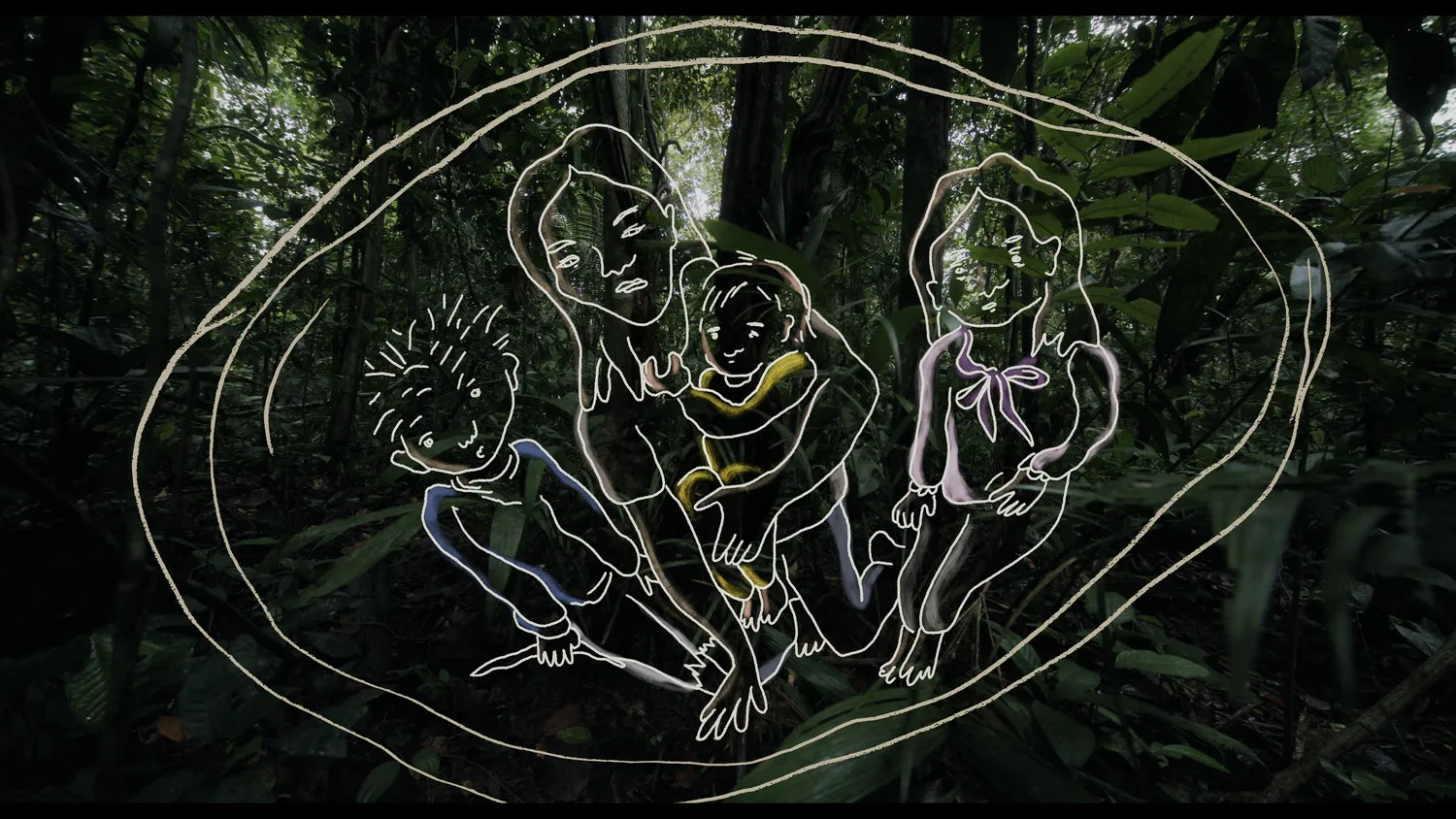
The pacing is deliberate, mirroring the agonizingly slow work on the ground. The other, more ethereal track attempts to capture the children’s experience. Here, the filmmakers make their boldest aesthetic choice. As the eldest child Lesly narrates, her memories are rendered in translucent, ghostly animations drawn over shots of the real jungle.
This is a classic expressionistic technique, a visual analog for a subjective state that defies objective depiction. The effect is profoundly ambivalent. This framing preserves the children’s privacy while turning their ordeal into a kind of folktale. Yet it also creates a frustrating psychic distance, holding the viewer at arm’s length from the visceral reality of their predicament.
We are told of Lesly’s ancestral knowledge, but the precise mechanics of survival remain a phantom, as fragmented and elusive as a child’s memory of trauma. The film denies the audience the satisfaction of a wilderness survival tutorial, a wise choice that elevates its focus from the practical to the existential.
The Searchers
The film finds its most potent philosophical ground in the uneasy alliance between its two search parties. This is where the narrative moves beyond a simple rescue and becomes an examination of a nation’s soul.
On one side, the Colombian Special Forces arrive with helicopters and military discipline, men trained to impose order on chaos through grid searches and technology that seems almost comically impotent against the jungle’s scale. On the other, local indigenous trackers move through the forest with a quiet fluency, their knowledge less a science and more an inherited instinct.
The initial frames showing their interactions are thick with a mistrust born from a long, bloody history of colonization and conflict. Theirs is a clash of epistemologies: the empirical world of maps versus the spiritual world of ayahuasca ceremonies and communion with the forest. The documentary carefully tracks the slow erosion of military skepticism, showing how the soldiers’ clipped certainty gives way to a grudging, then genuine, respect.
The jungle itself becomes the great equalizer. It is a powerful narrative, showing a pragmatic reconciliation forced by an unforgiving environment. Still, the camera’s perspective remains that of a respectful observer, documenting indigenous ritual without ever fully inhabiting its worldview. It approaches these traditions with care, yet one feels the invisible barrier between documentation and understanding.
A Different Kind of Danger
Beneath the immediate life-or-death struggle lies a darker, more complicated human story, a psychological thriller nested within the survival narrative. The film methodically reveals the family’s backstory, exposing a grim reality of domestic abuse that precipitated the mother’s fateful flight.
The children’s father, Manuel, becomes a figure of profound moral ambiguity, a classic noir archetype caught in a web of his own making. He joins the search, his voice broadcast through the jungle, yet the filmmakers juxtapose his grief with family testimony that the children might be hiding from the sound of that very voice.
This sub-narrative introduces a chilling dread, suggesting the jungle is not the only threat. The editing choices during his interviews are masterful, subtly sowing seeds of doubt without overt accusation. His presence complicates the clean lines of the survival tale. The eventual rescue provides a necessary catharsis, a moment of profound relief that the sound design amplifies with swelling music.
The film uses this to build a message about resilience and cooperation, a resolution that feels earned yet slightly too tidy for the messy human truths it so skillfully unearthed. It offers an uplifting note that, while emotionally effective, softens the story’s sharper, more unsettling edges.
Lost in the Jungle, a 96-minute documentary film, tells the extraordinary true story of four Indigenous children who survived a plane crash in the Colombian Amazon in May 2023 and endured 40 days alone in the jungle. The film had its world premiere at the 2025 Telluride Film Festival. Presented by National Geographic Documentary Films, the documentary is scheduled to air on National Geographic on September 12, 2025, and will be available for streaming the following day on Disney+ and Hulu.
Full Credits
Directors: Elizabeth Chai Vasarhelyi, Jimmy Chin, Juan Camilo Cruz
Producers and Executive Producers: Mark Grieco, Juan Camilo Cruz, Elizabeth Chai Vasarhelyi, Jimmy Chin, Anna Barnes, Simon Chinn, Jonathan Chinn, Guillermo Galdos, Carolyn Bernstein, Tim Horsburgh, Josh Braun, Luis Del Valle, Hollman Morris
Cast: Lesly Jacobombaire Mucutuy, Soleiny Jacobombaire Mucutuy, Tien Jacobombaire Mucutuy, Cristin Jacobombaire Mucutuy
Director of Photography (Cinematographer): Max Preiss
Editors: Deborah Dickson, Flavia de Souza
Composer: Claudia Sarne
The Review
Lost in the Jungle
Lost in the Jungle is a methodically crafted documentary that succeeds more as a philosophical inquiry than a visceral survival story. It skillfully dissects the cultural friction between modern militarism and ancestral wisdom, using the harrowing search as a crucible for a nation's soul. While its central stylistic choice—using animation to depict the children’s ordeal—creates a frustrating distance, the film’s tense exploration of a dark family history adds a welcome layer of noirish complexity. It is a thoughtful, compelling, and commendably respectful piece of filmmaking that prioritizes intellectual depth over simple emotional catharsis.
PROS
- Explores the rich philosophical clash between military and indigenous worldviews.
- Adds a compelling layer of psychological tension through the complex family backstory.
- Deliberate, procedural pacing builds a steady, effective tension throughout the search.
- A respectful and careful approach to its sensitive subject matter and the individuals involved.
CONS
- The animation style, while artistic, creates an emotional distance from the children's experience.
- Its 90-minute runtime feels too brief to fully explore the deep historical themes it introduces.
- The resolution provides a clean catharsis that somewhat softens the story's darker, more ambiguous edges.
- Leaves practical questions about the day-to-day survival unanswered, focusing instead on a more abstract and spiritual interpretation. Export to Sheets







