
























![Kingdom Hearts Collection [I-III] Review](https://gazettely.com/wp-content/uploads/2026/10/Kingdom-Hearts-Collection-I-III-1-360x180.webp "Kingdom Hearts Collection [I-III] Review: KHII Holds Steady as Newer Entries Fluctuate 37")




Director Viljar Bøe appears to have a specific mission: to locate the precise frequency of human awkwardness that makes an audience’s collective skin crawl. After the bizarre psychodrama of Good Boy, he returns with Above the Knee, another challenging piece of body horror that trades animal costumes for phantom rot.
The film introduces us to Amir, a man living with Body Integrity Dysphoria (BID). This is a condition where a person’s mental map of their body does not match its physical reality. For Amir, his left leg is an imposter, a foreign object he perceives as decaying on his own frame.
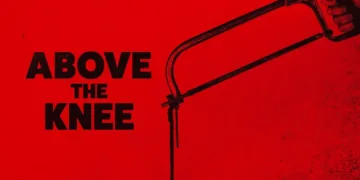
His life, outwardly perfect with a beautiful girlfriend, is a quiet fraud. He spends his days planning a bloody “accident” that will liberate him from the unwanted appendage. He is a man plotting a divorce from a part of himself. Bøe sets up a grim, methodical picture, one that is less interested in jump scares and more focused on the slow, suffocating pressure of a mind at war with its own flesh. The film is a meticulously planned descent into an obsession that redefines self-harm as an act of self-actualization.
A Confederacy of One
The film’s power is in its unblinking depiction of Body Integrity Dysphoria. Bøe visualizes Amir’s internal state with flashes of a blackened, gangrenous leg, making his psychological torment a visceral reality for the viewer. This is not a metaphor; it is what he sees. The rotting limb becomes a powerful symbol for a deeper existential schism, a rejection of biological reality in favor of a felt sense of self.
The film wades directly into the turbulent waters of modern identity politics, presenting an extreme, terrifying case study. Where does the authority of the self begin and end? The film suggests that when the mind declares war on the body, there can be no true victor, only casualties.
Amir’s condition creates a profound isolation. His relationships are managed, not lived. His loving girlfriend, Kim, becomes an unwitting warden, her affection a cage he must politely endure. Her attempts to connect are met with a vacant stare that is more chilling than any overt hostility. She is trying to love a man who is, for all intents, a ghost haunting his own body.
His solitude is broken by Rikke, a woman who appears on television to discuss her own BID (she feels she should be blind). In her, Amir finds a fellow citizen of a country of one, the first person who speaks his language. Their bond is a strange, platonic affair built on a foundation of shared disfigurement-to-be, a secret society for two. Their alliance validates his feelings and accelerates his departure from the world he is supposed to inhabit.
A Clinical Gaze on Carnage
Viljar Bøe’s direction is marked by a stark, almost sterile quality that separates it from the more operatic works of body horror. Where a director like Cronenberg might use baroque, expressive visuals to depict internal states, Bøe opts for a clinical detachment. The settings are aggressively mundane (think IKEA showrooms), the cinematography plain and unshowy.

This “Scandi-realism,” when applied to a grotesque premise, generates a unique brand of terror. It feels less like a horror movie and more like a documentary about a man calmly planning to destroy himself. The juxtaposition of extreme internal chaos with sterile, ordered environments feels like a quiet commentary on a sanitized modern world that has no place for the messy, the irrational, the aberrant.
The film’s tension is built with brutalist efficiency. An on-screen countdown marks the days to Amir’s planned event, a simple device that functions with the finality of a guillotine’s approach. This is punctuated by jarring flashes of gore, the bloody future leaking into the placid present. Freddy Singh, who also co-wrote the story, gives Amir a heavy, suffocating presence.
His performance is a masterclass in stillness, conveying a universe of torment through pained glances and subtle shifts in posture. He makes Amir’s self-absorption feel like a physical force. As a foil, Louise Waage Anda’s Rikke is a more dynamic figure. Where Amir is ashamed, Rikke is an activist, demanding the world recognize her reality. She is both a savior and a tempter, her confidence in her own affliction a siren song for the deeply insecure Amir.
The Amputation of Meaning
To watch Above the Knee is an ordeal. This is by design. The film is not a piece of entertainment; it is a meticulously crafted instrument of unease, designed to provoke, not to please. Its primary achievement is taking a taboo subject and examining it with a straight face, forcing the viewer to confront difficult questions about the nature of identity and the limits of empathy.

What does it mean to support someone’s self-proclaimed truth when that truth leads directly to the emergency room? The film offers no simple answers, leaving its audience to squirm in the ambiguity. It is a potent piece of psychological horror that will lodge itself in your mind.
The picture is not without its limitations. Its intense focus on Amir’s perspective creates an airless, myopic feeling. The protagonist’s chilly demeanor is a bold choice that prevents easy sympathy, and secondary characters like Kim exist less as people and more as obstacles. But this may be the point. We are trapped inside Amir’s obsession with him.
This is a film for a specific viewer, one who appreciates confrontational art that functions as a philosophical argument. It is a razor-sharp shocker that will have you reconsidering the strange and fragile pact between mind and body, and perhaps checking to ensure all your own limbs are still accounted for.
Above the Knee, a 76-minute Norwegian psychological horror-thriller film, is the fourth feature from writer/director Viljar Bøe. The film had its world premiere at Beyond Fest in the United States on September 29, 2024, followed by its UK premiere at FrightFest on August 25, 2025. The story was developed by Bøe in collaboration with star Freddy Singh. It is scheduled to be released on UK and Ireland digital platforms, including Apple TV, Amazon, Google, Rakuten, and Sky Store, on September 8, 2025. A “Screambox Exclusive” streaming release in the US is scheduled for September 9, 2025.
Full Credits
Director: Viljar Bøe
Writers: Viljar Bøe, Freddy Singh
Producers and Executive Producers: Karl Oskar Åsli, Marie Waade Grønning, Anders Fløysand, Mike Chapman, Evrim Ersoy, Fatima Hayward
Cast: Freddy Singh, Julie Abrahamsen, Louise Waage Anda, Viggo Solomon
Director of Photography (Cinematographer): Viljar Bøe
Editors: Viljar Bøe
The Review
Above the Knee
Above the Knee is a masterclass in sustained discomfort. It is a stark, intelligent, and deeply disturbing exploration of identity and self-destruction. While its clinical approach and unlikable protagonist may prove too alienating for some, its power as a piece of confrontational cinema is undeniable. This is a potent, thought-provoking film that functions less as a story and more as a philosophical problem with a very sharp edge. It is an ordeal by design, and a memorable one at that.
PROS
- A courageous and intellectually stimulating exploration of a taboo subject.
- Masterfully builds a tense, clinical, and unsettling atmosphere.
- Features strong, committed performances that convey deep psychological distress.
- Uncompromising direction that prioritizes thematic depth over audience comfort.
CONS
- The protagonist's cold, self-absorbed nature may alienate viewers.
- A narrow focus on the main character leaves others feeling underdeveloped.
- The grim subject matter and graphic content make for a difficult watch.
- Its methodical pace can feel slow and lacks conventional entertainment.







