
























![Kingdom Hearts Collection [I-III] Review](https://gazettely.com/wp-content/uploads/2026/10/Kingdom-Hearts-Collection-I-III-1-360x180.webp "Kingdom Hearts Collection [I-III] Review: KHII Holds Steady as Newer Entries Fluctuate 37")




The film opens with a Hadith: “Satan flows through man as blood flows through his veins.” This ancient warning sets the chilling tone for Yanis Koussim’s debut feature, Roqia. The story unfolds across two timelines in Algeria, creating a disorienting portrait of a nation haunted by its past. In the present day, an elderly Islamic exorcist, a Raqi, finds his connection to the divine fracturing under the degenerative pull of Alzheimer’s.
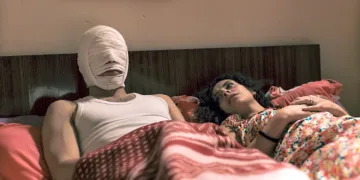
Decades earlier, during the country’s violent “Black Decade,” a soldier named Ahmed returns from a car accident a stranger to himself, his face shrouded in bandages and his memory erased. Koussim constructs a potent supernatural horror, using the genre’s framework to investigate the deeper wounds of historical trauma, shattered identity, and corrupted faith. The film’s unsettling mood suggests that some demons are born from memory, while others fester in its absence.
Crafting Unease
Koussim weaves the two timelines together not as a simple flashback device, but as a fractured consciousness. The past bleeds into the present, a historical trauma made manifest through a supernatural entity. The film’s power is in its patient, atmospheric construction of dread.

Cinematographer Jean-Marie Delorme shoots with a stark naturalism, using minimal camera tricks and real locations to ground the horror in a tangible, almost mundane reality. The camera often stays close to the characters, fostering a claustrophobic intimacy that traps the viewer within their paranoia. This visual style makes the eventual eruptions of bloody violence feel deeply violating.
The sound design is the film’s most effective tool for generating terror. A persistent cacophony of demonic whispers, guttural chants, and disorienting auditory hallucinations creates a state of perpetual anxiety. Silence is weaponized, its sudden presence amplifying the tension before it is broken by an unnatural sound from just outside the frame.
There are few jump scares here; the terror is psychological, built from a minimalist approach that forces the viewer into the same confused, paranoid state as the characters. The non-linear narrative is a deliberate choice, mirroring the fragmented mind of a man who cannot remember and another who is forgetting, leaving the audience to piece together a history that refuses to stay buried.
The Vessels of Trauma
The characters in Roqia function as powerful archetypes within its allegorical structure. Ali Namous plays Ahmed, the amnesiac soldier, with a quiet, devastating vulnerability. With his face wrapped in gauze, he is a literal blank slate, an “everyman” figure onto whom the sins of a nation are projected.

His post-accident gentleness creates a tragic irony; this kinder, more thoughtful man is a stranger his own son fears and a husband his wife, Selma, seems to prefer over the hard-line soldier he once was. Her reluctance for him to regain his memories speaks volumes about the horrors he has forgotten.
Opposite him is Mostefa Djadjam’s Raqi, a spiritual guardian whose failing mind symbolizes a society’s fading memory of its own civil war. The true horror of his condition is watching a spiritual warrior’s primary weapon, his encyclopedic memory of sacred texts, get dismantled from within.
His disciple, Slimane, portrayed with anxious energy by Akram Djeghim, is the inheritor of this fragile defense, tasked with fighting an ancient evil his master can no longer fully comprehend. These figures are less fully realized individuals and more symbolic vessels. Their interior lives are secondary to the thematic weight they are forced to carry, a choice that serves the film’s ultimate purpose as a national allegory.
A Sickness of the Soul
Roqia uses its demonic possession story as a potent metaphor for the infection of violent fundamentalism. The entity is not a creature of ancient myth but a modern contagion, a sickness of ideology that invades and corrupts faith from within. This horror is inextricably linked to the unstated historical context of the Algerian Civil War, with hints that the demon’s host picked up the parasite during military service in Afghanistan.

The film presents a study in collective trauma, exploring a nation’s deep-seated impulse to forget a painful and brutal past. Ahmed’s amnesia and the Raqi’s Alzheimer’s are direct representations of this societal condition, a willed and unwilled erasure of history. The film’s title refers to the Islamic practice of healing through scripture, an act of naming and confronting a spiritual ailment. This is precisely what the nation has failed to do with its own history.
The narrative suggests that repression creates its own monsters. The evil here is not an outside force but a dormant potential, a sickness in the blood awakened by conflict and allowed to fester when vigilance and memory fail. The story posits that history’s horrors do not vanish; they lie in wait for a moment of weakness to return in a new and terrifying form.
Roqia, an 89-minute Algerian horror-thriller film, had its world premiere at the 82nd Venice International Film Festival on August 31, 2025, as part of International Critics’ Week.
Full Credits
Director: Yanis Koussim
Writers: Yanis Koussim
Producers and Executive Producers: Farès Ladjimi, Irene Zoe Alameda, Ana Inés Bistiancic, Yann Mari Faget, Charly Granados, Johannes Rexin, Mounir Saguia
Cast: Ali Namous, Akram Djeghim, Mostefa Djadjam, Hanaa Mansour, Lydia Hanni, Abdelkrim Derradji, Adila Bendimerad
Director of Photography (Cinematographer): Jean-Marie Delorme
Editors: Sarah Zaanoun, Maxime Pozzi-Garcia
The Review
Roqia
Roqia is an intelligent and deeply unsettling film that successfully uses the framework of supernatural horror to dissect the wounds of a nation's history. While its symbolic characters may keep viewers at an emotional distance, its suffocating atmosphere and potent allegorical depth are undeniable. It is a confident, thought-provoking debut that lingers long after the credits, proving that the most terrifying demons are often the ones we try to forget.
PROS
- Expertly builds a sustained sense of unease through sound design and naturalistic visuals.
- Functions as a powerful allegory for national trauma, memory, and the corruption of faith.
- Prioritizes psychological tension and thematic resonance over conventional jump scares.
- The parallel between personal memory loss and a nation's willed amnesia is skillfully executed.
CONS
- The main figures often feel more like archetypes than fully developed individuals.
- Its slow, methodical build may not appeal to all horror fans.
- The dual-timeline structure, while effective, can sometimes feel disjointed.







