
























![Kingdom Hearts Collection [I-III] Review](https://gazettely.com/wp-content/uploads/2026/10/Kingdom-Hearts-Collection-I-III-1-360x180.webp "Kingdom Hearts Collection [I-III] Review: KHII Holds Steady as Newer Entries Fluctuate 37")





A photograph can possess a strange power. It freezes a moment of chaos, holding a fragment of history still for the world to inspect. The person who makes such an image, the conflict photographer, must navigate the unfolding violence while seeking a point of clarity, a single frame that speaks a larger truth. The documentary Love+War introduces its subject, Lynsey Addario, as a master of this difficult craft.
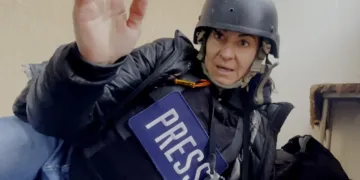
The film does not ease us into her story; it drops us directly into her working environment in eastern Ukraine, just as the 2022 Russian invasion begins. There, amidst the rising panic and distant explosions, Addario is a figure of intense focus. When a mortar shell kills a civilian family attempting to flee, her instincts take over.
The photograph she captures is brutal, immediate, and unambiguous. Its publication on the front page of The New York Times becomes a crucial piece of evidence in the information war, a stark rebuttal to official denials of civilian targeting. The opening establishes Addario as more than a reporter; she is a translator of conflict, whose work seeks to make the grim realities of war undeniable.
The Two Fronts: London and the War Zone
The dilemma of a woman balancing a demanding profession with domestic responsibility is a story told across global cinema, finding one of its most poignant expressions in Satyajit Ray’s 1963 film Mahanagar, which explored a housewife’s journey into the workforce and the subtle shifts it caused in her family’s foundation. Love+War examines this same tension through a contemporary lens and at its most extreme.

The filmmakers employ a deliberate cinematic language to mark the shift between Addario’s two worlds. The frantic, handheld camerawork and cacophonous soundscape of a war zone give way to stable, composed shots and the quiet hum of domestic life in her London home. Here, her husband, Paul de Bendern, a former Reuters journalist himself, manages the household and their two young sons.
His own background in the field adds a layer of silent understanding to their dynamic; he knows exactly what she is facing. The film captures the internal conflict that plagues Addario. She is candid about her guilt over missing moments with her children, yet she also admits that she feels most present and alive when she is working. This division has tangible consequences, seen in the anxious behavior of her children, who must cope with her long, unpredictable absences.
The Price of the Picture
Commercial cinema, from Hollywood action films to epic Bollywood productions, frequently presents conflict zones as backdrops for choreographed bravery and nationalist sentiment. Love+War presents a potent antidote to this romanticism, focusing instead on the authentic, unglamorous peril of the work. The film’s most terrifying sequence recounts Addario’s 2011 kidnapping in Libya.
Using her own harrowing testimony over sparse, chilling visuals, the filmmakers construct a visceral sense of the six days she and three colleagues were held captive. The story is not one of daring escape, but of pure survival and psychological endurance, a stark illustration of the absolute risk inherent in her profession. This section also confronts the gendered standards of the field.
Addario recounts being asked by male colleagues if being a mother compromises her nerve, a question rarely posed to fathers in the same line of work. Her decision to remain in a volatile Libyan city because the men were staying reveals the professional pressure to never show weakness. The film reinforces this by interviewing other journalists who speak candidly about the high rate of divorce and mental health struggles that shadow the profession, painting a full picture of the steep personal cost of bearing witness.
A Portrait of Purpose
Directors Elizabeth Chai Vasarhelyi and Jimmy Chin have built a career profiling individuals who push the limits of human capacity, from the ropeless rock climber in Free Solo to the cave divers in The Rescue. They bring the same intense focus to Addario’s psychological landscape. Their analysis of her motivation goes far beyond a simple desire for adventure.
The film argues that her purpose is rooted in a deep humanitarian impulse, which is powerfully illustrated through her work in Sierra Leone. Her photographs documenting the tragedy of maternal mortality had a direct policy impact, showing how a well-placed image can spur global action. The documentary thoughtfully proposes that Addario’s motherhood is not a professional liability but a source of distinct strength.
It sharpens her empathy, giving her a unique connection to the women and children whose stories she documents. Vasarhelyi and Chin refuse to construct a simple hagiography. They present a complex human being, unapologetic about her passion yet fully aware of the fractures it creates in her personal life. The result is a profoundly honest portrait of modern womanhood and professional dedication, forcing a confrontation with the difficult truth that a life of great purpose often requires immense sacrifice.
Love + War is a feature-length documentary film that premiered at the Toronto International Film Festival (TIFF) in 2025. Directed by Oscar-winners E. Chai Vasarhelyi and Jimmy Chin, the film chronicles the life and career of Pulitzer Prize-winning photojournalist Lynsey Addario, focusing on her dedication to documenting conflict zones—such as Ukraine, Afghanistan, Iraq, and Libya—while balancing the demands of her dangerous job with her family life at home in London with her husband, journalist Paul de Bendern, and their children. The film is produced by Little Monster Films and distributed by National Geographic Documentary Films, which will release it later on its platforms, including potentially Disney+ and Hulu.
Full Credits
Director: Chai Vasarhelyi, Jimmy Chin
Writers: Chai Vasarhelyi, Jimmy Chin (As directors of an original documentary, they are the primary creators of the story structure.)
Producers and Executive Producers: Chai Vasarhelyi, Jimmy Chin, Shannon Dill, Anna Barnes, Carolyn Bernstein, Tim Horsburgh
Cast: Lynsey Addario, Paul de Bendern, Dexter Filkins, Lukas
Director of Photography (Cinematographer): Thorsten Thielow
Editors: Keiko Deguchi, Hypatia Porter
Composer: Claudia Sarne
The Review
Love+War
Love+War is a riveting and essential documentary that succeeds by focusing intently on the human being behind the camera. It presents an unflinching portrait of a woman driven by profound purpose, refusing to simplify the immense personal and familial costs of her dedication. Directors Elizabeth Chai Vasarhelyi and Jimmy Chin craft a powerful, unsentimental film that explores the chaotic intersection of conflict and domesticity, resulting in a memorable study of a life lived at the extremes of human experience. It is a vital look at the price of truth.
PROS
- A compelling and deeply complex central subject.
- An honest, unflinching look at the psychological toll and physical dangers of conflict journalism.
- Skillful direction that masterfully balances intense front-line footage with intimate, quiet domestic scenes.
- Avoids hero-worship, presenting a nuanced and relatable human portrait.
CONS
- The relentless intensity and harrowing subject matter can be emotionally taxing for some viewers.
- Its sharp focus on the personal story means less contextual detail is provided on the geopolitical conflicts themselves.
- The jarring transitions between Addario's two worlds, while effective, might feel abrupt to some.







