





















A body surrenders to the stone floor. It is not a collapse of exhaustion but of devotion, a ritual prostration where the human form vanishes beneath a cascade of black fabric, becoming one with the shadows. This is our entry into the world of Mother Vera, a film that moves with the hushed, deliberate reverence of a liturgy.
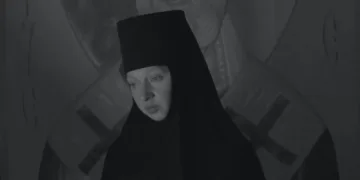
We are in a remote Orthodox monastery in Belarus, a place seemingly unstuck from time, where deep snow muffles the outside world and life is measured in the lighting of candles and the low cadence of chants. Here we meet the titular nun, her face a serene, almost translucent canvas upon which a history of immense pain is faintly visible. The film does not rush to tell her story or explain her presence.
Instead, it invites us to observe, to inhabit the quiet rhythms of her existence and to sense the turbulent, worldly life that led her to seek sanctuary within these austere walls. It is a portrait painted in long, patient strokes, a study in stillness that demands we slow our own pulse to match its meditative, questioning gait, asking what it means to erase a self in order to find a soul.
Monochrome Vespers
The film’s visual language is one of severe, contemplative beauty, rendered almost entirely in a stark, photographic black and white. This is not a mere stylistic choice; it is a moral and spiritual landscape, a world stripped to its essential, conflicting elements.
The screen presents a dualistic reality: the inky black of a habit against the blinding, absolute white of snow; the frail dance of a candle’s light against the profound darkness of a stone corridor. This aesthetic choice speaks to a life organized around a similar binary of sin and piety, corruption and purity. Each frame is composed with the meticulousness of a religious icon, freezing moments of profound stillness that seem to hold an entire life’s weight.
The soundscape is equally spare, built from the texture of wind through bare trees, the tolling of a distant bell, the soft crunch of boots on snow. Silence here is a primary element, a palpable presence, a space where the unsaid and perhaps the unspeakable can be felt most acutely. Then, late in the film, color bleeds quietly onto the screen.
This transition is a theological event. It suggests a movement from a world defined by rigid binaries toward an acceptance of life’s messier, warmer spectrum. It is the slow thaw of a soul, a quiet grace found not in the renunciation of the world but in its full, complicated, and perhaps forgiving embrace.
The Ghost of Olga
Beneath the habit of Mother Vera lives the ghost of Olga. Her past is not excavated through interviews but is whispered into the ether through voice-over confessions that feel both intimate and terribly distant, like echoes from another life.
She speaks of a former self entwined with a criminal husband, of theft and a destructive heroin addiction she once mistook for a form of transcendence before it showed her its demonic face. “I must be from hell,” she states with a chilling finality, the words carrying the immense weight of two decades of monastic atonement. Her guilt is the engine of her piety, a ceaseless penance.
The monastery itself is a sanctuary for similarly broken men, ex-convicts and addicts seeking a fragile redemption from their own histories. Vera’s work with them is not an act of charity but of profound, unsettling empathy, for she sees her own past in their eyes. This is shown in a raw, uncomfortable meeting where the men debate expelling one of their own for having “downcast” status, a prison term for the lowest outcasts.
As the men argue, perpetuating the cruel hierarchies of the world they supposedly left behind, a priest erupts in fury, his voice cracking with rage as he declares that such distinctions have no place before God. The scene exposes the stubborn persistence of judgment, a poison that seeps even into a place devoted to forgiveness.
The Gallop Towards Grace
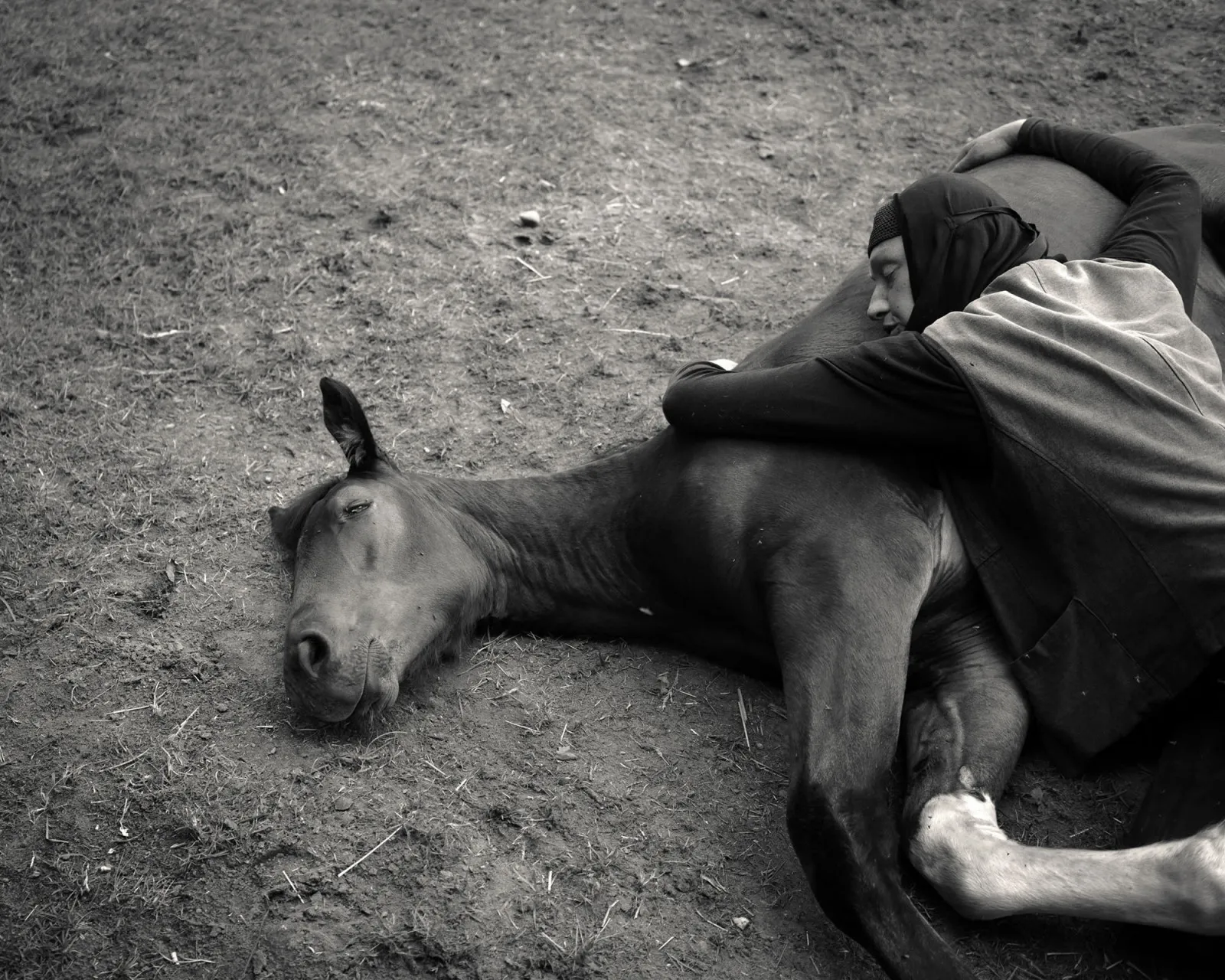
Outside the chapel and the confession, another form of spiritual practice exists for Vera: her work in the monastery’s stables. The horses are her tether to something primal and free, a life force unbound by human doctrine or the complex calculus of sin.

For a woman who has so thoroughly contained her existence within the strictures of a habit and the confines of a convent, the act of riding is a radical release. We see her galloping across the vast, snowy expanse, her black robe flowing behind her like a shadow in desperate flight. In these moments, she is not just a nun; she is a being in pure motion, experiencing a form of grace that is physical, immediate, and wild.
This communion with the natural world, also seen in tender interactions with her family and a playful donkey foal, stands in stark contrast to the solemnity of her religious duties. It is a different kind of prayer, one of flesh and breath.
The film does not offer her a final peace or a neat resolution. Her journey continues beyond the frame, leaving us with the powerful, lingering image of a woman perpetually in search of freedom, whether it is found in a silent, kneeling prayer or in the exhilarating, earth-shaking rhythm of a horse in full stride.
The film is a documentary from 2024. It won the Grierson Award for Best Documentary at the London Film Festival. It was released in UK and Irish cinemas from August 29.
Full Credits
Director: Alys Tomlinson, Cécile Embleton
Producers: She Makes Productions
Cast: Vera
The Review
Mother Vera
Mother Vera is a visually austere and spiritually profound documentary. It functions less as a narrative and more as a cinematic contemplation, offering an unflinching look at the weight of the past and the unending search for grace. The film's deliberate pace and stark beauty create an immersive, challenging experience that lingers long after the screen fades. It is a powerful piece of cinema that rewards patient observation.
PROS
- Stunning black-and-white cinematography creates a powerful, atmospheric world.
- The sound design is spare yet immersive, using silence effectively.
- Presents an intimate and complex character portrait without simple judgments.
- Explores deep philosophical questions of faith, sin, and redemption.
CONS
- The slow, meditative pace may prove challenging for some viewers.
- Its observational style lacks a conventional narrative structure or plot.
- The ambiguous ending offers no clear resolution to Vera's journey.