






















The Fantastic Golem Affairs opens with a moment of startling absurdity. After a night of drinking, Juan watches his best friend David play a game of charades on a rooftop, fall, and shatter into a thousand porcelain pieces on the car below. This is not a dream sequence. This is the new reality for Juan, a quiet slacker suddenly thrust into a mystery.
The film immediately establishes its central conflict: Juan is the only person who finds this event shocking. The police, the priest, and David’s own roommate treat the incident with a baffling sense of normalcy. This Spanish sci-fi comedy positions Juan as our bewildered guide through a world where the laws of physics and social decorum have been quietly rewritten. His search for answers about his ceramic friend becomes an expedition into a world that operates by an entirely different logic.
The Aesthetics of Apathy
The film’s visual language is key to its deadpan humor, creating an environment where the unbelievable feels commonplace. Directors Juan González and Fernando Martínez build a world that feels like a meticulously crafted dollhouse, using a bright, deliberate color palette and carefully arranged sets that evoke a storybook atmosphere.

This style is clearly in conversation with the work of Wes Anderson, sharing a fondness for curated, quirky spaces. The comparison has its limits, however. Anderson’s worlds are often hermetically sealed, with a rigid symmetry that reflects a desire for control. Here, the framing is looser and more unpredictable, suggesting a world where chaos is constantly intruding from the outside.
The camera reinforces this feeling with smooth, gliding movements that drift through walls and observe scenes as if unhindered by physical barriers. This technique positions the audience as detached observers, watching the strange experiment unfold.
Old-fashioned cinematic tricks, like using rear projection for scenes in moving cars, add to the handcrafted feel, reminding us that this reality is a construct. The aesthetic choices create an emotional distance, mirroring Juan’s own alienation and making the deadpan delivery of impossible events feel strangely logical within the film’s own universe.
Juan Versus the Caricatures
In a world so thoroughly strange, the audience needs an anchor, and Brays Efe’s performance as Juan provides just that. He is the film’s emotional core, a relatable straight man whose quiet reactions ground the spiraling madness. His performance is a study in subtle exasperation.
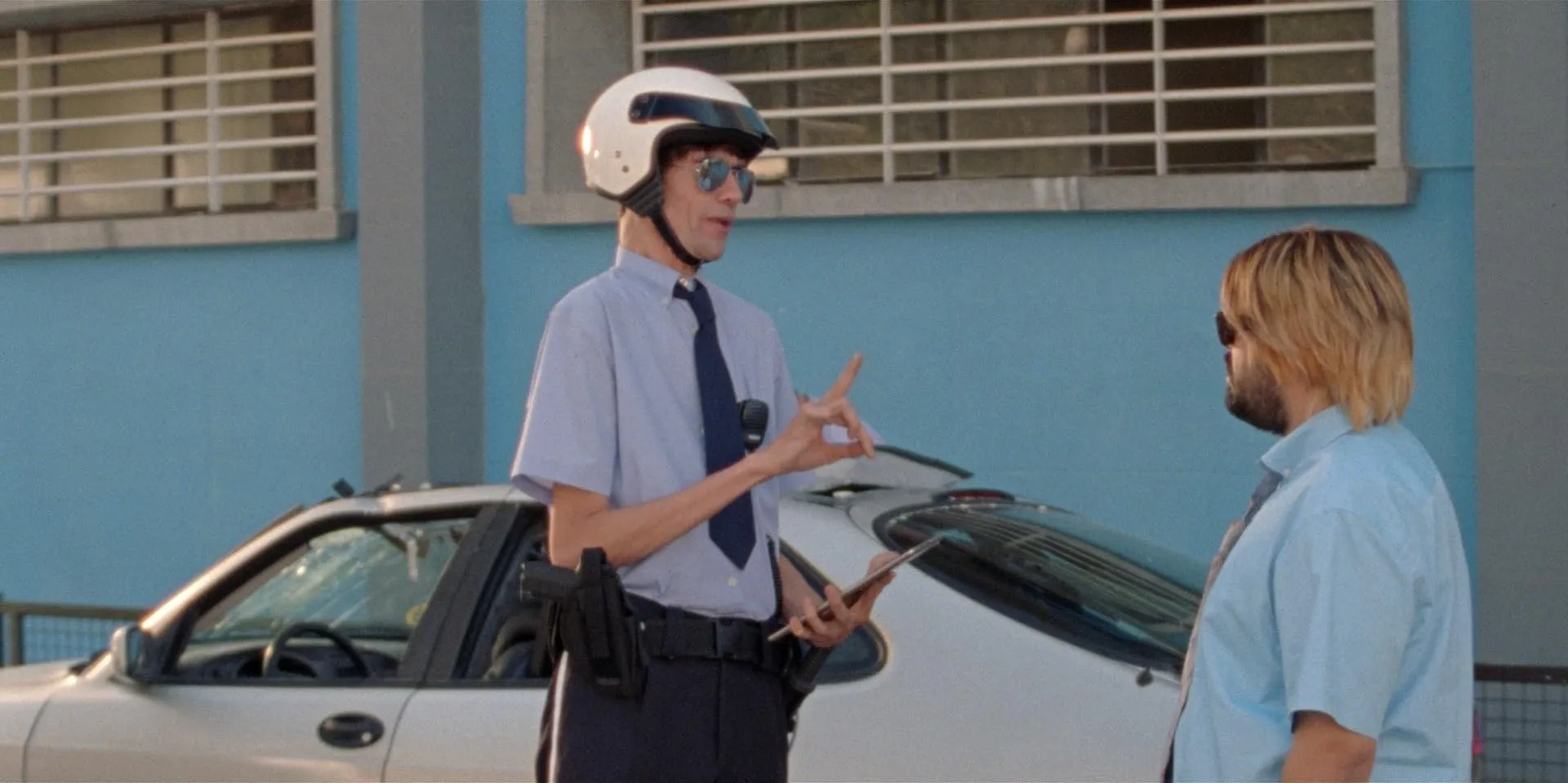
It is not broad comedy; it is built on the slightest shifts in expression, moving from muted confusion to weary resignation as he attempts to have a serious conversation about his disintegrated friend with people concerned only with insurance claims or potential inheritances.
These interactions are the source of the film’s unique humor. The supporting cast, by contrast, operates as a gallery of eccentric caricatures. Characters appear and disappear from the narrative without introduction or explanation, from greedy friends to a pair of mysterious bikers who seem to be following Juan. Using such flat characters is a deliberate choice.
It prevents the story from becoming a heavy meditation on grief and ensures the tone remains absurdly light. They are not meant to be emotionally complex individuals; they are functional pieces of the surreal puzzle, like non-player characters in a game designed to deliver specific information or create obstacles. Their apathy amplifies Juan’s isolation and makes his very human search for meaning feel both heroic and ridiculous.
A Tale in Pieces
The film’s imaginative premise is both its biggest asset and its primary weakness. The screenplay presents a wonderfully original concept but struggles with its execution, feeling more like a series of strange vignettes than a cohesive story. The narrative pacing is noticeably uneven.
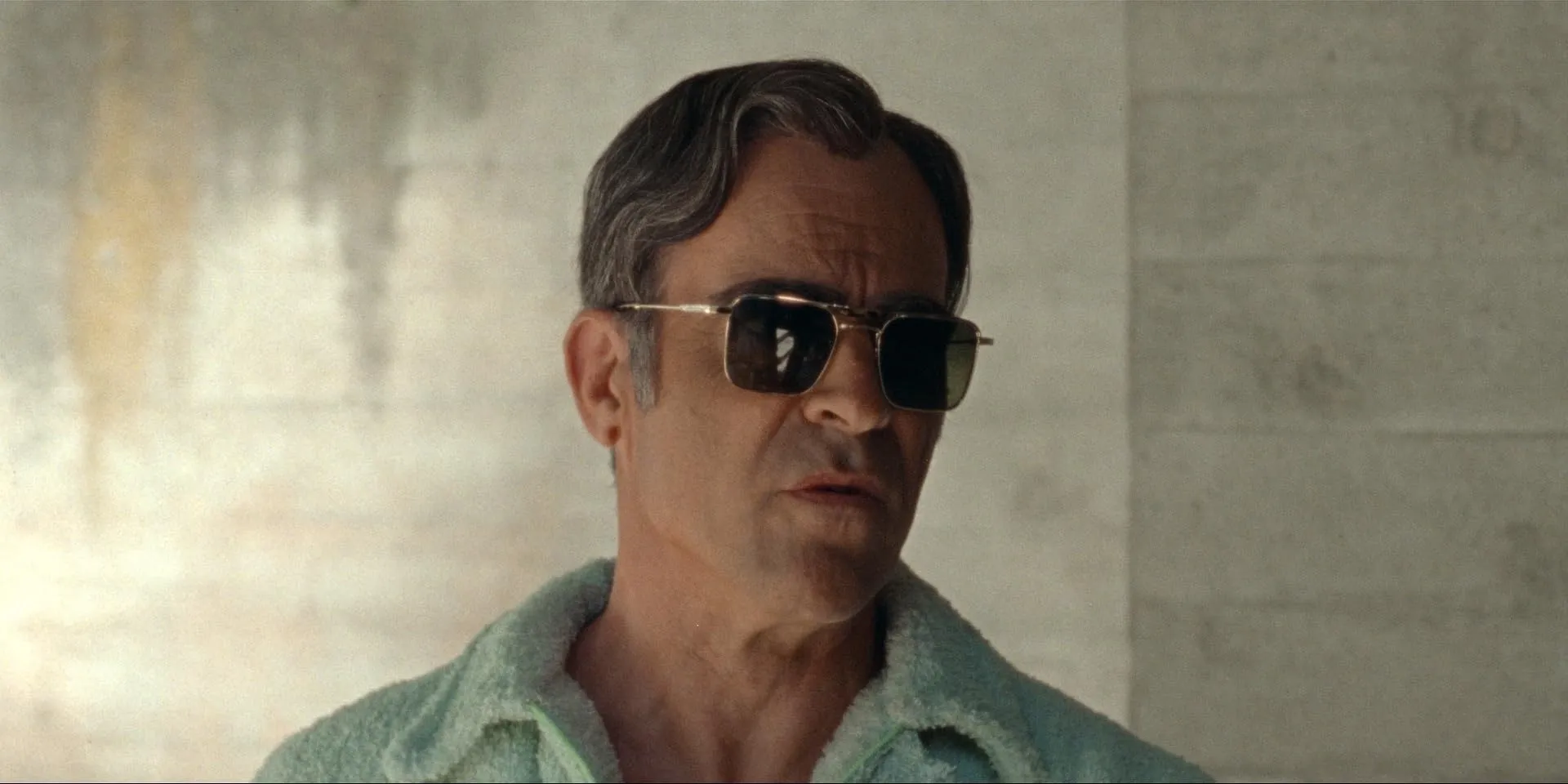
The first half moves with a sharp comedic energy, establishing the world’s bizarre rules with inventive gags like pianos randomly falling from the sky. This opening act has the hook of a great indie game, introducing a compelling mechanic that promises exciting developments. The second half, however, fails to build on that momentum. It introduces new plot threads that wander and dissipate, leaving the central mystery feeling less urgent.
This fractured narrative is home to some compelling ideas. The film’s treatment of death is particularly interesting. Mortality is stripped of all its emotional weight and finality. It becomes a recurring, almost bureaucratic problem or a slapstick event. David’s death is not a tragedy; it is a “glitch” in a system, a product defect. This casual approach removes the expected gravity and forces a reexamination of life’s supposed constants.
This connects directly to the movie’s main themes of companionship and the nature of reality. David, the golem, was an artificial being created for friendship, which raises questions about the authenticity of Juan’s grief. His sorrow is real, but the world treats it as an overreaction to a broken appliance. Juan’s struggle is a search for meaning in a reality where the fundamental rules have collapsed, leaving him to piece together a puzzle with parts that refuse to fit.
The film, which is also known by its Spanish title El fantástico caso del Golem, is a 2023 Spanish absurdist science fiction comedy. It was released in Spain on June 16, 2023. The film is about a man who witnesses his best friend fall from a rooftop and shatter into ceramic pieces. He begins an investigation to uncover the truth behind the strange death.
Full Credits
Director: Juan González, Nando Martínez
Writers: Juan González, Nando Martínez
Producers and Executive Producers: Pedro Hernández Santos, Roberto Butragueño, María Beltrán, Paola Botrán, Almudena Illoro, Andrea Moya Acaso, Julen Robles
Cast: Brays Efe, Bruna Cusí, Luis Tosar, Anna Castillo, Javier Botet, Tito Valverde, Roger Coma, Nao Albet, David Menéndez, Clara Sans, Vianessa Castaños, Aimar Vega, Mario Mayo, Ricardo Lacámara, David Pantaleón, Luis E. Parés, Héctor Abad
Director of Photography (Cinematographer): Ion de Sosa
Editors: Juliana Montañés
Composer: Sergio Bertran
The Review
The Fantastic Golem Affairs
The Fantastic Golem Affairs is a truly strange and visually inventive comedy that succeeds more as a collection of brilliant, absurd moments than as a cohesive story. Brays Efe’s wonderfully grounded performance keeps the film from spinning out of control, even when the narrative loses its way in the second half. For those with a taste for the surreal and a tolerance for narrative ambiguity, it’s a memorable and often hilarious experience that champions creative risk-taking. It’s a beautifully crafted puzzle box that seems unconcerned with providing a final solution.
PROS
- The central concept is wonderfully surreal and unpredictable.
- Features a quirky, handcrafted aesthetic with beautiful cinematography.
- Brays Efe provides a perfect, relatable anchor amidst the chaos.
- The film generates genuine laughs from its bizarre situations and underplayed reactions.
CONS
- The story loses significant momentum in its second half.
- The plot feels more like a series of vignettes than a focused story.
- Many of its interesting themes feel touched upon rather than fully explored.