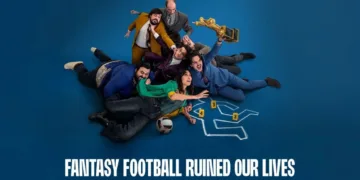





















A hobby can be a healthy diversion, a small world of rules and passions separate from the pressures of daily life. At what point does it become a prison? This is the territory explored, or at least mapped out, by Fantasy Football Ruined Our Lives, an Italian comedy centered on a group of friends whose existence revolves around “fantacalcio,” their nation’s version of fantasy soccer.
The film builds its narrative around this obsession, establishing a world where every life decision is weighed against its potential impact on the league. The story’s engine kicks into gear when Gianni, the group’s reigning champion, disappears from his own bachelor party just before his wedding.
His friends are promptly arrested, and the film’s structure reveals itself. Through a series of flashbacks prompted by a judge’s interrogation, the men must explain their all-consuming game, forcing the audience into the same position as the bewildered magistrate: trying to understand how a fantasy league led to such real-world chaos.
A Roster of Caricatures
The film anchors its story with Simone, an anxious, unemployed screenwriter who serves as the audience’s entry point into this hermetic world. His anxieties are rooted in a real-world inertia that contrasts sharply with the frantic energy he invests in the league. The script, however, provides a far shallower treatment for his friends, who exist as narrative functions rather than fully formed people.
We are given the put-upon family man, a character whose entire personality is his struggle to balance domestic life with league demands, a conflict that is played for repetitive laughs. There is the lawyer, whose legal expertise is reduced to a single-note gag about applying legalese to fantasy league disputes. These characterizations are so thin they feel like placeholders. Their fixed nature prevents the story from developing genuine emotional stakes, as their actions and reactions are always predictable, stemming from their one defining trait.
This structural weakness becomes most apparent with the introduction of Andrea, the league’s sole female member. The film presents her as a formidable expert on the sport, a promising setup that could challenge the group’s insulated dynamic. Yet, this potential is systematically dismantled. Her knowledge is quickly relegated to the background, and her primary purpose becomes a source of romantic tension for Simone.
It is a disappointingly conventional turn, reducing a potentially complex character to a simple plot device. While the actors themselves share a believable chemistry that hints at a long history of friendship, they are constrained by the material. They bring a flicker of humanity to their roles, but it is not enough to overcome a script that prefers broad caricatures over the complexities of real people.
Fumbling the Comedic Playbook
A story about a missing groom and a group of man-children retracing their chaotic steps feels immediately familiar. The narrative architecture of Fantasy Football Ruined Our Lives is heavily borrowed from American comedies of the 2000s, with The Hangover serving as its most obvious blueprint.

The structural parallels are impossible to miss: a pre-wedding disaster precipitates the action, the protagonists wake up in a state of confusion, and the plot proceeds as an episodic investigation into their own misdeeds. While that film used its structure to build comedic momentum, here the execution feels sluggish.
The story also invites comparison to the television series The League, which successfully built compelling characters around a similar premise. That show understood that the game was a lens through which to view its characters’ flawed lives; this film simply uses the game as a setup for jokes.
The humor itself is built on a flawed foundation. A significant portion of the gags relies on a viewer’s working knowledge of Italian soccer celebrities and the specific nuances of fantacalcio. This approach creates a closed comedic loop, rewarding a small segment of the audience while leaving others on the outside. It is a peculiar choice for a film on a global streaming platform.
When the script attempts broader humor, it falls back on uninspired physical comedy and juvenile jokes that feel dated. The narrative framework of the interrogation further weakens the film’s comedic impact. By constantly cutting away from the action to a sterile courtroom, the structure robs the story of its immediacy. We are told about the chaos instead of experiencing it, a choice that keeps the audience at a distance and effectively lowers the stakes of the entire misadventure.
A Missed Goal on Deeper Themes
Within its derivative premise, the film contains the seeds of a more thoughtful story. It gestures toward interesting ideas about arrested development, presenting a circle of grown men who use a game as an elaborate shield against adult responsibility. A more courageous script might have used this setup to deliver a sharp critique of modern escapism or the fragile nature of male friendship.

The film, however, seems actively afraid of its own thematic potential. It raises profound questions about the characters’ lives only to retreat into the safety of shallow comedy. The narrative consistently avoids any real consequences. We see the obsession’s impact on their relationships, but these conflicts are treated as minor hurdles rather than genuine crises.
This refusal to engage seriously with its ideas is most evident in the film’s conclusion. The central mystery of Gianni’s disappearance is resolved with a hurried, almost flippant explanation that lacks dramatic weight. The characters do not experience a true reckoning; they do not confront the destructive nature of their shared obsession in a way that leads to meaningful change.
They simply find their friend and reset to their previous state. The story wraps up its plot threads without resolving its central thematic questions, resulting in an unearned and unsatisfying ending. The film presents a group of men who avoid reality, and the narrative itself mirrors their behavior. It avoids depth, sidesteps complexity, and ultimately offers a story that is too timid to explore the interesting world it creates.
The Italian film “Fantasy Football Ruined Our Lives,” originally titled “Ogni Maledetto Fantacalcio,” premiered on Netflix on August 27, 2025. It is a comedy about a group of friends who are part of a fantasy football league. When one of their friends, the reigning champion of their league, goes missing on his wedding day, the group is questioned by a judge about the events leading up to his disappearance. The film is available to watch exclusively on Netflix.
Full Credits
Director: Alessio Maria Federici
Writers: Giulio Carrieri, Michele Bertini Malgarini, Roberta Breda
Producers and Executive Producers: Giovanni Cova, Filippo Broglia, Piergiuseppe Serra, QMI
Cast: Giacomo Ferrara, Silvia D’Amico, Enrico Borello, Caterina Guzzanti, Francesco Russo, Antonio Bannò, Valeria Angione
Director of Photography (Cinematographer): Manfredo Archinto
Editors: Christian Lombardi
Composer: Roberto Procaccini
The Review
Fantasy Football Ruined Our Lives
Fantasy Football Ruined Our Lives fields a promising concept but fumbles the execution. The film relies too heavily on a borrowed comedic playbook, offering a familiar story of arrested development without adding fresh insight. While the cast shows chemistry, they are saddled with one-dimensional characters and jokes that will only land with die-hard fans of Italian soccer. It is a forgettable comedy that plays it too safe, choosing shallow imitation over sharp satire.
PROS
- An interesting core premise exploring sports obsession.
- The cast has a believable and energetic chemistry.
- Giacomo Ferrara’s lead performance effectively captures the protagonist's anxiety.
CONS
- The plot is highly derivative of other American comedies.
- Characters are one-dimensional archetypes with no real development.
- Humor is often too niche, relying on specific Italian soccer knowledge.
- Fails to explore its deeper themes about obsession and escapism.
- The flashback-based narrative structure is clunky and hurts the pacing.
- The film’s resolution feels rushed and unsatisfying.