

























![Kingdom Hearts Collection [I-III] Review](https://gazettely.com/wp-content/uploads/2026/10/Kingdom-Hearts-Collection-I-III-1-360x180.webp "Kingdom Hearts Collection [I-III] Review: KHII Holds Steady as Newer Entries Fluctuate 37")



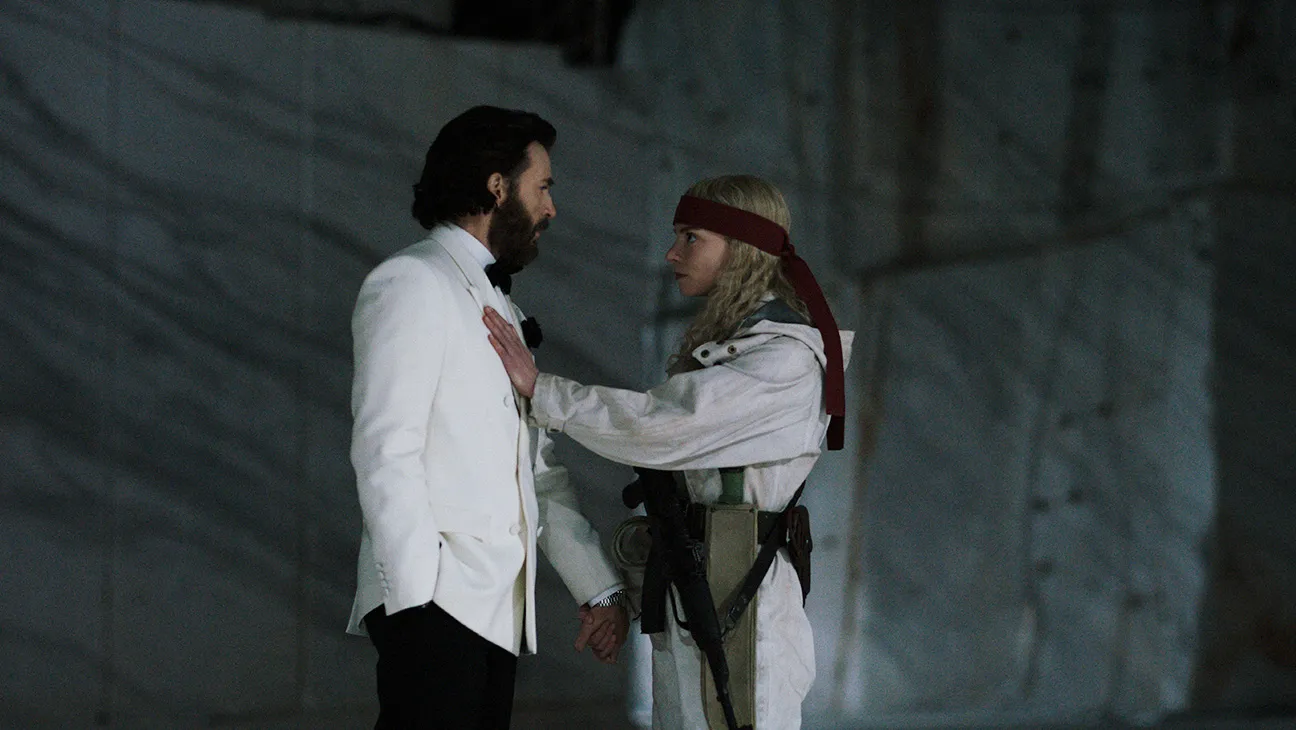

There’s a certain kind of modern film that feels like it was born from a fever dream induced by scrolling through social media for too long. Romain Gavras’s Sacrifice is that film. It drops us directly into the heart of absurdity: a lavish environmental charity gala held inside a remote Greek quarry.
The place is filled with the kind of ultra-wealthy individuals who fly private jets to events designed to lower our carbon footprint. Our guide through this madness is Mike Tyler, an actor played by Chris Evans who is in the middle of a full-blown crisis. Grieving his father and panicking about his thinning hair, Mike sees the gala as his big chance to rebrand himself as a serious person with a cause.
His plans are spectacularly derailed when the party is crashed by a cult of armed eco-warriors. Their leader, the fiercely committed Joan (Anya Taylor-Joy), announces that a nearby volcano is about to destroy the world. The only way to stop it is to offer three human sacrifices. In a moment of pure comic confusion, Mike is chosen as the designated “hero” for the offering.
Shooting Fish in a Gilded Barrel
The film’s first act is a masterclass in sharp, targeted satire, and it uses Mike Tyler as its primary weapon. He is a perfect distillation of modern celebrity anxieties, a man whose self-worth is tethered to the whims of online opinion.
One of the film’s funniest and saddest sequences finds him hiding in a bathroom stall, frantically doomscrolling through mocking posts about his latest public gaffe, the social media app providing a cold, numerical breakdown of his failure. His private panic over his hairline, which he believes is the barometer of his career’s vitality, is both ridiculous and painfully human.
Casting Chris Evans is the film’s smartest move. For a generation, he has been the face of unambiguous virtue on screen. This role actively deconstructs that persona. It creates a fascinating dialogue with his own stardom, asking what happens when the shield is down and the man is just a bundle of insecurities. The witty screenplay is relentless in its attack, exposing the deep chasm between a celebrity’s carefully managed public image and their chaotic inner life.
The film’s critique extends outward to the hollow spectacle of performative activism. The entire gala is a monument to insincerity. Banners with vapid slogans like “Make Earth Cool Again” hang from stark marble walls. The night’s entertainment includes a bizarre pop performance where Charli xcx appears as Mother Nature, singing a cringe-worthy ballad about the apocalypse.
The event’s host, a bald tech billionaire named Ben Bracken (Vincent Cassel), is a perfect caricature of Jeff Bezos, right down to his unnerving laugh. He promotes a new deep-sea mining operation that he claims, with a straight face, will actually help the ocean. This world is so insulated by wealth that its inhabitants have lost all touch with reality.
When Joan’s heavily armed followers storm the stage, the guests applaud, assuming it is just another piece of edgy performance art. The film is at its most potent here, targeting the dangerous hypocrisy of an elite class that has learned to treat global crises as branding opportunities instead of actual threats.
The Man Behind the Shield
This is the most compelling and transformative performance of Chris Evans’s career. For years, I’ve seen flashes of his talent for playing against type in smaller films, a skill often overshadowed by his iconic heroic roles. Here, he fully unleashes that potential. His comedic timing is impeccable, using his entire body to convey Mike’s spiraling panic.
When he flails about during his on-stage meltdown or puffs up his chest to incorrectly accept applause from his terrified fellow hostages, he commits completely to the character’s pathetic nature. Yet, he also gives Mike a surprising depth. The film often holds on his face in tight close-up, revealing the genuine pain and confusion behind the actor’s bluster. He shows us a man hollowed out by grief and professional anxiety, desperate to find something real to hold onto. This vulnerable performance is the anchor that keeps the film’s absurd premise from floating away entirely.
Anya Taylor-Joy provides a fantastic counterpoint as the cult leader, Joan. Her performance is defined by a chilling stillness. She delivers her apocalyptic prophecies in a flat, unwavering monotone that is both mesmerizing and deeply unsettling. She is the humorless, immovable object to Evans’s chaotic, unstoppable force. Their strange dynamic forms the core of the film’s second half, a bizarre dependency built on his desperate need for purpose and her absolute certainty.
The rest of the talented ensemble is largely squandered. Vincent Cassel and Salma Hayek have little to do beyond function as satirical props in the opening act. The most baffling choice is the late-film appearance of John Malkovich as Joan’s father.
His scene, set in an underground bunker, is a clumsy exposition dump that brings the story to a grinding halt. It feels like a shortcut the narrative didn’t need to take, and it disrupts the strange, hypnotic mood the film had been building. Smaller roles, like the one played by a frantic Ambika Mod, offer welcome sparks of energy, but they are too brief to make a lasting impact.
A Tale of Two Movies
Director Romain Gavras is a filmmaker with an incredible eye, a fact that is evident in every meticulously composed frame. His background in music videos has given him a maximalist sensibility, and he directs with a technical confidence that is thrilling to watch. Working with cinematographer Matias Boucard, he creates a world of stunning contrasts.
The cold, imposing geometry of the marble quarry where the gala is held feels both futuristic and ancient. This is set against the raw, untamed beauty of the Greek landscape during the long trek to the volcano. The production design is impeccable, crafting sets that are memorable and rich with detail. Gavras knows how to stage a sequence for maximum impact, from the controlled chaos of the initial hostage takeover to a surreal, drug-induced dream sequence where Mike confronts his own balding head on a giant cake. The film is a visual feast.
Where the film falters is in its very structure. It is a story split cleanly in two, and the two halves do not fit together comfortably. The first part is a sharp, fast-paced satirical comedy. The second part, once the characters leave the quarry, transforms into a slow, ponderous, and sincere fable about faith.
This jarring tonal shift feels less like a bold narrative choice and more like a fundamental indecision about what kind of story to tell. The propulsive energy of the opening vanishes, replaced by meandering scenes and repetitive philosophical debates.
The film raises big questions about belief, science, and the nature of sacrifice, but it seems uninterested in exploring them with any real depth. The rules of Joan’s prophecy remain vague, and the characters’ motivations become increasingly muddled. This structural break creates a disorienting experience for the viewer, a sense of whiplash that prevents the film from fully succeeding as either a biting satire or a profound meditation.
A Beautiful, Baffling Mess
The undeniable strength of Sacrifice lies in its brilliant first act. It operates as a hilarious and incisive satire, brought to life by a layered and fearless lead performance from Chris Evans that stands as his best work to date.
The film’s central flaw is its inability to sustain that focus and energy. It abandons its sharpest weapon, its satirical wit, in favor of a thematically confused and dramatically inert second half that never finds its footing. It feels like a film at war with itself, pitting a mainstream comedic sensibility against an art-house desire for profundity.
Ultimately, Sacrifice is a work of bold ambition and spectacular visual talent that stumbles over its own sprawling ideas. It is a frustrating watch because you can see the masterpiece that might have been. Yet, for all its flaws, it is far from a failure. It is the kind of big, messy, and thought-provoking film that will likely inspire debate and could easily earn cult status in the years to come.
I will always prefer a film that takes a wild swing and doesn’t quite connect over one that plays it safe. This movie attempts to say something important about our chaotic modern world, but like its protagonist, it gets lost on the journey. The result is a beautiful, baffling, and unforgettable offering.
Sacrifice is a 2025 film directed by Romain Gavras. The movie had its world premiere at the Toronto International Film Festival with screenings on September 6th and 7th. It is a British and Greek co-production. The film is the director’s first English-language feature.
Full Credits
Director: Romain Gavras
Writers: Romain Gavras, Will Arbery
Producers: Romain Gavras, Chris Evans, Anya Taylor-Joy, Robert Walak, Jacob Perlin, Gregory Jankilevitsch, Klaudia Smieja-Rostworowska, Giorgios Karnavas
Cast: Chris Evans, Anya Taylor-Joy, Salma Hayek, Vincent Cassel, Ambika Mod, Sam Richardson, John Malkovich, Charli XCX, Yung Lean, Brendan Fraser
The Review
Sacrifice
A film of two distinct, warring halves. Sacrifice soars in its opening act, powered by a career-defining performance from Chris Evans and a razor-sharp critique of celebrity culture. It is visually stunning from start to finish. However, a jarring tonal shift sends the narrative stumbling into a thematically muddled and dramatically inert second half. The result is a bold, frustrating, and ultimately fascinating failure—a beautiful mess that is more admirable for its ambition than its execution.
PROS
- A complex, hilarious, and deeply affecting lead performance from Chris Evans.
- The first act is a brilliant and witty satire of celebrity culture and performative activism.
- Visually stunning, with excellent cinematography and production design.
- An audacious and memorable high-concept premise.
CONS
- A jarring tonal shift creates a disjointed viewing experience.
- The narrative becomes unfocused and thematically confusing in the second half.
- A talented supporting cast is largely underutilized.
- The pacing drags considerably after the initial setup.







