
























![Kingdom Hearts Collection [I-III] Review](https://gazettely.com/wp-content/uploads/2026/10/Kingdom-Hearts-Collection-I-III-1-360x180.webp "Kingdom Hearts Collection [I-III] Review: KHII Holds Steady as Newer Entries Fluctuate 37")




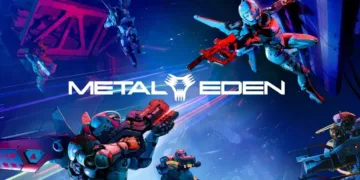
Metal Eden places you in the cybernetic body of Aska, a highly advanced combat unit sent to a fallen Earth. Your mission is to navigate the decaying metropolis of Moebius and fight through legions of hostile machines. This game is a pure, high-speed first-person shooter that builds upon the foundations of classic arena combat.
It combines relentless gunplay with a sophisticated suite of modern movement mechanics. The experience is designed from the ground up to be frenetic and demanding. From the first moment, you are expected to move with lethal purpose, as standing still is the quickest path to destruction. The game’s focus is clear: to deliver a constant rush of challenging, fast-paced action where momentum is your greatest weapon.
Kinetic Warfare
The core of Metal Eden is its exceptional fusion of movement and combat, creating an experience where motion is the primary language. You begin with a full suite of traversal abilities, a design choice that immediately empowers you. There is no gradual unlocking of a double jump or a dash; from the outset, you can wall-run, boost through the air, and use a grappling hook to gain verticality.
The true success of this system lies in how these actions chain together into an unbroken flow. A perfect sequence might involve sprinting toward a chasm, leaping into a wall-run, jumping off to trigger a double jump, and then firing the grappling hook to swing onto a high platform before landing in a dash. The level design is built to support this, with long, curved walls and strategically placed grapple points that turn traversal into a rewarding rhythm-based challenge, reminiscent of games like Ghostrunner.
This intricate movement is not just for platforming between combat zones; it is the central pillar of survival. The combat loop adopts the aggressive philosophy seen in DOOM Eternal, where offense is the best defense and constant motion is mandatory. Arenas are multi-layered environments with bridges, tunnels, and jump pads, encouraging verticality and flanking.
Standing still to line up a shot invites a barrage of projectiles, while hiding behind cover is a futile exercise against relentless ground-based units that pursue you without pause. Ammo for your more powerful weapons is a scarce resource, forcing you to move constantly around the arenas to collect regenerating drops. This design cleverly prevents players from finding a safe spot and forces them to engage with the entire map, turning every fight into a dynamic spatial puzzle.
The enemy roster is varied enough to demand constant adaptation. You will face hovering bots that fire explosive rockets, deadly snipers that punish slow movement, and heavily armored colossi with shields that must be broken. Dealing with a shielded enemy requires either a specific energy weapon or a close-range melee attack, forcing you to risk dashing into the heart of the fray.
This variety ensures that you must use your entire toolkit, switching between long-range potshots and aggressive up-close assaults. The game occasionally breaks its own formula, most notably with a ball transformation. In this form, Aska can roll at high speeds and fire homing missiles, but it feels disconnected from the core parkour-and-gunplay loop.
One significant frustration is that its default control input can lead to accidental transformations mid-fight, disrupting the carefully orchestrated flow of combat. It serves a purpose in specific open-world traversal sections but feels like an awkward addition to an otherwise cohesive mechanical identity.
An Evolving Arsenal
The game’s combat is deepened by its strategic systems, chief among them the Core Rip mechanic, a clear and clever evolution of DOOM’s Glory Kill system. After dealing enough damage to an enemy, you can perform a finishing move to tear out its power core. This presents a critical tactical choice in the heat of battle.

You can either hurl the core as a powerful grenade, perfect for clearing out a cluster of weaker machines, or absorb it to instantly regain a chunk of health and supercharge your melee attack. Imagine a scenario where you are low on health with a massive shielded enemy bearing down on you.
Do you risk getting closer to a weakened foe to absorb its core for the health boost, or do you use that core as a projectile to hopefully stagger the larger threat? This constant risk-reward calculation makes every encounter engaging and prevents combat from becoming a simple matter of pointing and shooting.
Your weapon arsenal is diverse, featuring mainstays like a shotgun, an SMG, and a plasma beam. Each weapon has a satisfying weight and sound design, making it feel powerful. The starting pistol has infinite ammo but will quickly overheat, establishing the weapon-switching rhythm early on. A critique of the arsenal is that some weapons feel less relevant as you progress.
The shotgun is a powerhouse when you first acquire it, but it is almost completely supplanted once you unlock the grenade launcher, suggesting some balancing issues. The progression system allows you to upgrade these weapons with alternate fire modes, though few of these feel transformative. The main skill tree is more successful, offering meaningful perks that unlock new strategic options.
Instead of boring percentage-based damage increases, you can unlock a bullet-time effect for precision aiming, freeze grenades for crowd control, or enhancements to your core abilities, like getting two empowered punches from an absorbed core instead of one.
The game’s brisk four-hour campaign paces these unlocks perfectly, ensuring you are constantly receiving a new tool or ability to experiment with, which keeps the short experience feeling fresh from start to finish. The depth of this skill tree does, however, feel slightly at odds with the game’s brevity, leaving one wishing for a New Game Plus mode to fully explore its potential.
A Dystopian Canvas
Metal Eden presents a visually impressive cyberpunk world that, while built on familiar genre tropes, is executed with genuine artistic flair. Its aesthetic shares DNA with the developer’s previous title, Ruiner, favoring a sleek world of chrome and neon. What elevates the game’s look is its spectacular use of colored lighting.

Entire cityscapes are bathed in vibrant reds, blues, and greens, creating a striking atmosphere that overcomes the potentially generic foundation of towering megastructures. The linear levels are well-designed to guide you through these stunning vistas, mixing intricate platforming segments with closed-off combat arenas. This visual spectacle is supported by a strong audio landscape.
Gunfire produces loud, impactful sound effects that give each weapon a distinct personality, and the action is propelled by a driving EDM soundtrack that sets a perfect rhythm for the high-speed combat.
Where the game’s presentation falters is its narrative. The story is perhaps the weakest element of the entire package. The plot, which borrows concepts from works like Altered Carbon, is paper-thin and struggles to make an impact. Most of the exposition is delivered through one-sided monologues from your AI companion during the worst possible moments, such as while you are sprinting along walls or zipping across wires.
This delivery method reduces critical story beats to background noise that is easily ignored. The writing itself aims for a deep, philosophical tone but often lands as overwrought and clichéd, failing to build a believable world or a compelling motivation for your actions.
The game consistently tells you about its world instead of showing it, leaving many of the environments feeling like beautiful but lifeless backdrops. The game’s atmosphere succeeds purely on the strength of its visuals and sound, creating a palpable sense of place that the direct storytelling completely fails to support.
The Review
Metal Eden
Metal Eden offers a spectacular rush of high-speed combat and fluid parkour, representing the genre at its kinetic best. Its core gameplay is deeply satisfying, backed by stunning cyberpunk visuals and a meaningful upgrade system. This excellence is constrained by a very short campaign and a forgettable story that feels like an afterthought. It is a brilliant but brief experience for anyone seeking a pure action challenge.
PROS
- Exhilarating and fluid movement system that combines parkour and grappling.
- Fast-paced, aggressive combat loop that rewards constant motion.
- Visually stunning cyberpunk art direction and lighting.
- Engaging upgrade mechanics that provide meaningful new strategies.
CONS
- Extremely short campaign length of only a few hours.
- Weak, clichéd story with poorly integrated delivery.
- Some weapons and abilities feel underdeveloped or become redundant.
- Difficulty balancing between modes can feel uneven.







