

























![Kingdom Hearts Collection [I-III] Review](https://gazettely.com/wp-content/uploads/2026/10/Kingdom-Hearts-Collection-I-III-1-360x180.webp "Kingdom Hearts Collection [I-III] Review: KHII Holds Steady as Newer Entries Fluctuate 37")




History is not what happened, but what is remembered. And what is remembered is a matter of record, of evidence. When the evidence is set on fire, history itself becomes a phantom, an ache where a limb used to be. The Eyes of Ghana is a story about such a phantom limb and the people determined to prove it was once real. At its center is a trove of film canisters, a national archive created to give a new country its own reflection, its own myth.
These reels were the work of Chris Hesse, the personal cameraman for Kwame Nkrumah, Ghana’s first president. He was tasked with capturing the birth of a nation, crafting a visual lexicon for its future. But futures are unstable. Following a coup that unseated Nkrumah, the new government sought to perform a lobotomy on the state’s memory.
They gave the order to destroy the archive. The film begins with this act of erasure, a foundation of ash from which an extraordinary story of survival and recovery is built. The revelation that the original negatives were secreted away in a London vault is the story’s inciting incident, a promise that a ghost might be brought back into the light.
A Trinity of Preservationists
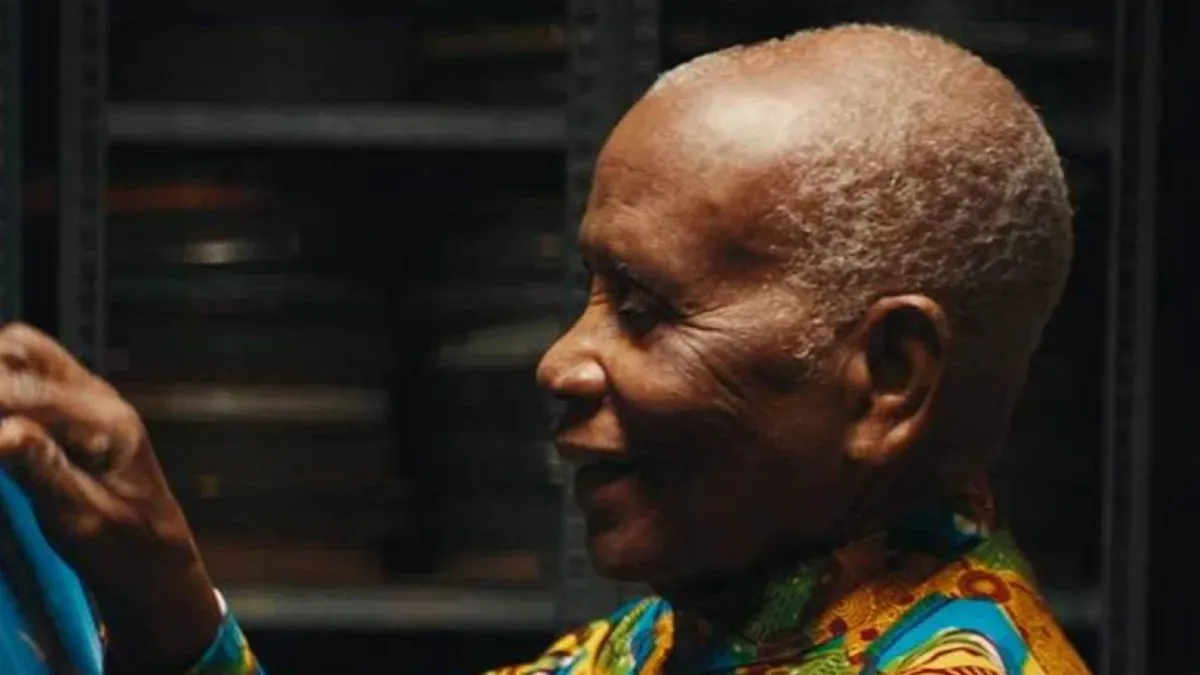
The film’s emotional weight rests on three figures, each a custodian of memory in a different way. Chris Hesse himself is a placid anchor in the storm of the past. He speaks with the gentle, almost serene authority of one who has seen history made and unmade, his belief in Nkrumah’s pan-African vision seemingly untouched by the leader’s complicated legacy. He is less a man than a living archive, a primary source with a wry, knowing glint in his eye.

It is the calm of a survivor, a stillness that speaks to the turbulence he documented. The project’s engine is Anita Afonu, a younger filmmaker whose scholarly inquiry evolves into a tender, intergenerational friendship. She is the detective in this archival noir, the one who follows the cold trail. Her persistent questions are the catalyst, forcing a dialogue with a past that might otherwise have remained silent. Her focused energy provides a necessary counterpoint to Hesse’s reflective stillness. Then there is Edmond Addo, the projectionist of the derelict Rex Cinema.
He is a man haunting a building that haunts him back, a poignant symbol of cinema’s faded communal magic. The dust motes dancing in the projector’s beam seem like the ghosts of old audiences. His personal resurrection, spurred by the project to screen the lost films, mirrors the very archive he is helping to revive, a return from a self-imposed exile. Together, they form a trinity bound by a shared faith in the transportive power of a projected image.
The Ambiguity of the Lens
At its core, the documentary poses a timeless question about the nature of the recorded image. Nkrumah understood cinema’s utility as a tool of statecraft, a form of soft power to project an aspirational identity inward and outward. Having studied in America, he saw how Hollywood manufactured a national dream and wanted to direct his own.

The film does not shy away from the difficult truth of his rule, acknowledging his slide from liberator to autocrat. This creates a fascinating ethical tension. Was Hesse’s camera a neutral witness or an agent of propaganda? This is the film’s central philosophical problem.
The documentary finds its pivot in a scene where a student asks Hesse if the footage proves Nkrumah was a good man. Hesse’s response is a masterclass in deflection: a filmmaker’s job is to present what happened, and the viewer must render the verdict. This stance is not an abdication of responsibility but a profound statement on the function of an archive.
It reframes the entire preservation project as an act of restoring not a single, authoritative truth, but the very possibility of debate. To destroy an archive is an act of epistemicide, a murder of a way of knowing. To restore it is to demand that difficult questions be asked again. The film suggests the camera’s truth is not in its objectivity, but in its capacity to provoke a moral reckoning.
The Texture of Remembrance
Ben Proudfoot’s direction is marked by a quiet, piercing intimacy. His subjects frequently address the lens directly, a choice that collapses the formal distance of the interview and transforms it into a confession or a direct appeal.
This technique places the viewer in the position of confidant, making the historical stakes feel deeply personal by denying the comfort of passive viewership. Visually, the film creates a dialogue between the crisp, controlled frames of the present day and the grainy, vital energy of Hesse’s restored footage. The archival material is not just illustrative; it feels like a transmission from another world, potent with a future that never quite happened.
The scratches and flicker of the old celluloid are not imperfections; they are part of its testimony, the scars of its survival. Kris Bowers’ score is an essential partner in this act of remembrance. It is a sonorous thread connecting past and present, providing an emotional undercurrent of reverence and quiet triumph that never overwhelms the images. The final scenes at the refurbished Rex Cinema offer a potent symbol.
The gathering of a community to watch the flickering images is not a conclusion but a commencement. It is the whir of the projector, a flicker of light pushing back against the darkness of a nation’s forgetting.
The documentary film The Eyes of Ghana, directed by Ben Proudfoot, had its world premiere at the Toronto International Film Festival (TIFF) as the opening documentary for the TIFF Docs section. The film, which features an original score by Kris Bowers and is executive produced by Barack and Michelle Obama, explores how Kwame Nkrumah, Ghana’s first president, used cinema as a tool for African liberation. It focuses on the work of cinematographer Chris Hesse, who documented Nkrumah’s life and travels. The film is not currently available for streaming.
Full Credits
Director: Ben Proudfoot
Writers: Not available
Producers: Nana Adwoa Frimpong, Ben Proudfoot, Anita Afonu, Moses Bwayo, Brandon Somerhalder, Ethan Lewis, Vinnie Malhotra
Executive Producers: Barack Obama, Michelle Obama, John Akomfrah, Dan & Lian Gill, Max Johnson, Jonathan E. Lim, Michael Risley, Josh Rosenberg, David Treatman, Esther Wojcicki
Cast: Chris Hesse, Anita Afonu, Edmund Addo, Kwame Nkrumah
Director of Photography: Brandon Somerhalder, David Feeney-Mosier
Editors: Mónica Salazar
Composer: Kris Bowers
The Review
The Eyes of Ghana
The Eyes of Ghana is a profound meditation on historical preservation and the power of the cinematic image. Through its intimate portraits and stunningly restored footage, the film explores how a nation's memory can be erased and reclaimed. It is a deeply moving and intellectually stimulating documentary about the fight to control a narrative, finding its pulse in the quiet dignity of those who guard the past. A vital and beautifully crafted piece of work.
PROS
- Features an unforgettable central figure in Chris Hesse, whose personal story is immense.
- Presents rare, historically significant archival footage to the public for the first time.
- Ben Proudfoot's intimate, direct-to-camera directorial style creates a deep connection with the subjects.
- Thoughtfully explores the complex relationship between filmmaking, political power, and historical memory.
- Kris Bowers' score provides a powerful emotional foundation for the narrative.
CONS
- Does not deeply investigate the political complexities of Nkrumah's later rule.
- The narrative's reflective pace might feel slow to some viewers.
- The focus remains tightly on the filmmakers and their mission, offering a limited view of modern Ghana.







