















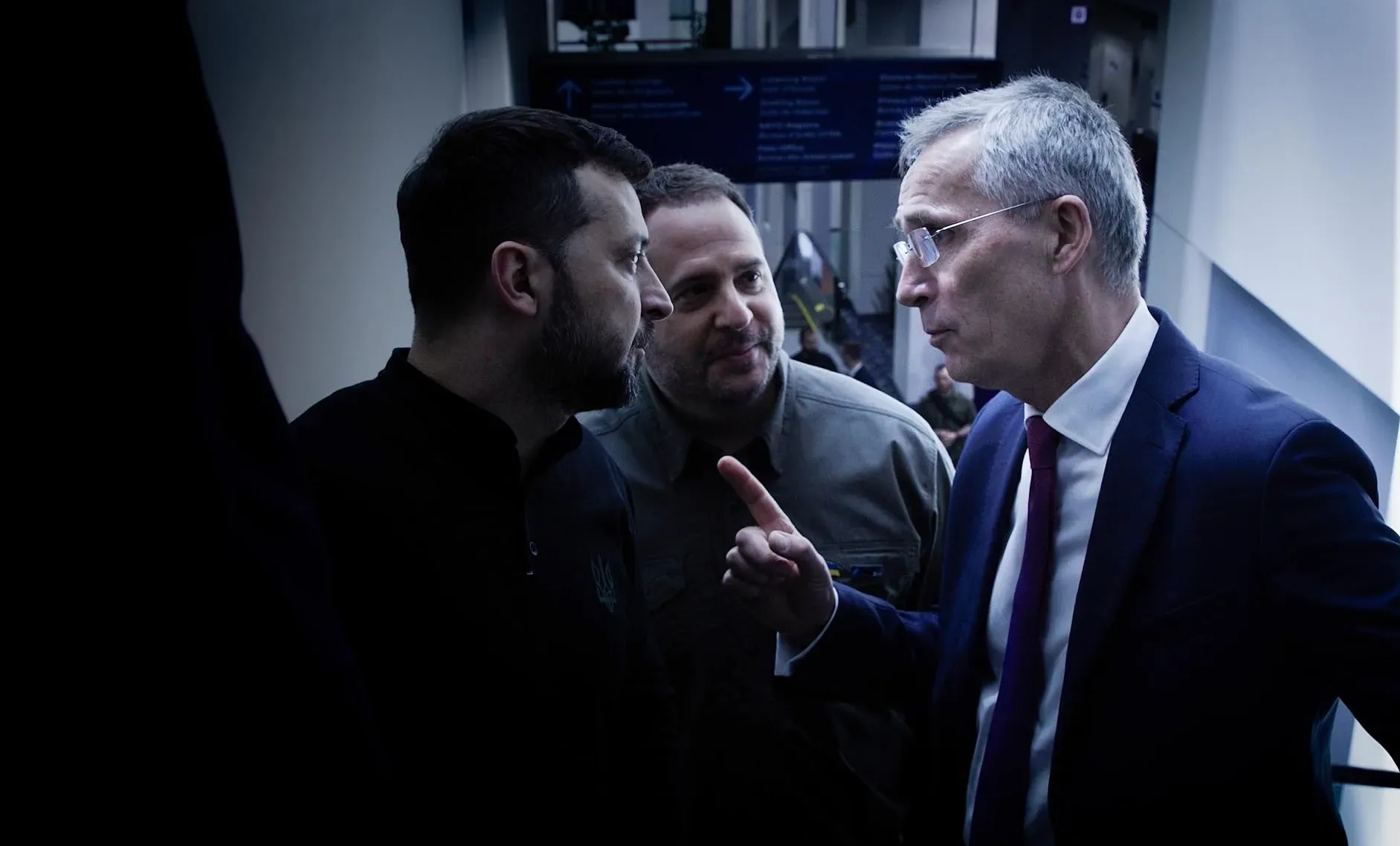

Facing War narrows its frame to a single, high-pressure year with Jens Stoltenberg, former NATO Secretary General, and studies how a leadership role functions under sustained strain. The timeline runs from 2023 to 2024, extended because of Russia’s invasion of Ukraine. The film sets clear narrative boundaries and then works patiently within them, observing routine motions that carry outsized consequences. The focus is process.
The stakes are built from meetings, calls, and carefully phrased statements rather than from expert narration. The tension forms around a practical question: how a coalition holds together while supporting Ukraine and avoiding a direct NATO–Russia war. Public appetite for decisive action presses on the diplomatic need for caution, and the camera stays close enough to register that pressure in the rhythms of speech and travel.
Access is the documentary’s primary device. It leads the viewer through NATO’s corridors and into rooms where unanimity is negotiated one conversation at a time. Stoltenberg’s task is presented with clarity. He must keep 32 member states aligned on funding and policy, and the film treats that alignment as a daily craft. The result reads like a case study in governance on a narrow ledge: the language of communiqués, the choreography of summits, the persistent trimming of phrases to avoid missteps.
The Art of the Fixer
Stoltenberg’s character arc is shaped through behavior. The portrait is steady and measured. He appears calm, pragmatic, and practiced, the traits of a political fixer whose value lies in reading rooms and nudging outcomes. The film ties his experience to the alliance’s ability to function. It selects moments that gauge where unity thins, especially around Sweden’s accession to NATO and the financing of Ukraine’s defense. The structure places these tests like signposts, returning to them as negotiations move forward.
Political theater is presented with operational detail. We watch Stoltenberg arrange bargains that defuse objections across the membership. The mechanics are explicit. Turkey’s Erdoğan receives a pathway to American F-16 fighter jets, a movement that secures support for Sweden.
Hungary’s Viktor Orbán accepts an opt-out that shields Hungarian taxpayers from Kyiv-related costs. The editing treats these transactions as part of the craft rather than as detours from principle. Diplomacy appears as an economy of concessions, with ideals stated in public and arithmetic performed in private.
The backstage material has the texture of work. On a train to Kyiv or in a car between engagements, his team edits statements line by line. Words are weighed, then weighed again. The film links leadership to persuasion and to the management of national self-interest, a pairing the subject seems to recognize. Stoltenberg jokes about feeling like Tony Soprano, a manager intent on keeping people satisfied, and the film lets that comparison hang as a dry note on the job’s psychology.
The Storytelling of Secrecy
The filmmaking takes a strict observational path. The camera favors presence over explanation, adopting a classic fly-on-the-wall approach that replaces analysis with access. The style sets up a clean visual grammar: cars, corridors, rooms, and the same faces under different lighting. Mundanity sits beside consequence. The repetition of travel and protocol builds a quiet rhythm that supports the heavier scenes.
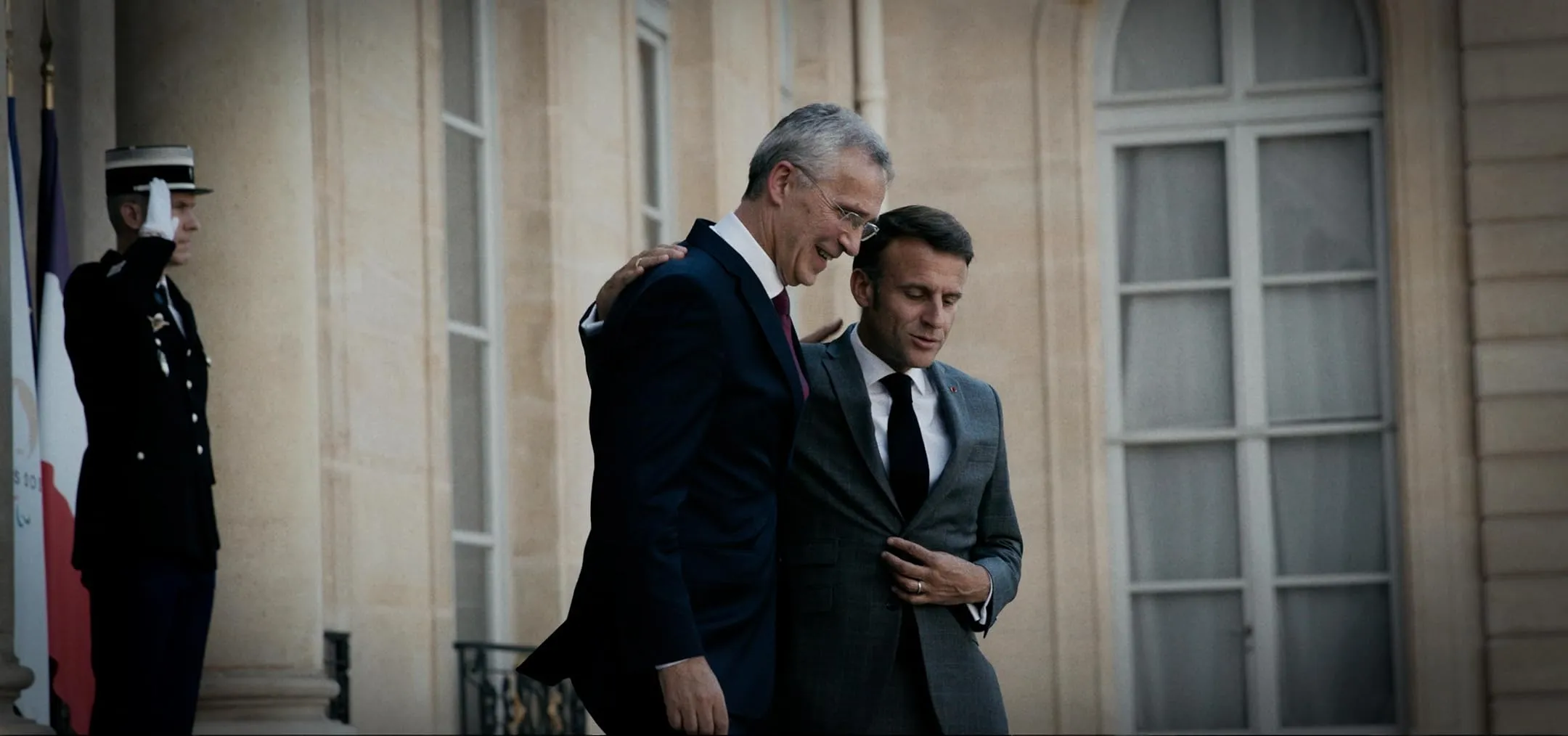
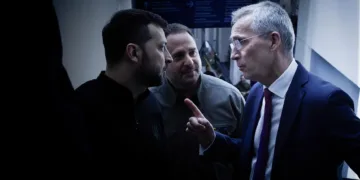
Small, human details give the access its value. Stoltenberg whispers to Volodymyr Zelenskyy about how smaller allies can be “pushed” toward agreement, a quick moment that sketches an informal hierarchy without a lecture. He speaks of the emotional toll of the role and admits to doubt, and these notes round the portrait rather than contradict it. The film trusts glimpses and lets viewers connect the pattern.
Tone is handled with care. The presentation feels like a firm record of the year’s events, yet persistent emphasis on Stoltenberg’s successful maneuvering leans toward tribute. The film lets a question sit in the margins: does political skill justify its compromises, or does effective management require them? The recurring pledge to support Ukraine “for as long as it takes” becomes the thematic hinge.
The work shows how that promise depends on a moving calculus of budgets, weapons, and politics across allied capitals. The stance is resolute on the podium and conditional in the meeting room, and the documentary holds that duality without forcing an answer.
A Document of Alliance Fragility
Facing War functions as a study of multilateralism under stress. By staying with Stoltenberg, it uses his day-to-day work to read NATO’s balance points. Fragility appears in multiple places, including pressure from Hungary and Turkey and the constant alignment required between major actors such as the United States and Germany. The film does not widen to a grand survey, yet the accumulation of scenes forms a map of where unity requires the most maintenance.
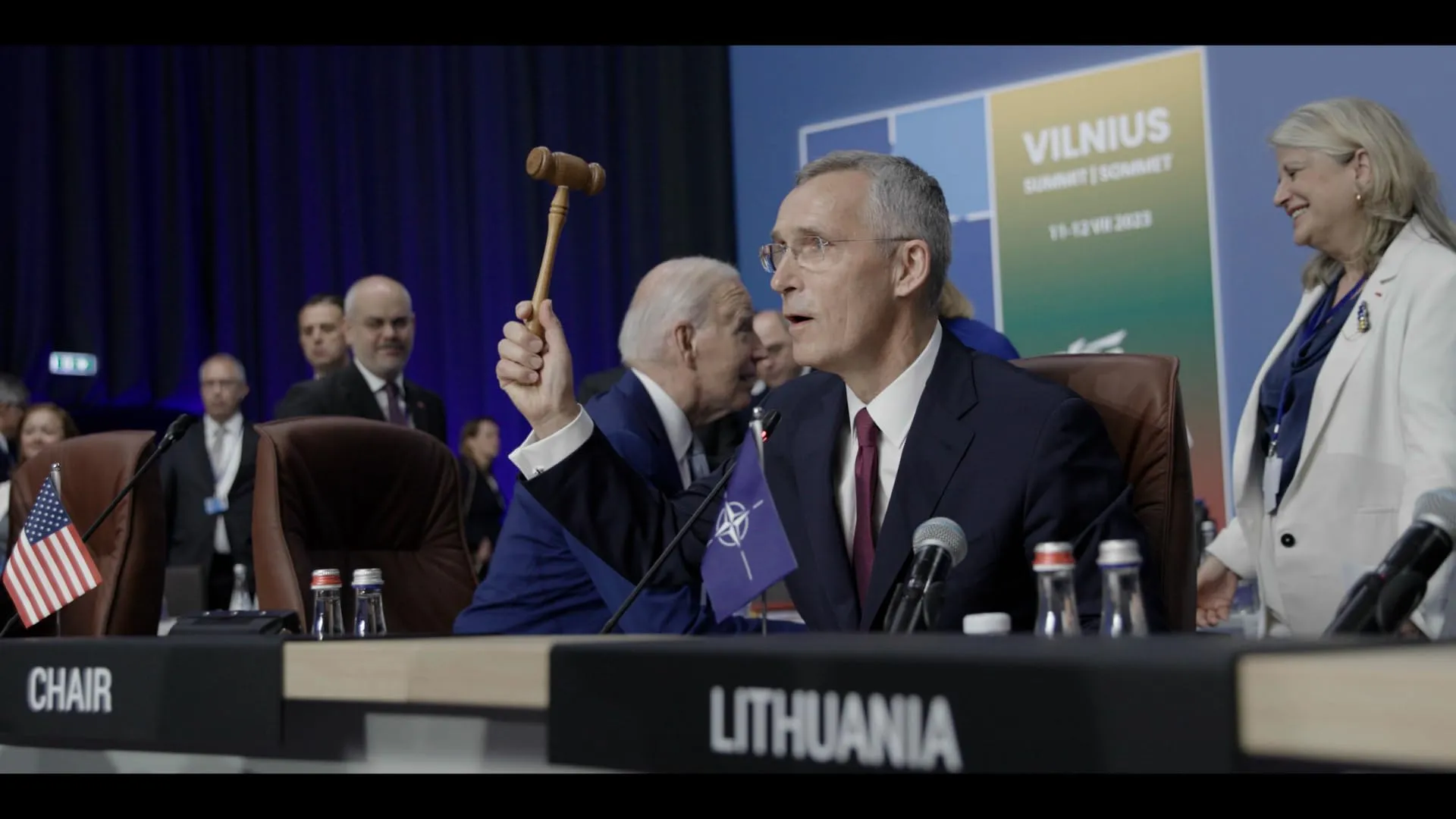
Summitry appears as stagecraft with a practical aim. Public images with Western leaders project unanimity, while the private sessions reveal arguments, revisions, and pauses. The cut between podium and prep room carries the argument forward: consensus is performed for audiences and engineered backstage. The “waiting game” against Russia depends on preserving that common face, and the effort to preserve it is portrayed as labor rather than rhetoric.
The film positions itself as a political record. It catalogs the repeated exertion needed to keep a large institution from splitting under pressure. Stability is shown as something negotiated each day, with agreements brokered and re-brokered as circumstances shift. The closing impression is of leadership under fire and of a process that looks orderly on television because it is messy in the room. The documentary’s methodical attention to structure, character, and wording makes that process legible without softening its edges.
Facing War is a compelling political documentary that chronicles the final, extended year of Jens Stoltenberg’s tenure as NATO Secretary General, a period defined by the high-stakes diplomacy surrounding Russia’s war against Ukraine. Premiering at CPH:DOX in March 2025 and having a theatrical release in countries like Norway in April 2025, the film offers viewers unprecedented, fly-on-the-wall access to NATO’s inner workings. It details Stoltenberg’s efforts to keep the alliance united amidst internal divisions and the critical strategic challenge of supporting Kyiv without provoking a direct conflict with Moscow. Information on widespread streaming or the specific US distribution platform is not currently finalized, but the film has been featured at major international documentary festivals.
Credits
Title: Facing War
Distributor: Dox Division, CAT&Docs (International Sales)
Release date: March 19, 2025 (World Premiere at CPH:DOX)
Running time: 100 minutes, 104 minutes, or 105 minutes
Director: Tommy Gulliksen
Writers: Tommy Gulliksen, Anne Marte Blindheim
Producers and Executive Producers: Anne Marte Blindheim, Danielle Turkov Wilson, Jenny Raskin, Jim Swartz, Susan Swartz, Geralyn White Dreyfous, Tonje Hessen Schei, Kelsey Koenig
Cast: Jens Stoltenberg, Joe Biden, Volodymyr Zelenskyy, Recep Tayyip Erdoğan, Viktor Orbán, Emmanuel Macron, Mark Rutte, Allison Hart, Stian Jenssen, Ulf Kristersson, Giorgia Meloni, Lorenz Meyer-Minnemann
Director of Photography (Cinematographer): Tommy Gulliksen, Øistein Bloch Haukeland
Editors: Erik Treimann, Margrete Vinnem, Øistein Bloch Haukeland
Composer: Torbjørn Brundtland, Svein Berge (Röyksopp)
The Review
Facing War
The final verdict on Facing War is that the documentary succeeds as a gripping, fly-on-the-wall character study. It meticulously dissects the complex mechanics of high-stakes diplomacy during a global crisis. The film is a valuable historical document for showing the intense political effort required to maintain a consensus-driven alliance in the face of internal fracturing and external threat. While the narrative occasionally leans toward reverence for its subject, its unprecedented access provides a vital, nuanced view of leadership under fire.
PROS
- Provides rare, minute-by-minute access to sensitive NATO meetings and private conversations.
- Offers a sharp, surprisingly personal portrait of Jens Stoltenberg as a pragmatic, resilient political figure.
- Constructs a compelling narrative around the core conflict of maintaining unity versus avoiding direct war.
- Explicitly reveals the strategic compromises and political maneuvering used to secure votes from dissenting allies (e.g., Turkey and Hungary).
- Effectively explores the fragile nature of international alliances when tested by real-world military conflict.
CONS
- The film's proximity to its subject gives the story a limited, occasionally one-sided, and somewhat celebratory tone.
- Assumes a high degree of viewer knowledge about NATO's political history and its broader mandate.
- The ambiguity around the true commitment level implied by the “for as long as it takes” promise is raised but left deliberately unresolved.