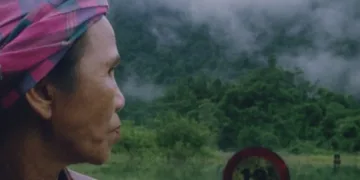

















Water drips in a cave, a clock made of stone and patience, an echo of origin. Hair, Paper, Water… presents an intimate character study within an ethnographic frame that invites a sensorial way of seeing and listening. Vietnamese director Truong Minh Quy and Belgian cinematographer Nicolas Graux stage a dialogue, their second collaboration, with Cao Thi Hâu, an elder of the Ruc people in Vietnam’s Quang Binh province who was born in a cave. This lineage anchors the narrative.
The film’s Bolex 16mm images carry grain and weight, a material surface that feels earthy and tangible. Thi Hâu’s voice-over in Ruc shapes the structure, with key words and phrases arriving as red intertitles. The method sets the film as a meditation on heritage, memory, and the natural world, and it frames a life lived at the margins of modern history through choices in language, image, and sound that speak to both local meaning and a wider audience.
The Indigenous Lexicon and Rooted Culture
Ruc functions as the film’s pulse and as an oral archive for an endangered Vietic language. Quy and Graux arrange the work around an introductory vocabulary lesson that reads as a form of indigenous pedagogy. Single words, including those in the title Hair, Paper, Water…, become anchors that link to land textures and to Thi Hâu’s stories.
The lexicon grows from the environment, and the images affirm that link: mountains, rain, buffalo, leeches. Knowledge passes through practice. Thi Hâu shares herbal wisdom, naming remedies for respiratory infections or sprains. The perspective stays inside the culture through her speech and experience, and it asserts continuity with the local ecosystem.
The film treats language as more than grammar rules; it lives in the healing properties of plants and in the names given to clouds. This approach reads as both cultural record and cinematic form, a choice that speaks to viewers beyond the region while staying grounded in place.
Tensions of Globalization and Generational Rifts
Quiet daily rhythms in Quang Binh meet pressures from modernity and urbanization. The film renders this through a generational gap. Thi Hâu teaches her grandson Ruc, while his schooling prioritizes Vietnamese and English. A first journey to Saigon to help a granddaughter after childbirth marks a key turning point.

The work sets caves and waterways beside dense streets and motorbikes, a pairing that makes social change visible. Economic forces drive movement toward distant cities and factory jobs that carry risk, and this dispersal leaves the grandson in his grandmother’s care. Local labor links to wider markets through the harvest of acacia trees for paper pulp, which ties the rural landscape to external demand.
The film records and preserves culture and language by making the Ruc world visible and by placing memory against the pull of global homogeneity. Present-day change echoes the history of the Ruc community moving from cave dwellings to village life, and the film observes that ongoing state of flux with careful attention to family, work, and speech.
The Tactile and Fragmentary Aesthetic
Hair, Paper, Water… speaks through touch and texture. The Bolex 16mm format produces grain and rich color that give the image a physical presence rare in contemporary digital work. Quy and Graux favor extreme close-ups of faces, objects, and plants, which reinforces the lived tie between people and environment. Sound builds an aural map.
Cave water taps into quiet timekeeping, while city motorbikes cut through with mechanical force. The editing adopts a fragmentary rhythm. Quick bursts of imagery arrive like entries in a visual primer, a structural echo of the vocabulary lesson.
These rapid passages sit alongside longer durational scenes, such as the grandson sprinting on a beach in heavy wind or a boat ride during the annual flood. The result captures beauty and transience inside a cultural record that reads clearly across borders. Narrative emphasis, linguistic structure, and sensory design work together, and that synergy allows the film to reflect its origins while speaking to viewers who meet it from far away.
Hair, Paper, Water… is a 2025 documentary film about an elderly Ruc woman who was born in a cave and now lives in a village in Vietnam, struggling to pass on her endangered language and cultural wisdom to her grandchildren amid changing times. The film is a co-production between Vietnam, Belgium, and France. It had its world premiere at the 78th Locarno Film Festival on August 9, 2025, where it won the Golden Leopard – Filmmakers of the Present award. Since its premiere, the film has been a fixture on the festival circuit, being screened at events like the BFI London Film Festival and the New York Film Festival. As of late 2025, the film is primarily available through film festivals and specialized screenings; it is not currently available on major streaming platforms like Netflix or MUBI in most regions.
Credits
Director: Trương Minh Quý, Nicolas Graux
Writers: Trương Minh Quý, Nicolas Graux
Producers and Executive Producers: Julie Frères, Thomas Hakim, Julien Graff
Cast: Cao Thị Hậu, Cao Xuân Doanh, Cao Thị Hiệu, Cao Thị Bát
Director of Photography (Cinematographer): Nicolas Graux
Editors: Trương Minh Quý
Composer: Michael Stearns
The Review
Hair, Paper, Water…
Hair, Paper, Water… is a visually stunning and deeply felt ethnographic document. It excels by fusing its aesthetic—rich 16mm cinematography and tactile sound—with its thematic core: the critical preservation of the endangered Ruc language and the traditional knowledge of Cao Thi Hâu. The film offers a meditative, essential perspective on heritage and identity confronting modernization, leaving the viewer with a sense of quiet wonder and inevitable loss.
PROS
- Exceptional use of 16mm film provides a beautiful, tactile, and highly sensorial experience.
- The use of Ruc language vocabulary as a structural backbone creates an innovative and intimate form of ethnographic documentation.
- It acts as a vital, poetic archive for an endangered language and the traditional knowledge of the Ruc people.
- Effectively captures the tension between deep-rooted rural life and the disruptive forces of modern urbanization and globalization.
CONS
- The documentary's highly meditative and impressionistic style may be perceived as slow or challenging by viewers expecting a traditional narrative structure.
- The thematic conflict is presented subtly, relying on visual inference rather than explicit narrative points, which might make the generational tensions less immediate for some audiences.