






















To film the creative process is to attempt to pin a butterfly to a board; the act of preservation kills the very life one wishes to capture. Juliette Binoche’s directorial debut, In-I In Motion, grapples with this paradox by refusing to mount the specimen neatly. Instead, it presents us with the entire chaotic habitat. The film is an exhaustive, sometimes exhausting, document of her 2007 stage collaboration with choreographer Akram Khan, an experiment predicated on a high-stakes exchange of skills: the actor would move, the dancer would speak.
This is not a film about making a show. It is an artifact of a collision, a record of what happens when two distinct artistic languages are forced to occupy the same space. It forgoes reflection for raw immersion, presenting over two and a half hours of footage as a piece of evidence. The central question it poses is not “How was this made?” but rather, “What is the substance of an artist when their primary tools are taken away?” It is a long, unblinking look into the void of starting over.
The Anatomy of a Process
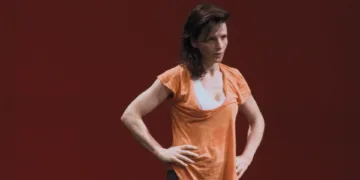
The film’s first ninety minutes are an exercise in radical transparency, an unglamorous liturgy of repetition and frustration set within the purgatorial confines of a black-box studio. This is the antithesis of the slick, inspirational “masterclass”; it is a document of labor. Here, Binoche and Khan are not icons but simply two people in a room, struggling with the limitations of their own bodies and histories.
The camera’s unblinking gaze records every bead of sweat, every exhausted sigh, every moment the intricate machinery of their respective crafts grinds to a halt. The physical space itself, devoid of any adornment, becomes a character, a vacuum that forces everything inward. It is in this void that the real work happens, a slow, painful process of deconstruction before anything can be built. The film insists on showing the sheer, monotonous effort involved, a necessary corrective to the cultural myth of effortless genius.
It suggests that creation is not a lightning strike of inspiration but a grueling war of attrition fought against one’s own inadequacies. This section is guided by the almost terrifying intensity of the creative coaches, particularly acting coach Susan Batson, who pushes the performers to transmute personal trauma into performance. The rehearsals become a form of psychodrama, a space where memory is physically excavated. At its most potent, this method feels revelatory; at its most indulgent, it skirts the edge of parody, a performance of pain for an audience of two.
The Performance Captured on Film
After the deconstruction of the process, the film presents the final construction: a full, seventy-minute recording of the stage piece “In-I.” The narrative is, perhaps surprisingly, a conventional one, charting the lifecycle of a love affair from its euphoric inception to its agonizing end. This familiar story unfolds on a stage dominated by a vast, merlot-red monolith designed by artist Anish Kapoor, an altar upon which the relationship is sacrificed.

Composer Philip Sheppard’s score shifts from delicate to discordant, mirroring the emotional turbulence. Binoche’s decision as a director is not simply to record, but to translate. The camera is not a passive spectator; it is an intimate third party in the relationship, moving with a fluidity that the stage itself cannot possess. Its most powerful tool is the close-up, a device that belongs wholly to cinema. While Binoche’s body is still learning the new language of dance, her face remains her native tongue, and the camera leans in to capture every flicker of doubt, rage, and sorrow.
This creates a fascinating tension, a dialogue between her seasoned mastery as a film actor and her raw vulnerability as a dancer. The performance becomes a hybrid entity, something that could only exist in this filmed state, where the epic scale of the stage and the microscopic intimacy of the screen are forced to coexist. The result is a portrait of a performance that is also a commentary on the act of watching.
An Unvarnished Artistic Statement
Ultimately, In-I In Motion is defined by its austere, observational style. In a culture saturated with curated narratives and explanatory voiceovers, the film’s refusal to guide the viewer is a radical act. There are no interviews to contextualize the struggle, no reflections to package the experience into a neat takeaway. This formal purity places an immense demand on the audience, forcing a level of engagement that borders on participation.

We are not told what to feel; we are simply left in the room to bear witness. This approach aligns with a certain modern fetish for the “unfiltered,” yet the film implicitly questions that very idea. The presence of the camera, the selection of shots, the final edit—these are all acts of profound mediation. The film is thus a beautiful contradiction: a seemingly raw document that is, by its very nature, a highly constructed piece of art.
Its formidable length is not a flaw but a central part of its thesis. It rejects the logic of the algorithm and the highlight reel, insisting that to understand the art, one must endure the process. It is a work that challenges our cultural impatience, suggesting that some things require time and that the struggle itself holds a meaning that cannot be summarized.
In-I In Motion is a 2025 documentary film that marks the directorial debut of French actress Juliette Binoche. The film, which has a running time of 2 hours and 36 minutes, records the intense creative process behind her 2008 hybrid dance-drama In-I, which she co-devised and performed with acclaimed British dancer and choreographer Akram Khan. The movie premiered at film festivals, including San Sebastian and Busan, with an initial release date of September 20, 2025. Reviewers suggest that the film’s likely destination for viewing is streaming platforms, where it will appeal particularly to devotees of Binoche and the dance film genre.
Full Credits
Director: Juliette Binoche
Writers: Juliette Binoche
Producers and Executive Producers: Sébastien de Fonseca, Ola Strøm, Solène Léger
Cast: Juliette Binoche, Akram Khan, Susan Batson, Su-Man Hsu
Director of Photography (Cinematographer): Marion Stalens
Editors: Sophie Brunet, Sophie Mandonnet
Composer: Philip Sheppard
The Review
In-I In Motion
In-I In Motion is less a film to be enjoyed and more an artifact to be studied. An unflinching, exhaustive document of the creative process, it offers a rare, unvarnished look at the vulnerabilities of two masters. Its demanding length and hermetic focus make it a challenging watch, but for those interested in the grueling mechanics of art, it is a raw and courageous statement that values the struggle as much as the result.
PROS
- An exceptionally raw and unfiltered look at the artistic process.
- A fascinating study of two masters willingly becoming novices.
- Intelligently translates a stage performance into a cinematic experience.
- Intellectually courageous in its observational style and demanding runtime.
CONS
- Its 156-minute length is a significant endurance test.
- The purely observational style can feel alienating or self-indulgent.
- Highly specialized appeal, not intended for a casual audience.
- The lengthy rehearsal section can feel repetitive and slow.