





















![Kingdom Hearts Collection [I-III] Review](https://gazettely.com/wp-content/uploads/2026/10/Kingdom-Hearts-Collection-I-III-1-360x180.webp "Kingdom Hearts Collection [I-III] Review: KHII Holds Steady as Newer Entries Fluctuate 37")





Every so often, a film arrives that feels less like a piece of entertainment and more like a smuggled piece of evidence. It lands with the disruptive weight of something that was never meant to be seen, challenging the very barrier between spectator and witness. The Alabama Solution, from directors Andrew Jarecki and Charlotte Kaufman, is precisely that kind of document.
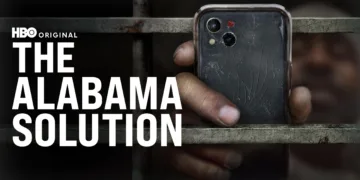
It operates outside the established rules of access journalism, because access was denied. Instead, it was built from the inside out, assembled from a stream of pixelated, desperate, and profoundly brave video files sent from contraband cell phones by men incarcerated within one of America’s most brutal prison systems.
This is not a film that observes from a safe distance. It places you directly inside the cell, forcing you to see through the eyes of men who are risking everything to operate a camera. The result is a raw, immediate experience that feels closer to a secret data leak than a traditional documentary, an urgent message in a digital bottle asking a single, damning question: are you watching?
The Unfiltered Feed
The project’s clandestine nature was not the original plan. Jarecki and Kaufman, known for their deep investigative work on projects like The Jinx, first entered an Alabama prison to film what was presented as a pleasant religious revival, complete with a barbecue. The illusion quickly shattered when prisoners approached them, whispering the grim truth behind the carefully staged event.
Once the guards shut down their cameras, the official door closed, but a secret one opened. This denial of access became the film’s defining creative force, sparking a collaboration with men inside who were already documenting their conditions. Figures like Robert Earl Council and Melvin Ray emerge as the story’s true authors, their smuggled phones becoming instruments of truth.
The aesthetic of the footage is central to its power. The video is often blurry, shaken, and poorly lit, a world away from pristine cinematography. This rawness serves the narrative perfectly. Much like a horror game that uses a body cam perspective, the limited and chaotic viewpoint heightens the sense of claustrophobia and immediate threat. The lack of polish is a constant reminder of the perilous conditions under which it was filmed.
Every second of footage represents a gamble against solitary confinement or a violent reprisal. Through this unstable lens, we witness the unfiltered reality of the system: pools of blood left on concrete floors after an assault, emaciated men catatonic from untreated addiction, and toilets swarming with rats. These are not abstract problems; they are visceral, daily horrors, amplified by the knowledge that these facilities are dangerously overcrowded at nearly 200 percent capacity and run by a critically insufficient staff.
Anatomy of Impunity
The film organizes its damning evidence around specific human stories, preventing the viewer from becoming numb to the horror. Its narrative spine is the case of Steven Davis, an inmate beaten to death by guards. The film methodically follows the aftermath, contrasting the official report of self-defense with the accounts of fellow prisoners who insist Davis was holding only a plastic knife.

His mother, Sandy Ray, becomes our guide through a bureaucratic labyrinth designed to protect the institution at all costs. Her search for justice is met with obfuscation and victim-blaming, a painful portrait of a system designed to be unaccountable.
The absolute impunity is personified by Roderick Gadson, the lead officer in the incident, whose casual dismissal of the evidence against him is chilling. This climate of fear is so pervasive that Davis’s own cellmate, James Sales, refuses to speak for fear of retaliation before his release date, his silence a powerful demonstration of the state’s coercive power.
Alongside this individual tragedy, the film documents a moment of collective defiance: the 2022 statewide prison strike. Incarcerated men organized to protest their forced, unpaid labor, a practice they correctly label as a continuation of slavery that generates hundreds of millions of dollars for the state. Using sound bites from local conservative radio, the film shows an outside world largely unsympathetic, content to dehumanize the strikers.
The state’s response was not dialogue but a calculated act of cruelty. The Alabama Department of Corrections cut food rations, attempting to starve the men back to work. This sequence is a stark illustration of the system’s core philosophy: these men are not people to be rehabilitated but resources to be controlled and exploited.
The Price of the ‘Solution’
The film’s title points to a deeply cynical political reality. The “Alabama Solution” offered by Governor Kay Ivey and other state officials is not reform. It is a plan to build even larger prisons, a proposal that promises to line the pockets of contractors while doing nothing to address the underlying humanitarian crisis.

The film connects the dots financially, showing how the state has spent over $53 million defending its prison system in court while simultaneously diverting funds from its education budget to finance new construction. This creates the grim feedback loop of the school-to-prison pipeline, where underfunded schools fail communities that then feed the ever-expanding carceral state.
Jarecki and Kaufman make it clear that Alabama is not an outlier but a magnifying glass for a national crisis. The federal government’s 2020 lawsuit against the state for unconstitutional conditions confirms that the horrors depicted are not merely anecdotal. The film ends without offering easy answers or a sense of hope for imminent change.
Its final message is instead one of defiant humanity. The most lasting impression is the resilience of the men inside who, against all odds, continue to fight for their own dignity and the truth. They have weaponized the very technology their captors use to monitor them, turning a simple cell phone into a tool of liberation. Their courage transforms the film from a bleak exposé into a vital act of resistance.
This documentary premiered at the Sundance Film Festival on January 28, 2025. It is an HBO Original Documentary and is available to stream on Max (formerly HBO Max), with a debut date on the platform of October 10. The film is a powerful and infuriating exposé into the horrific conditions, abuse, and cover-ups within Alabama’s prison system, largely documented by the incarcerated men themselves using contraband cell phones over the course of five years. It follows the story of these incarcerated activists and the grieving families who seek justice against a broken system.
Full Credits
The Review
The Alabama Solution
The Alabama Solution is a monumental work of guerrilla filmmaking and a harrowing act of witness. It leverages its raw, clandestine footage to create an experience of profound immediacy, transforming the viewer into a recipient of a vital, dangerous truth. This is not just an important documentary; it is an essential piece of evidence about a deep-rooted American crisis, made unforgettable by the courage of the men who risked everything to film it. It is a difficult, demanding, and absolutely necessary watch.
PROS
- The use of smuggled cellphone footage provides a raw, authentic perspective that traditional filmmaking could never capture.
- The film is a true partnership between the directors and the incarcerated men, giving them agency in telling their own stories.
- It skillfully weaves individual stories of tragedy and resistance into a larger critique of a systemic failure.
- Its unvarnished depiction of prison conditions is deeply affecting and impossible to ignore.
CONS
- The low-fidelity nature of the footage, while thematically effective, can be difficult to watch.
- The subject matter is relentlessly grim and may be too intense for some viewers.
- The film presents an ongoing crisis without offering simple solutions, which can feel overwhelming.