














The Royal Cat, a Chinese animated fantasy adventure directed by Liang Cao, introduces a vivid ancient Jinling where myth meets daily life. Talking animals share streets with humans, and bright markets conceal hidden threats. The plot zeroes in on a tight deadline before the Mid-Autumn Festival as strange disappearances, beastlike transformations among townspeople, and the absence of the Crown Prince press the city to the brink.
The main partnership pairs Zhan Ao, a clever tailless street cat known for disruptive antics and expert fighting skills, with Bao Zheng, a young investigator from the prefect’s office. Zhan Ao once served the deceased General Kou, a detail that shapes his choices. The film sets a kinetic, family-friendly tone that mixes suspense and mystery with rapid martial arts action and light adventure beats. These choices treat pacing as part of design, inviting viewers to feel each clue and scuffle as part of one system.
The Weight of Pacing on Narrative Coherence
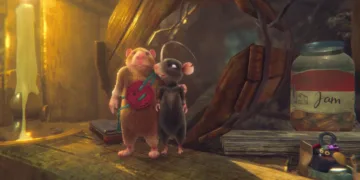
Pacing drives emotion here, and Liang Cao works with a densely packed screenplay. The alliance between Zhan Ao and Bao Zheng grows to include figures essential to the quest: Kou Zhu, daughter of the General; a crafty illusionist black fox; and Jinmaoshu, a masked mouse with charm and quick wit.
The central mystery keeps attention, and the film moves fast through successive action scenes and elaborate set pieces. This momentum maintains energy, yet the volume of ideas can complicate story tracking, trading clarity for speed at times. The film grounds its fantasy in a classic redemption arc. Zhan Ao’s path from streetwise stray to a figure who rediscovers purpose and honor gives the spectacle emotional weight.
The focus on underdog heroes facing a monumental task plays well for the intended audience. Themes of loyalty and courage, paired with quick humor, point the experience toward pre-teens and younger viewers. From a design perspective, progression and payoff match the cadence of fights and reveals, so emotional spikes arrive where the structure aims to place them.
Visuals as a Storyteller: Art Direction and Orchestration
Production values signal the craft level of current Chinese animation studios. The computer animation runs smoothly with clean lines and fine detail that support a slick world. Art direction stands out: colorful cityscapes present ancient architecture, traditional landscapes, and a strong sense of culture.

The environments carry personality, so setting functions like a supporting character. Character designs read clearly on screen, with Zhan Ao’s expressive features and Jinmaoshu’s appeal drawing focus. The animation remains polished, though the visual style favors familiarity over distinctive, era-defining choices compared to contemporary CG features. Music provides a firm anchor.
The score pairs traditional Chinese instruments and melodies with the suspense of action-adventure scoring, heightening the cultural setting and deepening quiet scenes while tightening the grip of chase and combat sequences. Sound work lands with presence and clarity, which helps keep young audiences engaged through the runtime. As a complete audiovisual system, image rhythm and musical cues support narrative beats and guide attention through each sequence.
Cinematic Lineage and Cultural Resonance
The Royal Cat joins a line of animated quests with animal heroes, with an obvious touchpoint in Puss in Boots. It frames itself as an animated wuxia for children, using fantastical martial arts as the driving mechanic.

The film ties itself to its culture through figures like Bao Zheng and a mythic framework in which talking animals and magic feel natural. Setting and instrumentation present Chinese traditions with ease, so the world’s rules feel consistent. The story structure follows fairy-tale logic and an underdog arc that read across borders, which keeps the film accessible to a wide audience.
The Royal Cat delivers a lively watch that relies on familiar narrative formulas and prioritizes pace over formal experimentation. Its craft, fast action, and clear emotional throughline make it a strong pick for families and for fans of animated adventure who want color, speed, and a focused emotional hook.
The Royal Cat is a Chinese CG-animated fantasy-adventure directed by Liang Cao. It premiered at the Shanghai International Film Festival in 2024. For North American audiences, the film was released on Digital platforms and on Blu-ray/DVD exclusively through Amazon on October 14, 2025, distributed by Well Go USA Entertainment.
Credits
Director: Liang Cao
Writers: Yue Luo
Cast: Tutehameng, Zhengyang Ma, Jie Zhang, Yi Zhu, Xiaoyu Liu, Cong Liu, Ai Zhang, Linhao Qing
The Review
The Royal Cat
The Royal Cat offers a vibrant, fast-paced animated adventure primarily for younger viewers. Its strengths lie in the smooth technical execution, the beautiful, detailed Chinese cityscapes, and an engaging soundtrack. While the story's rapid pace makes the plot feel overstuffed and predictable at times, the redemption arc of the titular cat provides a strong emotional anchor. It is a satisfying, colorful spectacle that successfully blends martial arts fantasy with classic family-friendly hero tropes. This is a solid, enjoyable watch for animation enthusiasts and families.
PROS
- Smooth, high-quality computer animation.
- Stunning, vibrant depiction of ancient Chinese cityscapes.
- Sophisticated soundtrack blending traditional instruments with modern scoring.
- Engaging redemption arc for the main character, Zhan Ao.
CONS
- Plot can feel convoluted due to an excess of ideas and rapid pacing.
- The narrative relies heavily on familiar, universal fairy tale tropes.
- Visual style, while clean, lacks a truly distinctive, memorable flair.
- World-building details, particularly court politics, remain vague.