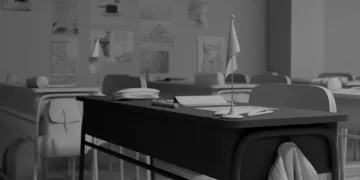






























Yulia Lokshina’s Active Vocabulary is a documentary essay about the bleak intersection of state control, collective memory and individual surrender. The film situates this meditation in contemporary Russia, where power reaches for ideological command of both the classroom and the land. One strand follows Maria, a Russian teacher expelled from her life after a pupil records her anti-war remarks and forces her to escape to Germany.
The other attends to the resistance of Muscovite women who confront the vast, ecologically destructive construction of a new school on the outskirts of the capital. Through patient observation, Lokshina arranges intimate classroom scenes, impersonal archival documents and stark 3D architectural renderings into a map of modern domination. The film reflects on forces that grind down individual resilience, a subdued examination of the politics of existence and the cost of remaining human inside an apparatus of control.
Whispers and Bulldozers
The two storylines in Active Vocabulary mirror each other as figures of state power. Maria’s story, filmed in the remote Transbaikal region, plays like a psychological horror. A student secretly captures her unauthorized thoughts on the war in Ukraine, which triggers an investigation and drives her toward a hurried flight to Germany.
In Berlin, her later use of role-playing with her ethnically varied students, ages 12 to 13, becomes an exercise in working through trauma. The classroom games reveal how fragile young people appear when they try to make sense of a world marked by geopolitical darkness.
The Moscow strand takes shape as a conflict written onto soil and trees. Muscovite women stand in front of the construction site for a huge new school, a building that figures Moscow’s insatiable growth. Their protest against the loss of the forest confronts a power that shows no regard for nature. The men hired to clear the ground are Central Asian migrants, Kirghiz workers who speak only basic Russian.
This detail shifts the line of confrontation. When the foreman is absent, a brief exchange appears, one that hints at shared exploitation and oppression, a small fracture in what first appears to be a solid wall of authority. Both narrative threads point toward the same picture: the state reaches for control of space by tearing up the environment for arbitrary “progress” and by planting official propaganda inside the mind.
The Limber Geometry of Fear
Lokshina’s essayistic practice rejects a straight path and moves through a supple structure in which links between scenes gather slowly. Nina Wesemann’s handheld camera in the Berlin classroom feels acutely responsive, set against the clinical accuracy of satellite images and archival records.
Felix Klee’s precise use of computer-generated 3D animation gives the “monster school” project an X-ray clarity that lays bare the reach of centralized architectural desire, a clear delusion of grandeur. The music, drawn from somber suites by J. S. Bach, places classical weight beside present-day anxiety and keeps the images under a steady, mournful pressure.
The work’s philosophical pull lies in the way it sets two educational policies against each other. On-screen captions outline the Russian state’s guidelines for teaching the “special military operation.” This contemporary form of pressure appears next to the West German “ban on overwhelming” from the 1970s, a legal tool designed to protect educational freedom from radical ideological influence.
By bringing these documents into conversation, the film invites reflection on political influence and oppression and the need for constant alertness to the slow spread of ideology. This idea becomes disturbingly concrete in a Russian math test shown on screen, where arithmetic tasks are framed around numbers linked to military deployments.
Resilience and the Human Anchor
Maria’s presence holds together the strands of Active Vocabulary. Her calm decision to use her own trauma as material for learning and understanding sets her against the machinery that tried to erase her. She comes to represent resilience itself. The figures around her extend this position. The German students, with their self-conscious glances and tentative attempts at connection, convey how difficult it is to construct a sense of self in a world shadowed by the conflicts of adults.
The Muscovite activists add a clear act of bodily refusal, standing on the contested ground. The film’s power lies in the way it renders a landscape marked by fear and surveillance as something immediate and physical. It poses a stark question about where the dominant stories of power take shape: inside the walls of a classroom or along the new edges of a cleared forest. Active Vocabulary reaches a grave clarity about the existential stakes of education and its role in shaping any society that dares to call itself free.
Active Vocabulary is a German documentary essay that premiered in October 2024 at DOK Leipzig, where it won the German Documentary Competition. The film, directed by Yulia Lokshina, follows a Russian teacher who flees to Germany after one of her students denounces her for criticizing the war in Ukraine, and also chronicles a parallel protest against a massive school construction project outside Moscow. As of November 2025, the film is primarily circulating through film festivals and has been featured on platforms like MUBI for a limited time, but a wide general release date for streaming or cinema is not yet confirmed.
Full Credits
Title: Active Vocabulary
Release date: October 2024 (Premiered at DOK Leipzig)
Director: Yulia Lokshina
Writers: Yulia Lokshina
Producers and Executive Producers: Yulia Lokshina
Director of Photography (Cinematographer): Nina Wesemann
Editors: Yulia Lokshina, Maya Klar
The Review
Active Vocabulary
Active Vocabulary is a deeply contemplative work, utilizing a fragmented, essayistic structure to map the silent trauma of ideological control. Its ambition sometimes outpaces its coherence, observing human struggle from a philosophical distance. The film presents a chilling anatomy of state power, finding universal truth in the particularities of Russian coercion and the quiet resistance of citizens. A challenging yet essential document on the fragility of free thought.
PROS
- It elevates its subject matter beyond current events, exploring timeless themes of coercion, dissent, and educational freedom.
- The effective use of 3D animations, archival footage, and the dual narrative creates a rich, layered cinematic experience.
- It successfully collapses the distance between "here" and "there," encouraging reflection on how state power operates globally.
- Maria’s use of role-playing to process betrayal provides a powerful, emotional anchor for the film's intellectual core.
CONS
- The essayist approach is sometimes too limber, leaving thematic connections between the two main narratives feeling tangential or under-explained.
- The film occasionally observes its human subjects from a deliberate distance, hindering a close, immediate emotional understanding of their plight.
- The contemplative, analytical style may require high engagement from the viewer, potentially alienating those seeking a straightforward narrative.







