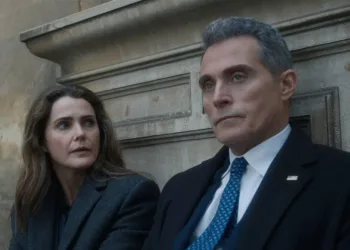
















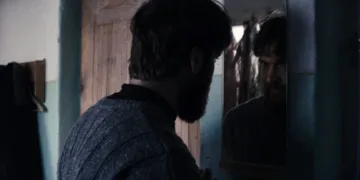














Paprika Steen, moving from performance to the director’s chair, delivers To New Beginnings as a compact study in social heat and pressure. A New Year’s Eve dinner in Copenhagen gathers Nomi (Tuva Novotny) and a circle of long-time friends who repeat their annual ritual for comfort and continuity. Into this arrangement enters Finn (Lars Brygmann), Nomi’s new boyfriend, an earnest outsider who replaces an absence.
The memory of Nomi’s late partner, Martin, lingers over the apartment and weighs most heavily on Jens (Anders W. Berthelsen), Martin’s closest friend. What opens with warmth and ensemble wit shifts into reckoning. The mood tilts from wry comedy toward darker drama that fixes on collective loss and the necessity of change. The party smiles, then tightens. The air changes.
Expressionistic Framing: The Tyranny of Ritual
The narrative architecture relies on near-liturgical devotion to local New Year’s customs. Rituals function as physical anchors for a shared, idealized past: cod prepared with ceremony, kransekage presented as a totem, the televised “Dinner For One” observed with exaggerated reverence, and the synchronized leap from the sofa at midnight. Jens embodies this stasis. His suit and bowtie amid casual clothes read as a costume for yesterday, a uniform of refusal. Composition makes that refusal legible; the image treats him as a figure posed against a looser social field.
Finn disrupts the pattern. Pedantic, exacting, and socially abrasive, he declines the funny hats and steps into Jens’s long-held kitchen role with clinical confidence. The breach crests when he picks up Martin’s guitar, an act that functions as ritual trespass. The offense is simple.
The effect is sharp. Dialogues slice with dry wit while misaligned etiquettes accumulate into friction. Tension grows from repetition under pressure. Camera placement and blocking emphasize lines of approach and retreat across the apartment; pathways through rooms start to look like tracks laid by habit. The space itself behaves like a metronome that the guests keep trying to reset.
Cutting maintains that pressure. Scenes move with a precise internal rhythm that allows jokes to land and discomfort to expand, beat by beat. When the film steps outside to the Copenhagen streets, the brief release registers as a charged intermission. Night air, city glow, a minute of grace before the next course of conflict. The image of a city poised for a calendar reset mirrors the characters’ stalled recalibration indoors. Small joke, hard truth, small joke. Repeat.
The Ensemble: An Actor’s Circuit of Denial
Steen’s direction builds a playable arena for the cast. Performances grow inside a tightly managed environment where timing and proximity matter. Brygmann’s Finn offers a study in calibrated irritation; his deadpan turns ordinary sentences into fine-grained provocations that abrade the group’s self-image. He steals laughs by refusing softness. Berthelsen’s Jens serves as the quivering counterpoint, a man hovering at the edge of collapse, his devotion to a friend’s memory shaping every gesture and misstep.

Younger players Nikoline Juul Rohold (Caro) and Daniel Ørum-Hansen (Vincent) supply steadier warmth. Their shared moments soften the film’s harsher frequencies and register as a humane buffer between blowups. Within a single apartment, Steen keeps the frame alive. Rooms open and close with bodies; doorways and tabletops turn into staging rails.
Sharp editing wrings both claustrophobic intensity and quiet conversational intimacy from the same square meters. The method feels theatrical in its unity of place, yet the camera’s subtle repositioning and the constant re-mapping of routes through the space give each exchange a new axis. Simple tools. Clean execution. The outcome is control of tempo.
Ethical Gray Zones: The Cost of Idealism
The dramatic pivot addresses grief and the human task of accepting change. Martin’s memory operates as the unspoken engine, a pressure that turns dinner into a slow diagnostic. Over the course of the night, the group faces an unwelcome idea: Martin was imperfect, and the halo they maintain distorts present life. The film points toward forward motion. It urges these friends to release a fixed past and meet the mess of current relationships without euphemism.

Loss and mental illness receive sustained attention and a sober tone. The treatment of infidelity, however, reveals a weak load-bearing joint. Affairs recur, staged as light comedy or casual romance, and threads often stop short of confrontation. Accountability rarely arrives. The result leaves several players strikingly unsympathetic, which feels out of step with the rigor applied to grief. Ethical slippage drifts by as decor rather than dilemma.
Pacing loosens as the film works to close out numerous arcs. Scenes linger; the dramatic line blurs at times. Yet the insistence on heavy themes pushes the material past simple dinner-party manners play. The structure maps denial, exposure, and adjustment across a single night, and the ensemble sustains that map. Ritual gives shape. Disruption gives movement. Grief gives gravity.
The film interrogates how memory polishes the dead and binds the living. It watches the politics of tradition compress a room. It watches the smallest joke pierce a seal of courtesy. Steen’s eye for spatial choreography, her command of cutting, and the cast’s responsive timing keep the frame alert to tiny shifts in allegiance and temperature. A glass placed too firmly on a table. A chair pulled an inch closer. A guitar picked up without asking. Little actions with moral weight. Quiet instruments of fate.
To New Beginnings is a Danish dramatic comedy that premiered at the Zurich Film Festival in October 2025 before its official theatrical release in Denmark on November 6, 2025. Directed by Paprika Steen and written by Jakob Weis, the film centers on a group of close friends whose annual New Year’s Eve gathering in Copenhagen is disrupted by the introduction of a new partner, forcing the group to confront their collective grief and rigid traditions.
Credits
Title: To New Beginnings
Distributor: Nordisk Film Distribution A/S
Release date: November 6, 2025
Running time: 95 minutes
Director: Paprika Steen
Writers: Jakob Weis
Producers and Executive Producers: Mikael Christian Rieks
Cast: Tuva Novotny, Anders W. Berthelsen, Lars Brygmann, Birgitte Hjort Sørensen, Christian Tafdrup, Daniel Ørum-Hansen, Nikoline Juul Rohold
Director of Photography (Cinematographer): Niels Thastum
Editors: Nicolaj Monberg
Composer: Nikolaj Steen, Poul Reimann
The Review
To New Beginnings
To New Beginnings functions effectively as a bitter pill of truth wrapped in the glitter of a holiday ensemble. The film masterfully utilizes its confined setting to escalate psychological tension, driven by a series of outstanding, tightly controlled performances. Steen’s direction successfully navigates complex emotional dynamics, exposing the painful gap between idealized memory and present reality. Its failure to ethically resolve or give weight to the consistent subplot of infidelity, however, is a notable misstep that compromises character sympathy. It remains a compelling, often hilarious, yet ultimately flawed examination of personal identity under the pressure of tradition.
PROS
- The chemistry and individual performances are highly refined, particularly Lars Brygmann's portrayal of the abrasive Finn and Anders W. Berthelsen's emotionally charged Jens.
- Paprika Steen effectively uses a single-location setting without inducing claustrophobia, maintaining strong atmospheric control and rhythmic pacing.
- The screenplay introduces genuine, awkward comedy through cultural clashes and social friction.
- The film thoughtfully explores significant themes of grief, the idealization of the past, and the necessity of confronting personal change.
- The depiction of precise Danish New Year's Eve traditions grounds the conflict in specific, meaningful ritual.
CONS
- The frequent inclusion of unresolved infidelity subplots is treated lightly, potentially making key characters unsympathetic and undermining the film's serious tone.
- The attempt to resolve every character's arc toward the conclusion causes the pacing to feel lengthy and sometimes messy.
- The Kris character (Christian Tafdrup) feels underdeveloped or lacks closure compared to the others.