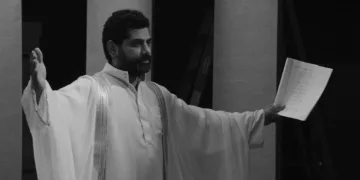





























Yes Repeat No arrives as a highly conceptual feature that actively sidesteps conventional biopic form. Director Michael Dahan confines the action to a theatrical studio space, using that limitation to probe the life and volatile self-definition of Juliano Mer-Khamis, the Palestinian-Jewish actor and activist who described himself as “100% Palestinian and 100% Jewish” before his murder in 2011. The premise follows three performers auditioning for the role of Mer-Khamis inside this enclosed environment.
Within that setup, Mer-Khamis functions as a meta-figure, a fractured presence whose legacy opens up questions about the Israel-Palestine conflict, the construction of identity, and the heavy emotional charge of collective memory. The film presents itself as an immediate cultural statement, expressed through a bold, formally inventive style that keeps the audience in an active, interpretive position.
Deconstructing the Story Engine
The film builds its narrative on an elaborate test of ideology and performance. The entire story plays out as a charged audition in which three actors, introduced as “Israeli Juliano,” “Arab Juliano,” and “Public Juliano,” compete for the same role under the provocation of the director, Yael. This enclosed contest functions as the story engine.
As the performers dissect Mer-Khamis’s history and restage a scene from his feature debut, The Little Drummer Girl, their divergent ideological backgrounds come to the surface. The conversation quickly shifts from technical script work to open confrontation, and the room fills with tension and flashes of aggression.
Dahan stacks the scene with meta-devices that disturb any stable sense of reality. The director steps into the frame, addressing the actors and shaping their choices in ways that read as a running commentary on filmmaking itself. Archival material from Mer-Khamis’s interviews and films punctuates these exchanges, setting up a direct conversation with the past.
A ticking metronome tracks the rising pressure and marks the growing unease. One key structural instruction asks the actors to trade their colored suits, white, black, and gray. The exchange becomes a behavioral experiment, pushing each performer to inhabit the position of the “other” and to submit to the social role signaled by the costume.
Form, Focus, and Thematic Ambition
Dahan’s direction builds meaning through tightly controlled visual choices and a precise sense of rhythm. The film relies largely on black-and-white imagery, a stylistic decision that mirrors the “gray area” of the conflict and hints at how hard it is to reach a complete perspective.
This monochrome world, which covers the staged audition, stands against bursts of color and restless handheld camerawork once the action shifts “backstage,” where the film breaks the fourth wall to expose the working environment of the studio. Dahan intercuts these planes with care, letting performed truth, improvisation, and documented reality slide into each other.
The structure leans heavily on dialogue and asks the viewer for sustained concentration. The script feels dense and grounded in context, and the flow of words can grow intense and exhausting. Dahan shapes that intensity by carving out pockets of silence that give the argument room to breathe and keep the audience from burning out on continuous verbal sparring.
The thematic reach is large. The film avoids a fixed political line and argues for a clear anti-war position rooted in logic. The project seeks to expose the mechanics of the conflict, study how easily a person can be turned into an ideology, and raise difficult questions about the origins of identity, asking if it is freely chosen or imposed.
The Power of Ensemble and Intellectual Challenge
The four principal performers, Salome Azizi, Karim Saleh, Mousa Hussein Kraish, and Adam Meir, create a sharply unified ensemble. Their work feels energetic yet carefully controlled, calibrated to fit the high-concept design without tipping into melodrama.
Through them, the intellectual argument gathers heat, as the debate on ideology gradually shifts into a raw emotional clash and the lines grow personal. Dahan leans on their delivery to foreground the text, depending on their precision and commitment to give emotional weight to material that might otherwise remain abstract.
By working through Mer-Khamis’s tangled experiences and ideas, the film shapes an archetype of the man. The audience gains access to his complexity regardless of prior knowledge of his activism. Yes Repeat No has little interest in casual viewing. The film sets up a rigorous intellectual exercise that demands close attention from its audience. It pulls viewers into the process of decoding its signals and coded messages, and offers a rich experience for cinephiles who seek ambitious narrative experiments.
Yes Repeat No is an experimental drama that premiered at film festivals in 2023. It explores the layered identity of the Palestinian-Jewish actor and activist Juliano Mer-Khamis by depicting three actors auditioning for his role. The film was distributed by Freestyle Digital Media for a VOD and digital release in November 2025 and is available to watch on platforms like Amazon, Apple TV, Google Play, YouTube Movies, and through Cable On Demand.
Credits
Title: Yes Repeat No
Distributor: Freestyle Digital Media
Release date: 2023 (Festival), November 11, 2025 (VOD/Digital)
Running time: 1 hour 38 minutes (98 minutes)
Director: Michael Dahan, Michael Moshe Dahan
Writers: Michael Dahan, Michael Moshe Dahan
Producers and Executive Producers: Michael Dahan, Braxton Pope, Sarah Szalavitz
Cast: Salome Azizi, Mousa Hussein Kraish, Adam Meir, Karim Saleh
Director of Photography (Cinematographer): B.J. Strongman, B.J. Iwen
Editors: Benjamin Shearn, Alex Tyson
Composer: Akram Haddad, Abe Hathot
The Review
Yes Repeat No
Yes Repeat No is an essential, challenging piece of filmmaking that transcends the typical biopic to become a charged ideological experiment. The film's dense structure, striking black-and-white aesthetic, and committed performances successfully dissect a complex legacy while promoting a profound anti-war sentiment. It demands full intellectual engagement but rewards the dedicated viewer with a multi-layered, relevant, and innovative cinematic experience.
PROS
- Defies traditional biographical and narrative forms.
- Effective use of black and white/color contrast to convey meaning.
- Successfully explores complex issues of identity and conflict without being prescriptive.
- Actors sustain intense, high-stakes emotional tension.
CONS
- The dense, contextual dialogue requires sustained, intense focus.
- The conversation-heavy structure may feel slow or abstract to some viewers.
- Not an accessible or casual viewing experience for a general audience.
- The layers of meta-narrative and constant disruption can be initially confusing.