




























A flat sheet of turquoise can read like an invitation, the Gulf of Mexico posing as polished glass meant for weekends and easy daylight. Seventy miles off Clearwater, Florida, that color turns clinical. Depth and distance empty the horizon of comfort, leaving a wilderness that feels indifferent by design. Not Without Hope, directed by Joe Carnahan, builds its first tension from that reversal, the moment a place associated with leisure becomes a site of erasure.
The film adapts the events of late February 2009, when a single-engine boat carrying four men, including NFL players Marquis Cooper and Corey Smith, disappeared into a storm that refused sentiment. Drawn from the memoir of the lone survivor, Nick Schuyler, the story keeps tightening its frame. What begins with the open promise of a professional athlete’s life collapses into the cramped orbit of an overturned hull, where space becomes a problem and time becomes a punishment.
Carnahan arrives with a history of muscular, kinetic filmmaking, a sensibility drawn to grit, exertion, and bodies under strain. That instinct fits a tale of violent weather, yet the film’s strongest register appears in quieter choices: silence, waiting, the slow abrasion of the human body by cold and salt. Endurance here carries no romantic glow. The hours become an inventory of pain, seconds stacking into something close to arithmetic. By trapping the audience in the cast’s perspective, the movie tries to approximate sensory deprivation and the ocean’s physical assault, inviting viewers to inhabit cold as a constant pressure rather than a dramatic beat.
The Invincibility Myth and the Anchor
The tragedy takes shape through a clear social chemistry. Nick Schuyler, Marquis Cooper, Corey Smith, and Will Bleakley move inside a world of masculine confidence reinforced by physical capability. Schuyler, played by Zachary Levi, is a personal trainer, the connective tissue between ordinary life and the elite athletic sphere occupied by Cooper and Smith.
Their language runs on friendly aggression and motivational shorthand. Locker-room rhythms dominate: banter as camouflage, affection delivered through insults, vulnerability kept behind noise. The camaraderie lands as credible because it feels learned, a practiced method for men trained to treat resistance as something the body can conquer through force.
Casting adds a stray layer of commentary. The actors read older than the mid-twenties men they portray, a visual mismatch in youth that still feeds the film’s theme of solidity. These bodies look finished, powerful, fully grown. Their size and strength function as narrative information, suggesting a high-water mark of physical conditioning. The film leans into an implicit thought experiment: if biology and training could shield anyone from the elements, it would be men like these. Their breakdown makes the counterpoint brutal. Nature does not negotiate with bench-press numbers or cardio discipline.
The inciting incident plays like a critique of contemporary hubris. The disaster begins before the storm becomes the central antagonist, triggered by mechanical failure intensified by human choice. When the anchor snags on the seabed, likely on debris or a shipwreck, the group faces a simple decision. Cutting the line sacrifices equipment and preserves the vessel.
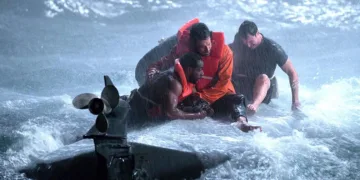
They choose the opposite route, trusting the machine and their own refusal to yield. They throttle the engine, trying to tear the anchor loose. The torque flips the boat and throws them into the water. One violent motion clears away the illusion of control. The technological buffer vanishes, leaving exposed bodies drifting in saltwater that treats flesh as just another material.
A Lens Beneath the Surface
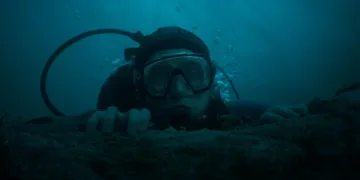
The film’s visual strategy depends on forced proximity. Cinematographer Juanmi Azpiroz repeatedly places the camera at the water line or just beneath it, refusing a detached, commanding view. That decision limits what can be known. The storm is not presented as a distant meteorological spectacle; it becomes a wall of grey water that consumes the horizon in fragments.
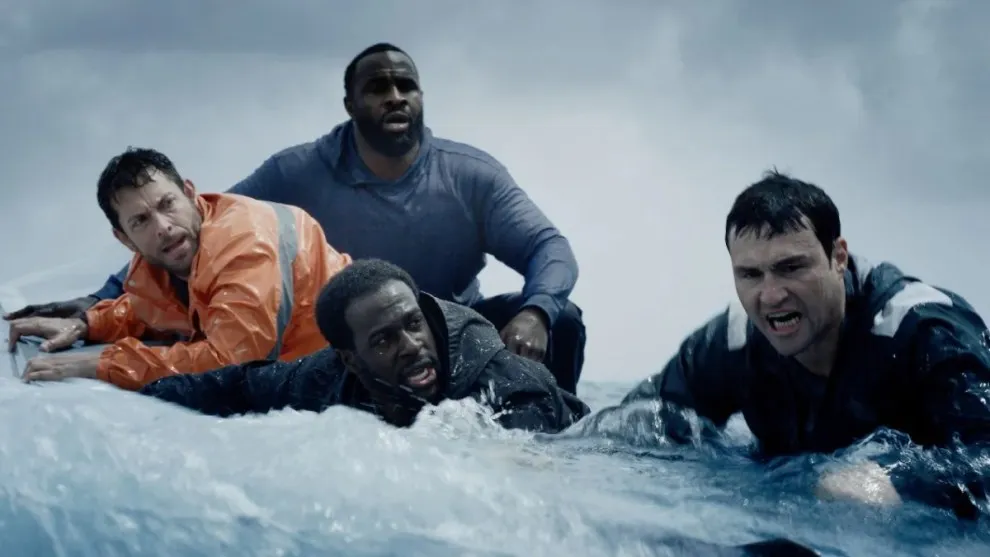
Saltwater clings to the lens, insisting on the medium and collapsing distance between a dry audience and a drowning simulation. Sound design deepens the effect: when the camera slips below the surface, the wind’s roar drops away, replaced by a muffled, pressurized hush. The shift communicates underwater isolation with unnerving clarity, a silence that can feel serene for a breath and terrifying for the next.
Immersion suffers when the production environment shows through. The stunt work in the tank carries weight and physical discipline, yet the lighting often signals artifice. Night at sea during a storm is total darkness, a void where water and sky fuse into one black field. The film lights its night sequences with studio legibility so faces remain visible, and that necessity costs the terror of blindness. Fear can be read in expressions, but the suffocating absence of sight never fully arrives.
The green screen backgrounds introduce a similar mismatch in texture. Foreground action is wet, chaotic, tactile. Background skies can resemble digital paintings. Storm fronts lack the density of real weather, and distant waves sometimes move with a repeated cadence that hints at computation rather than fluid motion. The result is a thin barrier between scene and viewer.
The actors work hard against that barrier. Much of the runtime finds them submerged, bodies reacting to cold with involuntary shivers, clenched muscles, and visible strain. Those physiological cues ground the film. Even when the sky looks manufactured, the misery reads as immediate and real, supplying a baseline the visual effects cannot always sustain.
The Anchor and the Exposition Machine
Levi carries the central performance with a seriousness that feels far removed from his comic associations. Known for Shazam! and the affable charm of Chuck, he plays Schuyler without that familiar warmth, replacing it with wide-eyed terror and a dawning comprehension of helplessness.
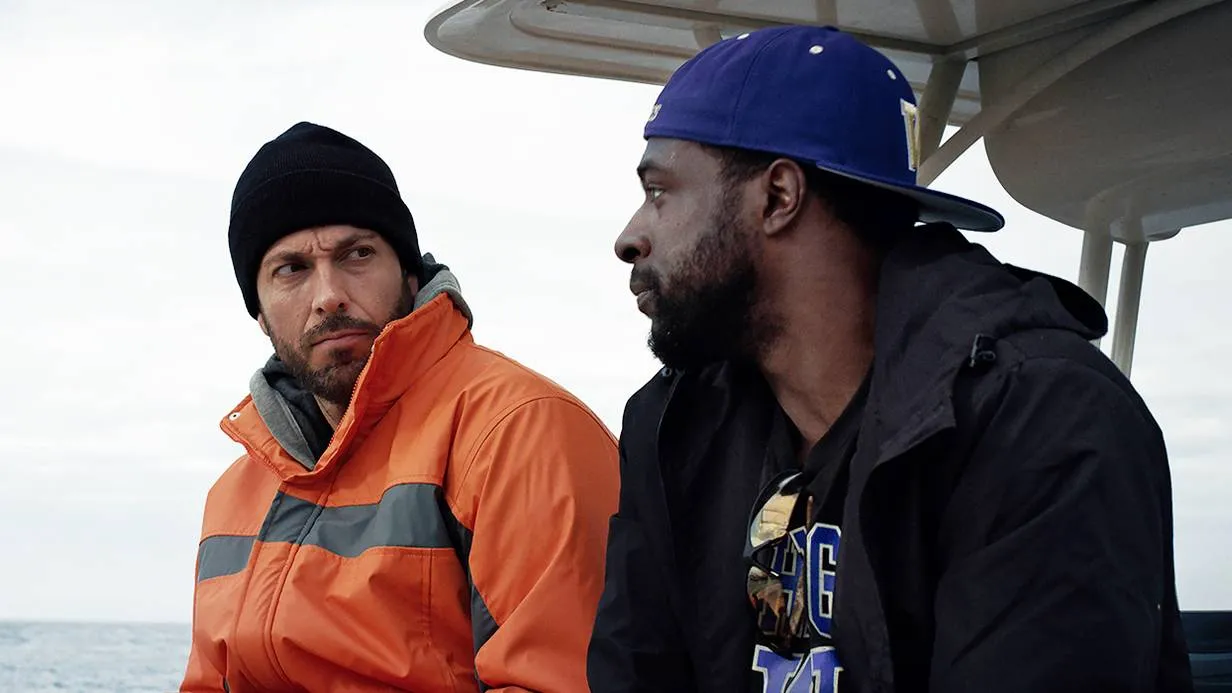
As the hours stretch, a hollowness settles into his gaze, the look of a mind trying to retreat from what the body cannot escape. Some moments feel calibrated for cinematic clarity rather than the disorder of shipwreck reality, yet Levi holds the audience’s emotional access point. Schuyler becomes the witness who watches his friends diminish, and the film uses that position to channel fear into observation rather than spectacle.
On land, Josh Duhamel plays Captain Timothy Close, a bridge between the victims and the rescue apparatus. Duhamel gives Close a steady presence, though the script treats him as function first and person second. His scenes exist to deliver information the audience needs, even when colleagues in the room would already know it. Coast Guard command center sequences lean into procedural dialogue about search patterns and drift models. The approach peaks in a monologue describing hypothermia’s stages.
Close details the body’s breakdown, hallucinations, paradoxical undressing, final lethargy, in a speech that mirrors what is unfolding at sea. The clarity serves as cinematic shorthand, instructing the viewer what to watch for in the men’s decline. It also narrows the sea sequences, reducing uncertainty by labeling the experience in advance.
The land-based emotional stakes find sharper life through the women waiting for news. JoBeth Williams, playing Nick’s mother, delivers the film’s most piercing human contact. Her confrontation with authorities plays as more than parental worry; it reads as an accusation aimed at bureaucracy struggling to match the velocity of fear.
Floriana Lima, as Nick’s fiancée Paula, embodies the suspended torment of the person left behind: trapped in sterile rooms, staring at phones that refuse to ring, forced to place faith in strangers and systems. These scenes counterbalance the isolation on the water, reminding the audience that the disaster spreads outward, dismantling families in real time.
The Distortion of Time
Editing follows a metronomic swing between the ocean’s static horror and the rescue operation’s activity. Cross-cutting is a familiar suspense tool, meant to suggest converging timelines. Here it produces an uneven effect. The water sequences depend on duration as a form of terror, a purgatory built from waiting and exposure.

Frequent returns to bright, dry command centers release pressure. The viewer gets air, light, motion, a sense of competence at work. That relief weakens the attempt to make the ordeal feel suffocating. A bolder editorial approach might have stayed longer with the men, allowing discomfort to accumulate through stillness rather than being reset by procedural momentum.
The film also stamps the passage of time with on-screen text, marking the hours lost at sea. The device tries to force linear order onto an experience defined by disorientation. The story compresses more than forty hours into two, a necessary condensation that still changes the feel of survival. Sunrises and sunsets appear, yet the rhythm can make the ordeal feel strangely accelerated. The middle stretch faces the challenge of dramatizing inaction. The men drift. The body cools. Death approaches slowly. The script fills that void with hallucinations and fractured conversation.
Hallucinatory sequences aim to visualize mental decay driven by hypothermia, with phantoms of rescue or memories of land appearing at the edge of perception. The gestures align with the condition’s effects, yet they can feel like busywork, images used to keep the screen moving when the lived reality may have been silence and the sound of water.
Pacing struggles to reconcile cinematic propulsion with a death that arrives through patience. Repeated near-misses, ships passing in the distance, planes overhead that fail to spot them, form a cycle of hope and collapse. The repetition is exhausting by intention, though the film sometimes renders it as repetition without accumulation.
The Cold Math of the Ocean
The film reaches its strongest register when it stops straining for thriller mechanics and accepts the bleak philosophy of its setting. The ocean is not framed as a villain with intent. It carries no malice. It operates as a thermodynamic system that strips heat from anything warmer than itself.
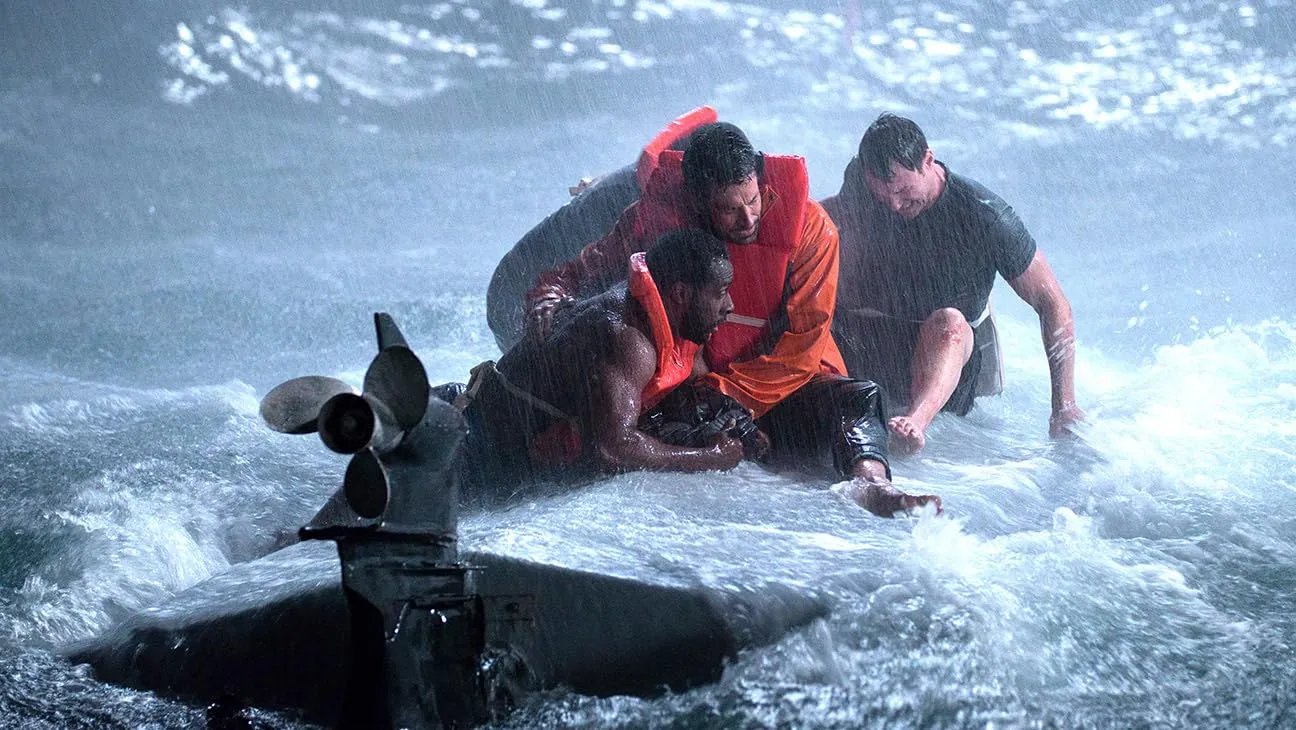
The film places the NFL players’ physical power against that indifferent equation. Men who have built armor from muscle discover that muscle does nothing against water’s conductivity. The tragedy lives in that mismatch. Pep talks, chants of “We get strong,” athletic discipline, all function as social language that offers no currency in open water.
Psychological collapse arrives with grim clarity. Cold does not merely stop a heart; it disassembles thought. The camaraderie that defined the opening act fractures into confusion and delirium. The film treats the deaths of Cooper, Smith, and Bleakley with somber restraint. Their passing carries no melodramatic flourish. They fade, and the ocean reclaims the frame.
The score recedes, leaving silence to occupy the space again. In those moments, technical flaws and genre habits matter less. The film becomes a memorial shaped by the plain recognition that nature is vast, and human strength is fragile. It serves as a stark reminder of how quickly a life built on power can become a memory held above water by someone who survived.
The survival thriller Not Without Hope premiered in United States theaters on December 12, 2025, distributed by Inaugural Entertainment. Directed by Joe Carnahan, the film adapts the harrowing true story of four friends stranded in the Gulf of Mexico during a severe storm in 2009. The production was filmed primarily in Malta, utilizing local water tanks to replicate the open ocean conditions. As of today, December 13, 2025, it is currently playing in select cinemas, with future streaming availability likely to follow its theatrical run.
Full Credits
Title: Not Without Hope
Distributor: Inaugural Entertainment
Release date: December 12, 2025
Rating: R
Running time: 119 minutes
Director: Joe Carnahan
Writers: Joe Carnahan, E. Nicholas Mariani
Producers and Executive Producers: Joe Carnahan, Michael Jefferson, Adam Beasley, Cindy Bru, Kia Jam, Dean Altit, Rick French, David Lipper, Robert A. Daly Jr., Alla Belaya, Vadim Fortunin, Jean-Pierre Magro, Leeshon Alexander, Ford Corbett, Grant Cramer, Jatin Desai, Greg Friedman, Andre Gaines
Cast: Zachary Levi, Josh Duhamel, JoBeth Williams, Quentin Plair, Terrence Terrell, Marshall Cook, Floriana Lima, Jessica Blackmore
Director of Photography (Cinematographer): Juan Miguel Azpiroz
Editors: Kevin Hale
Composer: Clinton Shorter
The Review
Not Without Hope
Not Without Hope is a grueling, often terrifying examination of physical fragility that succeeds more as a memorial than a polished thriller. While hampered by structural repetition, synthetic visual effects, and clunky exposition, the film is anchored by a raw, committed performance from Zachary Levi and an uncompromising depiction of nature’s indifference. It effectively strips away the glamour of athleticism to reveal the terrifying equality of survival, resulting in a viewing experience that is exhausting, imperfect, but undeniably haunting.
PROS
- The water-level camera work effectively simulates the suffocating experience of being lost at sea.
- The cast, particularly Zachary Levi, delivers committed physical acting that conveys the genuine misery of hypothermia and exhaustion.
- The film refuses to sugarcoat the brutality of nature, offering a stark contrast between human strength and the ocean's power.
- The deaths of the real-life individuals are handled with dignity and somber restraint.
CONS
- The obvious green screen backgrounds and studio lighting in night scenes undermine the realism of the location.
- Josh Duhamel’s dialogue often feels like an unnatural lecture on science rather than organic conversation.
- The cross-cutting between land and sea frequently punctures the tension, and the timeline feels compressed.
- The middle act struggles to maintain momentum, relying on repetitive hallucinations to fill the runtime.