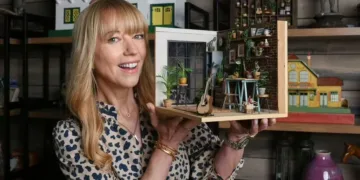






























BBC One sets aside a half hour for The Marvellous Miniature Workshop, a small-screen breather that treats attention like a virtue. Sara Cox hosts with an easy steadiness, welcoming expert artisans who rebuild significant landmarks at a 1:24 scale.
The buildings exist now through memory alone, so the work starts with records: archival material, months of research, and the sort of meticulous planning that daytime television usually treats as a scheduling problem. Makers such as Hannah Lemon and Lee Robinson reconstruct these lost sites for the public, episode by episode, commission by commission, until a vanished place reappears with exacting clarity.
The series frames architecture as personal history with a roof. Rooms become evidence. Corridors become timelines. The pace follows that idea. The show leans into slow labour and sustained focus, keeping the energy calm while much of the daytime dial chases busier rhythms. Each build takes time, and the structure of an episode respects that, tracking the accumulation of detail until the final replica feels like a world restored.
Tweezers, Resins, and Toothpicks
The workshop plays like a temple to patience, and the camera treats every tool like it matters. Hannah Lemon turns the basics into spectacle: a library wall begins with fibreboard and primer, then grows into something lived-in through careful layering. Wood veneer becomes parquet flooring, assembled from tiny strips the size of matchsticks. Polystyrene rods shift into stained glass windows once tinted resins enter the picture. Toothpicks become paintbrushes for fine details on clear plastic. It is the kind of craftsmanship that makes you stare at your own hands and reconsider your hobbies.
The scale keeps landing its punches. Lemon created three thousand tiny books for the Crumpsall library, and every volume carries its own cover. That detail lands as a performance beat in miniature: a repeated action, refined through repetition, then delivered with the quiet confidence of someone who knows the audience will catch up eventually.
Lee Robinson arrives with a different toolkit for the colliery model, and the episode rhythm adjusts around that shift. Laser cutters manufacture intricate winding wheels. Thinned black oil paint settles into brickwork, building years of coal soot one careful pass at a time.
A single project takes one hundred and fifty hours, and the editing honours the labour by staying with process instead of rushing to pay-off. The attraction sits in that transformation, raw material becoming a believable structure through measured decisions and steady hands. Accuracy lives in the smallest measurements here. Simple items gain weight at 1:24 scale, and the builders treat millimeters like moral obligations.
Architecture of the Human Spirit
The emotional force comes from the stories attached to the structures, and the series knows exactly when to step back and let them speak. Leah’s connection to the Crumpsall library carries the heft of a life: she met her husband there as a teenager, and they shared sixty-one years together before he died. The miniature becomes a tangible link to that relationship, something she can return to with her eyes and her hands. The show treats that moment with respect, keeping the attention on what the place meant and why its return matters.

Kareem’s 1980s classroom is remembered as a sanctuary from a difficult world, a physical space that offered safety and hope. The build becomes a kind of reconstruction of feeling as much as layout, with tiny specifics doing the heavy lifting. Reg is taken back to Silverwood Colliery through a miniature banner, the gold thread spelling out a motto of solidarity among miners. It is one of the clearest statements the series makes about place and identity: a building can hold a community’s language, and a replica can carry it forward.
The makers understand how memory works in cues. A school cap left on a miniature chair suggests someone who has stepped away for a moment. The detail reads fast, then lingers. Those choices turn a hobby into therapy, and the workshop treats the guests’ memories with care that feels earned. Each finished piece functions like a portal to a different time, and the guests respond as if they have been handed access to a version of themselves they thought was gone. Belonging shows up in these small rooms, built from research, patience, and a refusal to cut corners.
A Slower Frequency for the Craft
Sara Cox gives the series an earthy warmth that fits the space. Her history with dolls houses makes her a natural presence in the workshop, and she knows how to appreciate the artistry without pulling focus. Even the title sequence gets in on the joke, using a clever visual trick that shrinks her outside the shop before the work begins. It sets the tone: this is a place where scale is the point, and the show is happy to let that idea land with a wink.
The half-hour format matches the deliberate pacing, shaping each episode around gradual build-up and release. The viewer watches detail accumulate without the pressure of a ticking clock, and the series keeps its attention on craft rather than manufactured tension. It also skips the celebrity-padding habit that so many formats lean on to fill time, choosing the makers and the memory keepers as its stars.
The absence of human figures in the final models is a striking decision, and it deepens the quiet in the reveal. The camera lingers on empty desks and tiny newspapers, letting stillness do its work and letting craftsmanship carry the scene. In a loud television landscape, The Marvellous Miniature Workshop offers calm as its own hook. A show this careful makes a simple bet: do viewers still have room for television that stays quiet long enough for meaning to arrive?
The Marvellous Miniature Workshop premiered on BBC One and BBC iPlayer on December 1, 2025, as a centerpiece of the channel’s daytime winter schedule. Hosted by the amiable Sara Cox, the eight-episode series follows a group of highly skilled artisans who use microscopes, 3D technology, and traditional hand-crafting to reconstruct lost or cherished locations at a 1:24 scale. Each episode focuses on the emotional backstories of members of the public, ranging from the recreation of a 1950s library to a detailed model of a long-closed coal mine. The series is currently available to stream in its entirety on BBC iPlayer for viewers in the UK.
Full Credits
Title: The Marvellous Miniature Workshop
Distributor: BBC One, BBC iPlayer
Release date: December 1, 2025
Rating: TV-G
Running time: 30 minutes
Director: Clara Bhugra Schmid, Tim Wren
Writers: MGM Alternative UK
Producers and Executive Producers: Nicki Stoker, Rachel Platt, Rob Unsworth, MGM Alternative UK
Cast: Sara Cox, Hannah Lemon, Lee Robinson, Abi Trotman, Ethan Goodbody
Director of Photography (Cinematographer): Clara Bhugra Schmid, Tim Wren
Editors: BBC Post Production Team
Composer: BBC Music Library
The Review
The Marvellous Miniature Workshop
The program succeeds by honoring the quiet intersection of craftsmanship and memory. It avoids the frantic tropes of modern reality television to offer a meditative look at how we process loss and nostalgia. Watching a derelict library or a closed colliery return to life in such minute detail provides a rare sense of peace. The technical skill on display is exceptional. This series captures the profound weight of small things with grace and sincerity.
PROS
- Exceptional attention to technical detail.
- Gentle and sincere emotional storytelling.
- Pacing that allows the audience to appreciate the craft.
- Warm and unobtrusive hosting by Sara Cox.
CONS
- The half-hour runtime feels short for such complex builds.
- Empty models can feel slightly eerie without miniature people.
- The format stays very close to established crafting show templates.