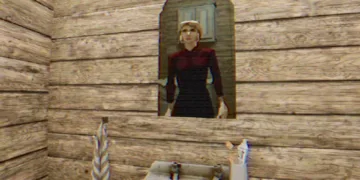

























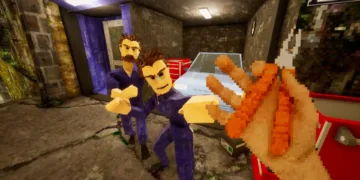

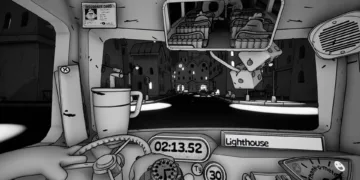



Galactic Crows launched Christmas Mutilator on PC in 2024, setting this first-person horror story inside a remote cabin caught in a heavy snowstorm. You step into Amelia’s night as she tries to hold onto a small piece of holiday routine, prepping dinner while she waits for her family to arrive. That calm breaks with a phone call from her husband, Adam. He tells her that he and the children are stranded out in the snow, leaving Amelia alone, miles from help, with nothing in the house that feels truly secure anymore.
Outside, the woods sit frozen and quiet, and the silence starts to feel staged. Something is there, watching. The game gives that threat a name and a role: the Christmas Mutilator, a stalker circling the house and waiting for a mistake. What begins with warm domestic detail turns sharp fast, and the shift lands because the cabin keeps the same shape while its meaning changes.
Rooms that read as safe a moment earlier start to feel like traps. The snowstorm stretches the space outward, too. The woods seem endless and empty, and the distance between Amelia and any rescue becomes a constant pressure. The story leans hard on isolation, then uses that isolation as the point of entry for dread. Survival takes over as the one clear objective, and the game frames you as prey inside a fragile shelter, pulled into a lethal version of hide and seek.
Survival Through Silence
The core loop runs on small chores, and that simplicity is the trick. Tasks like heading out into the forest to gather firewood slow you down and make you feel exposed. The pacing of these actions matters because the game wants you to feel time passing while danger stays close. Each trip outside pulls Amelia away from the thin comfort of the cabin, and each slow movement turns the weather into its own kind of threat alongside the killer.
Mechanically, stealth sits at the center of every choice. Amelia has to use the cabin’s tight layout as cover, reading corners, doorways, and line of sight like they are tools. The stalker’s reactive AI reinforces that pressure by tracking movement and listening for sound. Noise becomes a mechanic you can feel in your hands, since a single mistake can end the run. If you get spotted, death comes immediately, and that harsh penalty pushes you into careful, deliberate play. Even crossing the floorboards carries a sense of risk, because the game teaches you to treat every step like a signal.
The structure stays linear, with progress tied to a specific sequence of events. That guided shape keeps the tension focused: you move forward because the game demands it, not because the cabin ever feels cleared or safe. Your phone becomes a narrative tether during these stretches. Checking messages fills in details about the situation getting worse and hints at the characters’ history, so story comes through in brief bursts while the mechanical pressure keeps rising.
With no way to fight back, you settle into a defensive mindset built around hiding, waiting, and choosing moments to move. The killer also responds to the environment, which makes your tactics feel situational rather than routine. The slow tempo of the chores plays an important role here, since it primes you for shock. When the killer appears, the jolt hits harder because the game has trained you to live inside quiet, methodical actions.
Retro Aesthetics and Slasher Soundscapes
Visually, the game commits to a style that echoes the original PlayStation era. Grainy textures and low-polygon models create a nostalgic tone that fits the story’s “trapped in a tape” feeling. The filter system pushes that idea further, letting you apply five different options meant to mimic old VHS recordings. Those filters can make the cabin extremely dark, and with every filter active, some players may struggle to see the environment clearly or read text. That friction becomes part of the experience for anyone who keeps the filters on, since limited visibility turns simple navigation into another layer of stress.

The cabin also carries visual glitches, like flickering on the walls, that show up throughout the house. These rough edges contribute to the gritty impression of an old horror film, where the image itself feels unstable. The game uses that instability to support its tone: you are playing in a space that looks worn down, distorted, and unreliable, which matches the story’s slide from comfort into fear.
Sound does a lot of the emotional heavy lifting. A synth-heavy track kicks in when the killer draws close, and its upbeat energy channels the spirit of an ’80s slasher. The score doesn’t aim for subtle background mood so much as a clear signal that the situation has shifted into immediate danger. Silence works just as well in the opposite direction. In quieter moments, you get the creaks of the cabin and the wind outside, and those details make the environment feel alive in a way that turns the house into a threat all its own.
When the killer catches you, the game doesn’t pull away from violent death scenes. That blunt approach pairs with the lo-fi visuals and aggressive music to lock in a specific mood, like stepping through a lost horror tape where the grime, the noise, and the gore all serve the same purpose. If the darkness becomes too hard to manage, the option to turn off filters is there, and the winter setting still communicates cold and authenticity through the combined visual and audio choices.
Control Limits and Branching Fates
Movement feels stiff and heavy, leaning into an old-school survival-horror philosophy where agility stays limited. Amelia can’t jump, and running is tied to a stamina meter that drains quickly. Those constraints turn pursuit into panic, because the game makes you feel your body’s limits right when you want speed the most. The control scheme reinforces the tone: escape is never smooth, and that clumsiness feeds fear during chases.

The game also keeps its runtime tight. You can reach an ending in about forty-five minutes, which shapes how the pacing lands. The story hits quickly, stays focused, then stops before repetition can dull the tension. Replay value comes from the six different endings, pushing you to run it again to see how choices change Amelia’s outcome. That branching structure gives the narrative a reason to revisit the same spaces, and each return also helps you internalize the cabin’s layout, turning familiarity into a tool you earn through repeated pressure.
Pricing supports that design. On Steam, it costs five dollars and ninety-nine cents, and it’s available on Xbox as well. The low cost lines up with the short length and the focused ambitions of an indie project. The emphasis stays on atmosphere and brutal gore, with the cabin acting as a tight stage for stealth, tension, and sudden violence.
Chasing every secret and seeing every ending adds up to a meaningful amount of content at that price point, and the technical roughness reads as part of the intended retro charm. The relationship between Amelia and Adam threads through the different endings, letting those outcomes carry character weight rather than functioning as simple variations for their own sake.
The Review
Christmas Mutilator
Christmas Mutilator succeeds as a focused horror experience through its thick atmosphere and retro charm. The stiff movement and short length find balance in the intense slasher vibes and varied outcomes. It remains a solid choice for fans of lo-fi indie horror who enjoy a quick, bloody thrill.
PROS
- Strong 80s slasher atmosphere
- Effective retro visual style
- High tension during stealth sequences
- Multiple endings provide replay value
CONS
- Clunky and stiff control system
- Very short total playtime
- Obscure visual filters hinder visibility
- Linear gameplay path offers little freedom