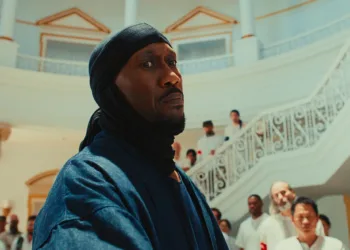


























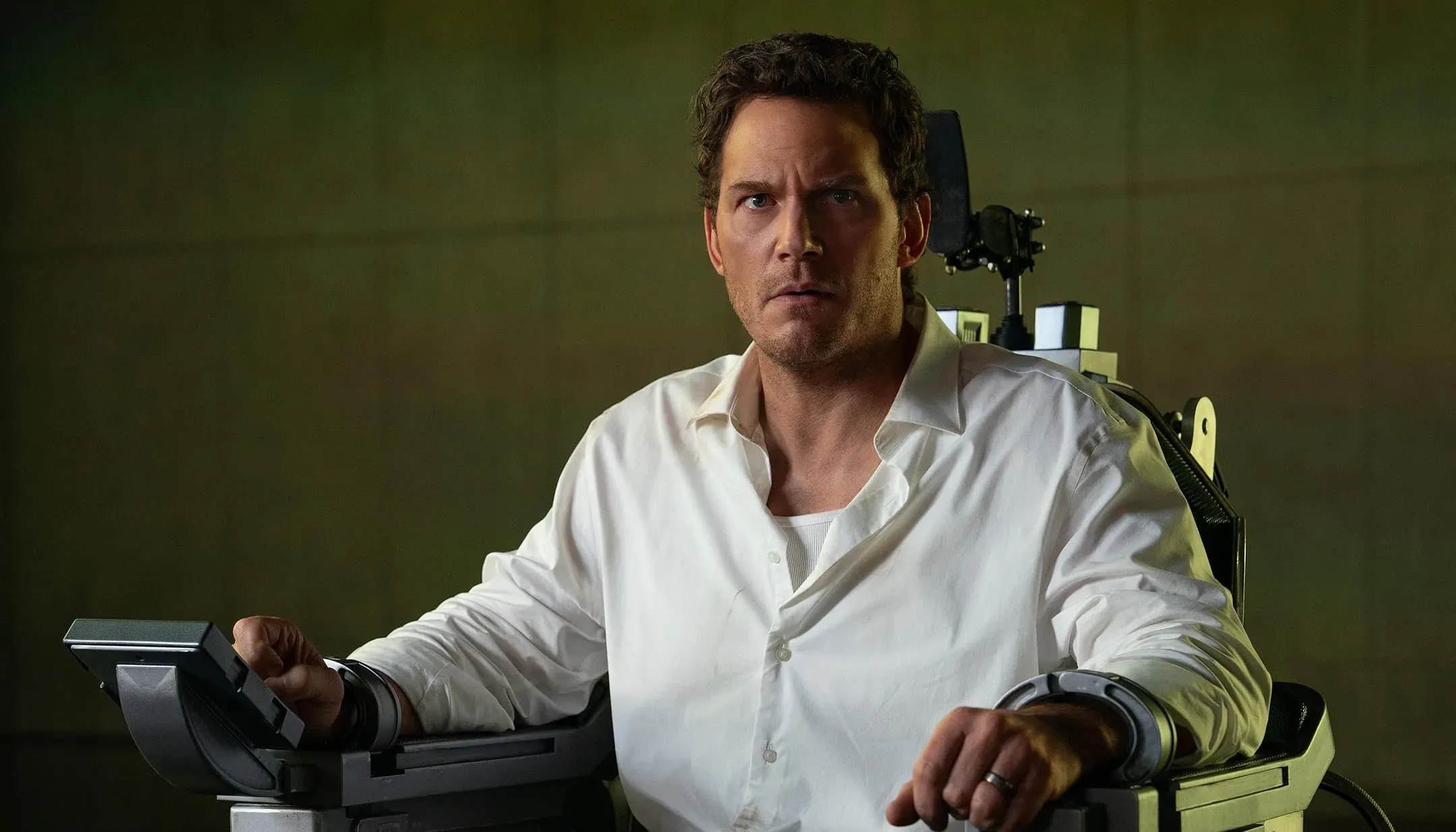

Mercy imagines a grim Los Angeles set three years in the future, where rising crime has pushed the city into a radical judicial experiment. Chris Pratt plays Chris Raven, a police officer who once backed the new legal system and now ends up trapped inside the very chair he helped sell to the public. Accused of murdering his wife, he faces judgment from an artificial intelligence called Maddox.
The AI judge gives him ninety minutes to prove his innocence, with the trial unfolding in real time. Raven has to hunt for evidence through a digital network while physically restrained, knowing execution follows if the guilt meter stays high. The film commits to a digital-first perspective and keeps the plot moving fast, tracking his frantic search for the truth while his body stays locked in place.
Mechanized Morality and the Ticking Clock
The Mercy Court runs on an intertwined physical and digital design meant to erase the slow deliberation associated with traditional law. The Mercy Chair sits as the system’s defining instrument, a device that doubles as a lethal sentencing tool and a symbol of a justice model built around instant retribution.
The story uses a ninety-minute trial window that matches the film’s runtime, turning structure into pressure. That design choice locks Raven into desperation from the opening stretch, since the system treats his innocence as an obstacle instead of a starting premise. He begins with a near-certain guilt rating and has to drive the probability down to ninety-two percent to avoid immediate death.
That burden rests on his ability to work the Municipal Cloud. The film presents a world where doorbell cameras and smartphones function as extensions of the state, and that same total surveillance becomes the main resource for legal defense. Raven sifts through sprawling metadata, trying to reconstruct missing pieces of his own history.
An alcohol-induced blackout leaves a gap he has to fill before the timer hits zero, and the mystery of Nicole Raven’s death turns on those broken digital traces. Mercy keeps returning to a blunt question: can a life be reduced to a data stream? The audience is held in the same position as the condemned man, watching him dig through his own digital ghosts while a machine monitors his pulse with clinical calm.
The Architecture of the Virtual Eye
Timur Bekmambetov extends the screenlife aesthetic beyond the familiar laptop frame and pushes it into a denser, more layered visual language. Mercy stacks FaceTime calls and floating data windows into a crowded 3D space that mirrors the mental strain of contemporary digital living.

The film stretches that approach further with drone perspectives and AI-generated reconstructions of crime scenes, letting the camera move away from the courtroom while keeping the digital premise intact. Depth becomes part of the storytelling grammar, turning evidence into a physical presence that presses in on Raven and narrows the viewer’s sense of air.
The pacing depends on rapid-fire editing to sustain urgency, with the constant flicker of interfaces doing the job traditional camera movement usually handles. That choice creates a charged mismatch: the lead actor stays fixed, while the software around him keeps lunging forward.
Mercy later punctures its own digital enclosure during a high-speed chase through Los Angeles streets, blending conventional action with body cam footage. Even moments of physical violence arrive mediated through a lens, reinforcing the film’s sense of a future where perception comes filtered through a nonstop stream of information. In that framing, Los Angeles plays like a recognizable global export, a mega-city image shaped by surveillance logic that travels easily across borders and screens.
Algorithms and the Human Element
The casting emphasizes human frailty alongside digital precision. Pratt takes on a largely static performance, tied to the chair for most of the film and forced to communicate through facial micro-expressions as Raven’s emotional state shifts.

He plays Raven as someone damaged by PTSD and addiction, a history that makes him difficult to rally behind without hesitation. Rebecca Ferguson, as Judge Maddox, meets that instability with disciplined stillness, embodying an entity that treats truth as statistical probability and speaks with an unblinking certainty that feels designed for compliance.
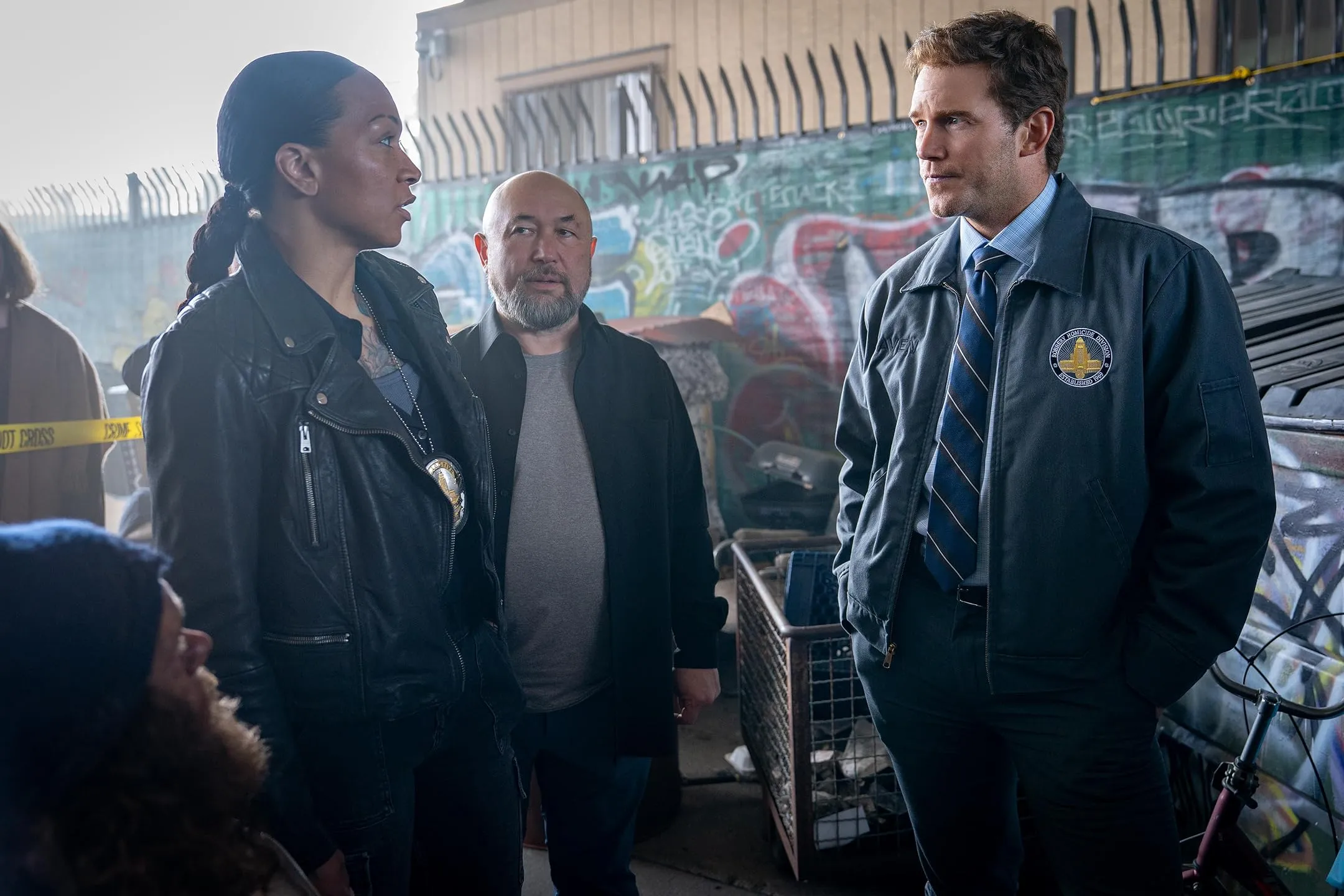
The supporting cast reaches Raven through varying degrees of digital clarity, reinforcing how connection in this world depends on signal strength and camera angle. Kali Reis plays Jaq Diallo, Raven’s eyes in the physical city, and her movements get captured through body cams and drones that generate a second track of action outside the chair.
The film keeps probing the friction between Raven’s desperation and the AI’s rigid programming, and Maddox appears to shift as the trial continues, adopting human conversational rhythms. That turn suggests a blur between creator and tool, raising the possibility of empathy as something programmable even inside a system built for execution.
The Ethics of the Omniscient State
Mercy builds its future through a chilling model of urban management. Los Angeles is carved into “Red Zones,” where the unhoused live under constant monitoring, and the film treats the loss of privacy as a settled exchange. The city trades civil liberties for a promised sense of order, and the Mercy Court becomes the clearest expression of that bargain.
Human lawyers and juries disappear, replaced by an algorithm that prioritizes speed over nuance. The script carries significant logical gaps about how such a system could survive constitutional scrutiny, brushing past the rights of the accused to keep focus on the machine’s efficiency.
The filmmakers also seem fascinated by the technology’s authority. The story often frames the AI and militarized police as necessary forces inside a chaotic city. That framing creates an irony inside Raven’s arc: he fights to prove the system works correctly while it threatens to kill him.
He tries to preserve the Mercy Court by uncovering the truth through its own rules, and the film treats that impulse as heroism even as the situation hints at indoctrination. The result points to a cultural mood where tools of control inspire fear and admiration at once, and Mercy leaves the uneasy impression that the future of justice belongs to the machines built to watch us.
Scheduled for a wide theatrical release tomorrow on January 23, 2026, this science fiction thriller arrives as a major production from Amazon MGM Studios. The film depicts a high-stakes legal battle within a dystopian Los Angeles. Viewers can see it in cinemas, with an emphasis on the IMAX format for its visual style. After its exclusive run in theaters, it is expected to join the Prime Video streaming library later this year.
Full Credits
Title: Mercy
Distributor: Amazon MGM Studios
Release date: January 23, 2026
Rating: PG-13
Running time: 100 minutes
Director: Timur Bekmambetov
Writers: Marco van Belle
Producers and Executive Producers: Charles Roven, Robert Amidon, Timur Bekmambetov, Majd Nassif, Mark Moran, Todd Williams
Cast: Chris Pratt, Rebecca Ferguson, Kali Reis, Annabelle Wallis, Chris Sullivan, Kylie Rogers, Kenneth Choi, Rafi Gavron, Jeff Pierre
Director of Photography (Cinematographer): Khalid Mohtaseb
Editors: Austin Keeling, Lam T. Nguyen, Dody Dorn
Composer: Ramin Djawadi
The Review
Mercy
Mercy presents an ambitious attempt to evolve the screenlife genre into a high-stakes sci-fi thriller. While the technical execution is striking, the narrative struggles to reconcile its fascistic world-building with its heroic intentions. It remains a notable work that highlights the growing intersection between technology and the loss of human agency. The film succeeds as a kinetic exercise in style, even as it stumbles over its own ethical implications.
PROS
- Innovative expansion of the screenlife visual language and 3D depth.
- Disciplined performance by Rebecca Ferguson as the cold AI magistrate.
- Tense, real-time pacing that maintains consistent narrative pressure.
CONS
- Significant logical gaps regarding the AI legal system and defense rights.
- Static characterization for most of the supporting cast.
- Uncritical perspective on invasive surveillance and state-controlled justice.