





















Victoria Wood stands as a monumental figure in British culture, a writer, musician, and performer who claimed space in an era with little room for multifaceted female talent. Catherine Abbott’s documentary, Becoming Victoria Wood, fixes its attention on the years that shaped her, tracing a line from a quiet childhood in Bury to drama school and onward to a breakthrough in 1984.
The film treats this period as the slow accumulation of craft, nerve, and self-definition. Abbott anchors that story in personal materials. Diary fragments, private scrapbooks, and rare recordings open a view into a guarded inner life, and the documentary leans on that access as its guiding method. The tone stays appreciative and steady, granting Wood’s influence its proper weight while keeping the frame tight on the person behind the public image.
Voices from the Archive
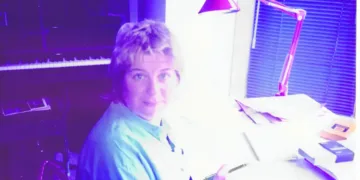
The narrative commits to a specific ascent, following Wood from a self-described neglected child practicing piano in a Bury bungalow to a performer with the authority to command the Royal Albert Hall. Archive footage becomes the film’s spine. Early university appearances from 1973 sit beside the sketches that later shaped British television, creating a timeline built from evidence rather than legend.
A key stylistic decision brings actress Jessica Barden into the structure. Barden reads extracts from Wood’s letters and diaries, giving the documentary a voice that feels drawn from the source rather than applied from the outside. This approach hands Wood the narration of her own struggle in plain, candid language, and it clarifies how difficult it could be for a young woman trying to find traction in the 1970s comedy scene.
Long-term collaborators surface mainly through older clips, yet their presence still carries historical weight, a reminder that the career being mapped here already had a long shadow. The documentary trusts primary sources to form its portrait: a woman marked by reserve and intellectual restlessness, with a mind that kept moving even when her public manner stayed controlled. The density of material keeps the portrayal grounded in Wood’s words and work, and it quietly challenges the expectation that a documentary must “interpret” its subject into coherence. Here, coherence arrives through accumulation.
Breaking the Comedy Glass Ceiling
Abbott’s film renders the 1970s entertainment industry as a restrictive club for men, and Wood’s path through it reads as a sustained encounter with systemic misogyny. Talent-show footage captures the patronizing attitudes she faced. Presenters dismiss her, treat her as a novelty, and present her ambition as something to be managed. The documentary does not need commentary to sharpen that point; the archive speaks with its own casual cruelty.
Wood’s answer, as the film frames it, was an uncompromising commitment to her own voice. She wrote about pregnancy, periods, and the mundane textures of female life at a time when those topics were treated as taboo. The material sketches a striking tension between her famous shyness and her fierce professional ambition, a pairing that complicates easy readings of what confidence looks like on screen. The documentary presents creative control as a central principle in her working life. Wood demanded it, and that insistence becomes part of how she moved through an industry that expected women to stay in supporting positions.
The film also acknowledges the pressure of balancing an intense career with motherhood, using Wood’s reflections to keep the cost visible. Success appears here as craft welded to will: a deliberate refusal to conform to external expectations, sustained across years that offered little institutional comfort. In that sense, the documentary asks for a recalibration of the usual story told about comedic stardom. The work comes first, and the myth of effortless brilliance falls away.
A Legacy of Quiet Defiance
The production style stays unshowy, holding back any appetite for visual flourish so Wood’s wit and the archival record remain in the foreground. New interviews with contemporaries such as Dawn French, Jennifer Saunders, and Joan Armatrading add professional context, mapping how Wood’s presence registered among peers.
Yet the most surprising insights come from school and university friends, who describe an obstinate, reserved student who never quite fitted the traditional mold. Their memories do not sentimentalize her. They trace a temperament: a refusal to be shaped into something more acceptable, a determination to keep her own angle of vision.
The film makes a noticeable choice in its present-day testimony. Immediate family members and certain close co-stars do not appear in the new segments. Abbott prioritizes professional development and early inspirations, including Joyce Grenfell, tightening the documentary’s focus on Wood as a creator above all else. That narrowing carries its own argument. It suggests that the most accurate intimacy may live in the work itself and in the private record that fed it.
A decade after Wood’s death, the documentary functions as a reminder of the void she left behind, and it captures the force of a performer who turned perceived outsidership into a language of humor that could travel widely. The film’s restraint becomes part of its respect. It leaves room for the evidence to breathe, and it leaves room for the audience to recognize how much of a cultural monument can be built from quiet persistence.
Becoming Victoria Wood premiered in UK cinemas on January 9, 2026, distributed by Dartmouth Films. Following its successful theatrical release, the documentary is set to premiere on the UKTV channel U&Gold and the streaming platform U in February 2026. This feature-length film provides an intimate look at the legendary comedian’s life, using rare archival footage and personal diaries to explore her journey from a shy student in Bury to a national treasure.
Full Credits
Title: Becoming Victoria Wood
Distributor: Dartmouth Films, U&Gold, UKTV
Release date: January 9, 2026
Rating: 15
Running time: 90 minutes
Director: Catherine Abbott
Writers: Catherine Abbott, Victoria Wood (Archival Material)
Producers and Executive Producers: Heather McCorriston, James Rogan, Mark Hedgecoe, Helen Nightingale
Cast: Victoria Wood, Jessica Barden, Dawn French, Jennifer Saunders, Maxine Peake, Michael Ball, Joan Armatrading, Jasper Carrott
Director of Photography (Cinematographer): Catherine Abbott
Editors: Jane Tubb
Composer: Francis Macdonald
The Review
Becoming Victoria Wood
Becoming Victoria Wood serves as a disciplined, affectionate study of a comedic pioneer. By prioritizing archival intimacy over modern polish, the film captures the friction between Wood’s private reserve and her public genius. While it occasionally avoids the more complicated aspects of her personal life, it succeeds as a rigorous examination of creative independence. It is an essential watch for those wishing to understand how a quiet girl from Bury dismantled the industry's barriers through sharp observation and a refusal to compromise her voice.
PROS
- Uses rare diaries and letters to provide a direct, authentic voice.
- Effectively illustrates the blatant misogyny of the 1970s comedy circuit.
- Features wonderful, rarely seen footage of early performances and sketches.
CONS
- Absence of immediate family and certain key co-stars feels noticeable.
- The tone stays largely celebratory and avoids deeper psychological scrutiny.
- Primarily centers on the early years, leaving later career milestones less explored.